
Blackbelly salamander
The blackbelly salamander, formerly classified as Desmognathus quadramaculatus, is a medium-sized salamander endemic to the Appalachian Mountains of the southeastern United States. It is distinguished by its dark brown to black coloration, often with pale spots, and its predominantly aquatic lifestyle, inhabiting cold mountain streams. Recent research has reclassified this group, splitting it into multiple distinct species.
Key Facts
- ›It is the largest species within the genus Desmognathus.
- ›Found in the Appalachian Mountains from West Virginia to northern Georgia.
- ›Primarily inhabits cold mountain streams at elevations between 375 and 1,725 meters.
- ›Spends more time in water than most other dusky salamanders, foraging on land near streams.
- ›Its diet varies by life stage, including insect nymphs, juveniles, and adults that prey on other salamanders.
- ›Defensive behaviors include biting, tail shedding, and remaining still.

Blackbelly Salamander
Rivers, Intermittent Rivers, Freshwater Springs, Cold Mountain Streams
United States
- Medium-Sized Salamander, 10 To 18 Cm Long.
- Largest Species In the Genus Desmognathus.
- Sturdily Built With A Long Tail.
- Ground Color Is Dark Brown Or Black.
- Two Rows of Small Pale Spots Along Each Side of the Back.
- Underside Is Usually Black, Sometimes With Pale Flecks In Young Individuals.
- Highly Variable In Color, Ranging From Light Gray To Deep Black, Potentially Related To Habitat.
- Insect Nymphs
- Aquatic and Aerial Prey
- Aquatic, Aerial, and Terrestrial Prey, Including Other Salamanders
- Spends More Time In Water Than Most Other Members of the Genus.
- Mainly Forages On Land Near Streams.
- Defends Refugia Aggressively.
- Can Exhibit Cannibalism.
- Breeds In the Late Spring.
- Females Attach Eggs To Submerged Boulders.
- Larvae Develop Slowly, Undergoing Metamorphosis Over About Three and A Half Years.
- Can Detect Differences In Fish To Identify Predators.
- May Use Chemical Cues To Avoid Seal Salamanders.
- Defense Strategies Include Warning Coloration, Immobility, Biting, and Tail Shedding .
Habitat Loss, Stream Acidification From Mining, Collection For Bait
About Blackbelly salamander
The blackbelly salamander, historically identified as Desmognathus quadramaculatus, is a species of salamander native to the Appalachian Mountains in the southeastern United States. It is the largest member of the Desmognathus genus, which comprises dusky salamanders. Its natural habitats include rivers, intermittent streams, and freshwater springs, typically found at elevations between 375 and 1,725 meters.
Physical Characteristics and Variation
This salamander is medium-sized, generally measuring between 10 to 18 centimeters in length, with a sturdy build and a long tail. Its dorsal coloration is typically dark brown or black, often adorned with two rows of small, pale spots along its sides. The underside is usually black, though younger individuals may show pale flecks. A notable characteristic is its high degree of color variability, with ground colors ranging from light gray to deep black. Studies suggest this variation can be linked to habitat differences, such as the amount of shade, leaf litter, and the color of rocks within their environment, with populations mere meters apart exhibiting significant phenotypic differences.
Distribution and Habitat
The geographic range of the blackbelly salamander extends across the Appalachian Mountains, encompassing West Virginia, southeastern Virginia, eastern Tennessee, western North and South Carolina, and northern Georgia. It is considered a largely aquatic species, preferring the cool waters of mountain streams. While it spends a significant amount of time in water, it primarily forages on land, maintaining a home range close to a stream, typically within 30 centimeters of its edge.
Behavior and Diet
Blackbelly salamanders are known to be territorial, defending their chosen refugia, such as rock crevices or burrow entrances, against other individuals of the same species, sometimes resorting to cannibalism. Their diet shifts with life stage: larvae prey on insect nymphs, juveniles consume a mix of aquatic and aerial prey, and adults broaden their diet to include terrestrial prey and even other salamanders. Their defensive strategies are varied, including remaining motionless, biting predators, and autotomy (shedding the tail) as a distraction.
Reproduction and Life Cycle
Breeding occurs in the late spring. Females lay between fifteen to forty eggs, attaching them to the base of submerged boulders. The eggs hatch after approximately three months, and the larval stage is lengthy, with metamorphosis into juveniles taking about three and a half years. Research indicates that larval salamanders possess the ability to discern and react to different fish species as potential predators.
Conservation Status and Threats
The blackbelly salamander is listed as "Least Concern" by the IUCN Red List, with an estimated population of at least 10,000 individuals. However, localized declines can occur due to habitat loss, stream acidification from mining activities, and collection for use as fishing bait. Recent scientific studies have also led to a reclassification of Desmognathus quadramaculatus, with the group being split into several distinct species, potentially impacting future conservation assessments for these newly defined taxa.
Source: Wikipedia ↗
Frequently Asked Questions
What is the scientific name for the blackbelly salamander?
The blackbelly salamander was formerly known by the scientific name Desmognathus quadramaculatus. However, a 2022 study indicated this name is a synonym for the Northern Dusky Salamander and has been split into multiple species, including Desmognathus amphileucus, Desmognathus folkertsi, Desmognathus gvnigeusgwotli, Desmognathus kanawha, and Desmognathus mavrokoilius.
Where can the blackbelly salamander be found?
This species is endemic to the Appalachian Mountains in the southeastern United States. Its range spans from West Virginia, through southeastern Virginia, eastern Tennessee, western North and South Carolina, and into northern Georgia.
What are the natural habitats of the blackbelly salamander?
The blackbelly salamander is largely aquatic and lives in cold mountain streams, intermittent rivers, and freshwater springs. They are typically found at elevations ranging from 375 to 1,725 meters above sea level.
How large can blackbelly salamanders grow?
The blackbelly salamander is a medium-sized salamander, reaching lengths of approximately 10 to 18 centimeters (3.9 to 7.1 inches). It is recognized as the largest species within its genus, Desmognathus.
What does the blackbelly salamander eat?
The diet of the blackbelly salamander changes throughout its life. Larvae primarily consume insect nymphs, while juveniles eat a mix of aquatic and aerial prey. Adults are more diverse feeders, consuming aquatic, aerial, and terrestrial prey, including other salamanders.
What are the conservation threats to the blackbelly salamander?
The primary threat to the blackbelly salamander is habitat loss. Additionally, streams can become acidic due to mining activities, and some individuals are captured by fishermen for use as bait.
Related Salamander and Newt species
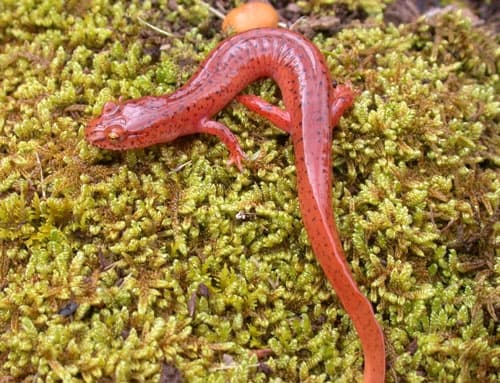
Blue Ridge spring salamander
The Blue Ridge spring salamander, a subspecies of the spring salamander (Gyrinophilus porphyriticus), is found in the southern Appalachian Mountains and adjacent Piedmont regions of the United States. This species is distinguished by a distinctive white line from its eye to its nostril, bordered by a dark line, and its varied dorsal coloration ranging from reddish to orange-yellow with black or brown spots. They inhabit cool springs, mountain springs, and moist forest areas, and are notable for their diet which can include other salamanders.

Ambystoma macrodactylum
The long-toed salamander (Ambystoma macrodactylum) is a mole salamander native to the Pacific Northwest of North America. It is distinguished by its mottled black, brown, and yellow coloration and a notably long outer fourth toe on its hind limbs. This species occupies a wide range of habitats, from temperate rainforests to alpine meadows, and is known for its subterranean adult lifestyle and aquatic breeding phase.

Alpine newt
The alpine newt is a species of newt native to continental Europe, with introduced populations in Great Britain and New Zealand. Adults are typically dark grey to blue on their back and sides, with a vibrant orange belly and throat, with males displaying more striking coloration, especially during the breeding season. They are adaptable, inhabiting both lowlands and high altitudes, and are primarily nocturnal during their terrestrial phase.