
Blacksburg salamander
Plethodon jacksoni·Plethodontidae·Up to 13.5 cm (5.3 in) total length for males, 13.3 cm (5.2 in) for females
The Blacksburg salamander (Plethodon jacksoni) is a species of woodland salamander found in the Appalachian Mountains of southwestern Virginia and potentially neighboring North Carolina. It is characterized by its slender build, dark bluish-gray background coloration, and distinctive white blotches on its sides and limbs. This species was initially considered a variant of Wehrle's salamander but has since been recognized as a distinct species based on genetic evidence.
Key Facts
- ›Endemic to the Appalachian Mountains in southwestern Virginia and possibly North Carolina.
- ›Similar in appearance to Wehrle's salamander (P. wehrlei).
- ›Possesses a dark bluish-gray body with distinctive white blotches on the sides and limbs.
- ›Males have a prominent mental gland on the chin and swellings above the tail base.
- ›Found sheltering under rocks and logs in temperate forests and sometimes in caves.
- ›Genetic studies confirm its status as a distinct species, diverging from relatives around 4.6 million years ago.

Jackson's Salamander
Temperate Forest, Under Rocks and Logs, Dry Hillsides, Caves
United States
- Slender Build
- Rounded Head
- Large Eyes
- Short Snout
- Dark Bluish-Gray Background Color
- Throat and Belly Are Lighter
- Distinctive White Blotches On Sides and Limbs
- Silvery Mottling and Tiny White Flecks On Back and Tail
- Sparse Reddish-Orange Spots On the Back In Some Individuals
- Males Have A Prominent Mental Gland On the Chin
- Males Have Swellings Above the Base of the Tail
- Females Have Proportionally Longer Bodies
- Shelters Under Rocks and Logs
- Active During Late Winter and Early Spring On Dry Hillsides
- Some Individuals Inhabit Caves Year-Round
About Blacksburg salamander
The Blacksburg Salamander
The Blacksburg salamander, scientifically known as Plethodon jacksoni, is a species of woodland salamander endemic to the Appalachian Mountains of the Southeastern United States. Its natural range is primarily confined to southwestern Virginia, with possible extensions into neighboring areas of North Carolina. The common name 'Blacksburg salamander' originates from the initial discovery of many specimens in the vicinity of Blacksburg, Virginia.
Description and Appearance
This species exhibits a slender build, characterized by a rounded head, large eyes, and a short snout. Its coloration is typically a dark bluish-gray, with the back being the darkest part of its body. A distinctive feature is the presence of white blotches, which usually appear on the sides and limbs and can sometimes extend onto the belly. Silvery mottling and small white flecks may also be observed on the back and tail. Some individuals, including the holotype specimen, display sparse but notable reddish-orange spots on their dorsal surface. Mature males are distinguishable by a prominent mental gland on their chin and swellings located above the base of their tail, while females tend to have proportionally longer bodies.
Taxonomy and Evolution
Formally described in 1954, Plethodon jacksoni was initially considered a southern population of Plethodon wehrlei and was grouped with that species for many years. However, extensive genetic research, including a significant study in 2019, has re-established Plethodon jacksoni as a valid and distinct species. This confirmation is based on the genetic distinctiveness of its mitochondrial cytochrome b gene, with analyses suggesting that P. wehrlei is a paraphyletic taxon. Evolutionary estimates place the divergence of Plethodon jacksoni from its closest relatives at approximately 4.6 million years ago. Ongoing research continues to explore the full extent of its geographic range and genetic diversity, with some populations previously identified as 'southern wehrlei' potentially falling within a broader definition of P. jacksoni.
Habitat and Distribution
The Blacksburg salamander thrives in temperate forest environments. It is commonly found sheltering beneath rocks and logs on dry hillsides, particularly during the late winter and early spring months. Some members of the species also inhabit caves, residing there even during parts of the year when they are not observed on the surface. The species is most frequently encountered in Montgomery County, Virginia, with documented occurrences also in Giles and Craig counties, and potential presence in Pittsylvania County. The closely related 'southern wehrlei' population, which may be part of P. jacksoni, has been found as far south as Stokes and Alleghany counties in North Carolina.
Source: Wikipedia ↗
Frequently Asked Questions
What is the Blacksburg salamander?
The Blacksburg salamander (Plethodon jacksoni) is a species of salamander belonging to the Plethodontidae family. It is native to the Appalachian Mountains in southwestern Virginia and potentially adjacent areas of North Carolina. Its common name is derived from the town of Blacksburg, Virginia, where many of the first specimens were discovered.
What does the Blacksburg salamander look like?
This salamander has a slender body, a rounded head, large eyes, and a short snout. Its background color is typically dark bluish-gray, with the back being the darkest part. Distinctive white blotches are usually present on its sides and limbs, and some individuals may have silvery mottling or reddish-orange spots.
Where does the Blacksburg salamander live?
The Blacksburg salamander is found in temperate forests within the Appalachian Mountains. It shelters under rocks and logs on dry hillsides, particularly in late winter and early spring. Some individuals also inhabit caves, even during periods when they are not seen on the surface.
How large can Blacksburg salamanders get?
Mature males can reach up to 13.5 cm (5.3 inches) in total length, with an average of 11.6 cm (4.6 inches). Females are slightly smaller, reaching up to 13.3 cm (5.2 inches) in total length, with an average of 12.5 cm (4.9 inches). They are generally larger than P. dixi and smaller than P. wehrlei.
Is the Blacksburg salamander a separate species?
Yes, genetic studies, particularly a 2019 analysis of mitochondrial DNA, have confirmed Plethodon jacksoni as a valid species distinct from Wehrle's salamander (P. wehrlei). Earlier genomic studies in 2012 and 2018 also supported this classification.
What are the geographic boundaries of the Blacksburg salamander's range?
The species is primarily observed in Montgomery County, Virginia, and has also been reported in Giles, Craig, and potentially Pittsylvania counties. There is also evidence of related populations, possibly within this species, extending into northwestern North Carolina.
Related Salamander and Newt species
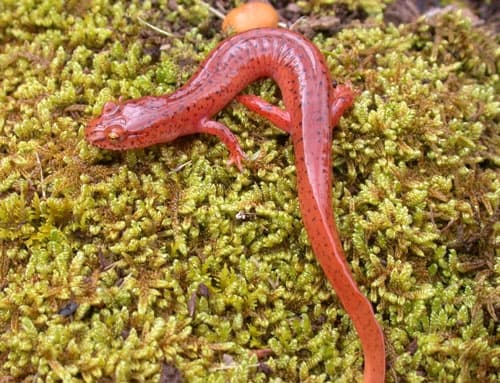
Blue Ridge spring salamander
The Blue Ridge spring salamander, a subspecies of the spring salamander (Gyrinophilus porphyriticus), is found in the southern Appalachian Mountains and adjacent Piedmont regions of the United States. This species is distinguished by a distinctive white line from its eye to its nostril, bordered by a dark line, and its varied dorsal coloration ranging from reddish to orange-yellow with black or brown spots. They inhabit cool springs, mountain springs, and moist forest areas, and are notable for their diet which can include other salamanders.

Chiropterotriton magnipes
The bigfoot splayfoot salamander (Chiropterotriton magnipes) is a species of salamander endemic to northeastern Mexico. It is distinguished by its large feet and is found in caves and forest crevices, primarily in pine-oak woodlands. This species is notably threatened by habitat loss due to deforestation, which leads to cave desiccation.
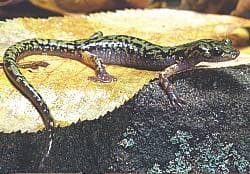
Aneides aeneus
The green salamander (Aneides aeneus) is a small, flat, lungless salamander found in moist, shaded rock crevices in the eastern United States. Its most distinctive feature is its green, lichen-like markings against a darker body, making it unique among North American salamanders. This species is highly specialized in its habitat and exhibits unusual territorial aggression.