
Aneides aeneus
Oviparous (direct development)
The green salamander (Aneides aeneus) is a small, flat, lungless salamander found in moist, shaded rock crevices in the eastern United States. Its most distinctive feature is its green, lichen-like markings against a darker body, making it unique among North American salamanders. This species is highly specialized in its habitat and exhibits unusual territorial aggression.
Key Facts
- ›Possesses distinctive green, lichen-like blotches on a darker dorsum.
- ›Adults range from 8 to 12 CM (3 to 5 inches) in total length.
- ›Characterized by squared toe-tips and a prehensile tail for climbing.
- ›Exhibits unusually high territorial aggression, especially in males.
- ›Undergoes direct development, lacking a larval stage.
- ›Found primarily in rock crevices on cliffs and outcroppings.
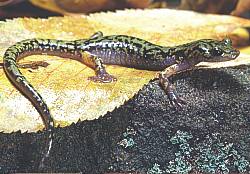
Green Salamander
Moist, Shaded Rock Crevices, Cliffs, Outcroppings, Arboreal Situations
Southwestern Pennsylvania, Eastern West Virginia, Eastern Kentucky, Extreme Western Virginia, Tennessee, Alabama, Northeastern Mississippi, South-Central Ohio, Georgia, North Carolina, South Carolina
- Small and Notably Flat Body
- Green, Lichen-Like Blotches Against A Darker Dorsum
- Squared Toe-Tips
- Large, Conspicuous Eyes
- Light Blue To Yellow Ventral Surface
- Prehensile Tail
Invertebrates
- Extremely Habitat-Specific
- Highly Territorial, Especially Males, Engaging In Butting, Snapping, Biting, Or Snout-Pressing
- Females Exhibit Aggressive Behavior Towards Intruders Near Eggs
- Direct Development, No Larval Stage
- Pre-Hibernation Aggregation and Dispersal
- Wandering Over and Between Rock Crevices During Hibernation Emergence
- Active During Light Rains At Night During Post-Hibernation
Habitat Loss, Climate Change, Disease, Overcollection
About Aneides aeneus
Green Salamander (Aneides aeneus)
The green salamander, scientifically known as Aneides aeneus, is a unique lungless salamander belonging to the Plethodontidae family. It is one of the only two species in the genus Aneides found in the eastern United States, with most other members of the genus residing west of the Mississippi River. This salamander is highly specialized in its habitat, rarely being found away from moist, shaded rock crevices on cliffs and outcroppings.
Description and Distinctiveness
Aneides aeneus is characterized by its small size and flattened body, with adults typically measuring between 8 to 12 cm (3 to 5 inches) in total length. Its most striking feature is its coloration: green, lichen-like blotches set against a darker dorsal background, a trait unmatched by any other salamander species in North America. It also possesses squared toe-tips and a prehensile tail, adaptations that aid in its arboreal and rupicolous (rock-dwelling) lifestyle. The ventral surface is typically a light blue to yellow.
Geographic Distribution and Habitat
The green salamander's range encompasses the Alleghenies and Cumberland Plateau, stretching from southwestern Pennsylvania down to northern Alabama and northeastern Mississippi, and is commonly found in South-Central Ohio. Isolated populations exist at the Blue Ridge Escarpment. Its preferred habitat is extremely specific: shaded rock crevices where sunlight is minimal. While it can be found in arboreal situations, these are usually in trees adjacent to rock outcroppings or under bark.
Life History and Behavior
Aneides aeneus exhibits direct development, meaning it hatches from its eggs as a fully formed juvenile, bypassing a free-swimming larval stage. The breeding period begins in late May to early June, with males defending specialized breeding crevices. Courtship involves a unique dance, followed by the male depositing a spermatophore. Females lay clutches of 15–25 eggs and guard them diligently for approximately three months, often foregoing feeding during this period. Males are notably territorial, displaying aggressive behaviors such as biting and snout-pressing towards rivals and potential predators. Females also exhibit defensive actions when guarding their eggs.
Conservation Concerns
The conservation of the green salamander is complicated by its specialized habitat requirements, making it vulnerable to habitat destruction. However, its preferred cliff and outcropping habitats are often relatively safe. Major threats include habitat loss, climate change, disease, and overcollection. The species' slow growth rate, with reproductive maturity taking several years, further exacerbates these threats. Consequently, Aneides aeneus is listed as endangered in Indiana, imperiled in Georgia and North Carolina, and critically imperiled in South Carolina, and is a Species of Conservation Concern in Tennessee.
Source: Wikipedia ↗
Frequently Asked Questions
What is the scientific name for the green salamander?
The scientific name for the green salamander is Aneides aeneus. The generic name 'Aneides' means 'lacking form or shape' due to its flattened body, while 'aeneus' is Latin for bronze or copper, referring to its coloration.
Where is the green salamander found?
Aneides aeneus inhabits the Alleghenies and Cumberland Plateau, extending from southwestern Pennsylvania to northern Alabama and northeastern Mississippi. It is also found in South-Central Ohio and has isolated populations at the Blue Ridge Escarpment.
What makes the green salamander distinctive in appearance?
The green salamander is unique among North American salamanders for its green, lichen-like blotches set against a darker dorsal coloration. It is also notably flat, with squared toe-tips and large eyes.
What is the preferred habitat of Aneides aeneus?
Aneides aeneus is an extreme habitat specialist, preferring the moist, shaded crevices of rocks on cliffs and other outcroppings. While arboreal instances occur, they are typically near rock formations, or the salamander is found under tree bark.
How does the green salamander reproduce?
The green salamander undergoes direct development, meaning it hatches from the egg as a miniature adult, bypassing a larval stage. Females guard their eggs, which are laid in rock crevices, for about three months.
What are the main threats to the green salamander?
Major threats to the green salamander include habitat loss, climate change, disease, and overcollection. Its specialized habitat requirements make it particularly vulnerable to environmental changes.
Related Salamander and Newt species

Arboreal salamander
The arboreal salamander (Aneides lugubris) is a lungless salamander species native to California and Baja California, known for its climbing ability and distinctive prehensile tail. It inhabits oak and sycamore woodlands and chaparral, spending daylight hours in tree cavities and exhibiting unique gliding behaviors when falling.

Ambrosi's cave salamander
Ambrosi's cave salamander, also known as the Spezia cave salamander, is a species of salamander endemic to a small region of northwestern Italy. It inhabits temperate forests, rocky areas, caves, and subterranean environments, distinguishing itself with a variable coloration ranging from brown to black, often with marbling or mottling. This species is critically endangered due to habitat loss and its very restricted range.

Andrias davidianus
The Chinese giant salamander (Andrias davidianus) is one of the largest salamanders and amphibians globally, endemic to the Yangtze river basin in China. It is a fully aquatic species known for its large size, dark, wrinkly skin, and distinctive vocalizations that resemble a human infant's cry, earning it the nickname "infant fish." Critically endangered in the wild, its populations have drastically declined due to habitat loss, pollution, and overcollection for food and traditional medicine.