
Blue Ridge two-lined salamander
Least Concern·External fertilization
The Blue Ridge two-lined salamander (Eurycea wilderae) is a species of salamander native to the southern Appalachian Mountains in the United States. It is distinguished by two black dorsolateral lines that run along its back, often breaking into dots. This species inhabits moist, cool environments near streams and is named after zoologist Inez Whipple Wilder.
Key Facts
- ›Found in the southern Appalachian Mountains, primarily south of Virginia.
- ›Adults range from 7-10.7 CM (2 3/4 - 4 1/2 inches) in length.
- ›Coloration varies from bright yellow to orange with two distinctive black dorsolateral lines.
- ›Larvae are aquatic and spend approximately two years in streams before metamorphosis.
- ›Diet includes copepods, midge larvae, nematodes, and various terrestrial and aquatic insects.
- ›Listed as a species of Least Concern by the IUCN.

Blue Ridge Two-Lined Salamander
Stream Banks, Streams, Seeps, Temperate Forests, Rivers, Intermittent Rivers, Freshwater Springs
United States
- Ranges In Size From 7-10.7 Cm .
- Color Ranges From Bright Yellow, Yellow-Orange, To Orange.
- Features Two Black Dorsolateral Lines That Usually Break Into Dots Or Blotches Around the Middle of the Tail.
- May Have Scattered Black Dots On the Back.
- Has A Relatively Long Tail, Between 55-60% of the Total Length.
- Generally Possesses 14 To 16 Costal Grooves.
- Larvae Are Typically Pale-Yellow To Yellow-Green Dorsally.
Copepods, Midge Larvae, Nematodes, Aquatic Insects, Terrestrial Insects, Non-Insect Arthropods, Worms, Marine Invertebrates
- Larvae Seek Refuge Underneath Rocks Or In Interstitial Spaces In Stream Beds During the Day and Move Throughout the Stream At Night To Feed.
- Adults May Venture Up To 15-20 Meters From the Stream Edge, Risking Desiccation For Less Predator-Prone Environments.
- Exhibit Spatial Segregation Within Terrestrial Habitats To Avoid Competition and Predation.
- Can Use Chemical Sensing To Detect Predators.
- Adults Have Been Observed Not Utilizing Rocks For Cover Even When Predators Are Present.
Habitat Loss
About Blue Ridge two-lined salamander
The Blue Ridge two-lined salamander, scientifically known as Eurycea wilderae, is a species of salamander belonging to the family Plethodontidae. It is native to the United States, with its primary range encompassing the southern Appalachian Mountains, predominantly south of Virginia. This species is closely related to the northern two-lined salamander (Eurycea bislineata), which occupies areas further north.
Morphology and Physical Description
Adult Blue Ridge two-lined salamanders typically measure between 7 and 10.7 centimeters (2 3/4 to 4 1/2 inches) in length. Their coloration varies, appearing as bright yellow, yellow-orange, or orange. A defining characteristic is the presence of two black dorsolateral lines that run along their back, which often fragment into dots or blotches towards the middle of the tail. Additional scattered black dots may be present on the dorsal surface. The tail is relatively long, constituting 55% to 60% of the total body length. The number of costal grooves, which are external vertical grooves along the sides of the body, generally ranges from 14 to 16, with fewer grooves being more common at lower elevations. Nasolabial grooves, also referred to as cirri, are typically observed. The larval stage of the Blue Ridge two-lined salamander is characterized by a pale-yellow to yellow-green dorsal coloration.
Reproduction and Life Cycle
Reproduction in the Blue Ridge two-lined salamander involves external fertilization. The breeding season usually occurs during the late winter or early spring months. Females deposit their eggs in aquatic environments, typically under rocks, logs, or leaf litter, and provide parental care by guarding the eggs until they hatch. Upon hatching, the young salamanders possess external gills and remain in an aquatic larval stage for approximately two years before undergoing metamorphosis into adults. The timing of metamorphosis is influenced by environmental factors such as temperature and food availability; higher temperatures can accelerate the process, while greater food resources may lead to larger size and a delayed metamorphosis.
There is a notable sexual dimorphism observed between two types of males: searching males and guarding males. Searching males are equipped with cirri, mental glands, longer legs, and protruding premaxillary teeth, adaptations that aid in locating and courting females in terrestrial environments. In contrast, guarding males lack these features but possess seasonally enlarged jaw musculature, which is adapted for defending females at aquatic nesting sites.
Distribution and Habitat
The Blue Ridge two-lined salamander is found within the southern Appalachian Mountain range, inhabiting areas along streams and in forested environments. Their presence can be more terrestrial or aquatic depending on the mating season. These amphibians are lungless and depend on moist, cool conditions for survival. Suitable streams for this species often contain submerged substrates, which are utilized for oviposition. When not actively breeding, they tend to burrow, commonly seeking shelter under logs and leaf litter. Under favorable habitat conditions, Blue Ridge two-lined salamanders can achieve high population densities, exceeding 100 individuals per square meter.
Diet and Behavior
The diet of the Blue Ridge two-lined salamander is quite similar to that of other terrestrial salamanders. Both the aquatic juveniles and terrestrial adults feed on a variety of organisms, including copepods, midge larvae, nematodes, and both aquatic and terrestrial insects. The size of the prey items consumed is generally correlated with the salamander's own size and growth rate.
Behaviorally, stream salamanders like the Blue Ridge two-lined salamander exhibit spatial segregation within terrestrial habitats as a means to mitigate competition and predation. During daylight hours, larvae typically take refuge beneath rocks or within the interstitial spaces of gravel stream beds. As night falls, they become more active, moving throughout the stream to forage. Studies suggest that adults may venture away from the immediate stream edge, up to 15–20 meters, to find habitats that are less suitable for predators, even if it means risking desiccation due to drier conditions.
Predators and Conservation
Predators of the Blue Ridge two-lined salamander include species such as spring salamanders, garter snakes, and black-bellied salamanders, as well as other larger plethodontids. Adults possess the ability to detect predators through chemical sensing. However, research has indicated that even in the presence of visual or scent cues from predators like the black-bellied salamander, adult Blue Ridge two-lined salamanders may not consistently utilize available rock cover for protection.
The Blue Ridge two-lined salamander is classified by the IUCN as a species of Least Concern, indicating a relatively stable population. However, habitat loss remains a significant threat to its survival, highlighting the importance of conservation efforts to protect its natural environment.
Source: Wikipedia ↗
Frequently Asked Questions
What is the scientific name for the Blue Ridge two-lined salamander?
The scientific name for the Blue Ridge two-lined salamander is Eurycea wilderae. This binomial nomenclature is used to classify the species within the scientific community.
Where can the Blue Ridge two-lined salamander be found?
This species is endemic to the United States, specifically in the southern Appalachian Mountains, primarily south of Virginia. They inhabit temperate forests, rivers, intermittent rivers, and freshwater springs, typically near stream banks.
What are the distinctive physical characteristics of the Blue Ridge two-lined salamander?
Adults are typically 7-10.7 cm long and range in color from bright yellow to orange. They are characterized by two black dorsolateral lines that often break into dots or blotches along their tail. Their tail is relatively long, making up 55-60% of their total length.
What do Blue Ridge two-lined salamanders eat?
Both the aquatic juveniles and terrestrial adults consume a similar diet, including copepods, midge larvae, nematodes, and both aquatic and terrestrial insects. The size of their prey depends on the salamander's own size and growth rate.
What is the reproductive behavior of the Blue Ridge two-lined salamander?
The Blue Ridge two-lined salamander reproduces through external fertilization, with oviposition typically occurring in late winter or early spring. Females lay eggs under rocks, logs, or leaves in water and guard them until hatching. The larvae are aquatic and develop external gills before transforming into adults.
What are the main threats to the Blue Ridge two-lined salamander?
The primary threat to the Blue Ridge two-lined salamander is habitat loss. Their reliance on moist, cool environments near streams makes them vulnerable to changes in their environment caused by human activities.
Related Salamander and Newt species

Ambystoma macrodactylum
The long-toed salamander (Ambystoma macrodactylum) is a mole salamander native to the Pacific Northwest of North America. It is distinguished by its mottled black, brown, and yellow coloration and a notably long outer fourth toe on its hind limbs. This species occupies a wide range of habitats, from temperate rainforests to alpine meadows, and is known for its subterranean adult lifestyle and aquatic breeding phase.
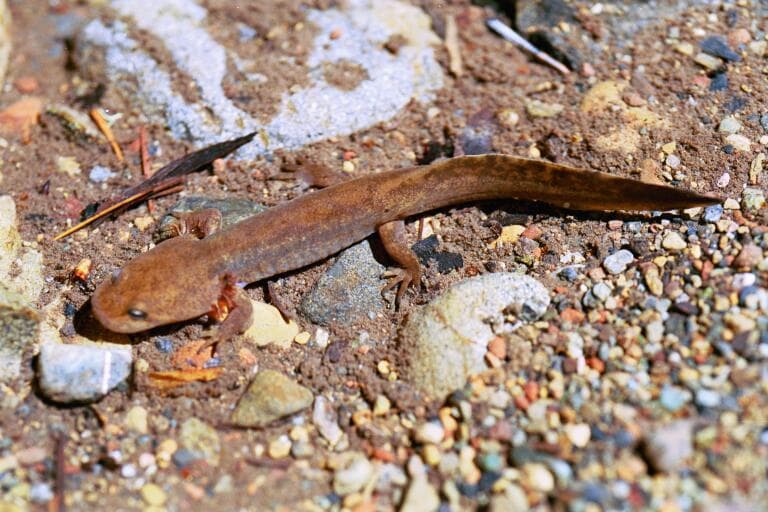
California giant salamander
The California giant salamander is a large amphibian endemic to Northern California, spending its adult terrestrial life near freshwater sources. Distinctive features include a marbled pattern, a broad head, and the ability to vocalize. This species is an important indicator of stream health.
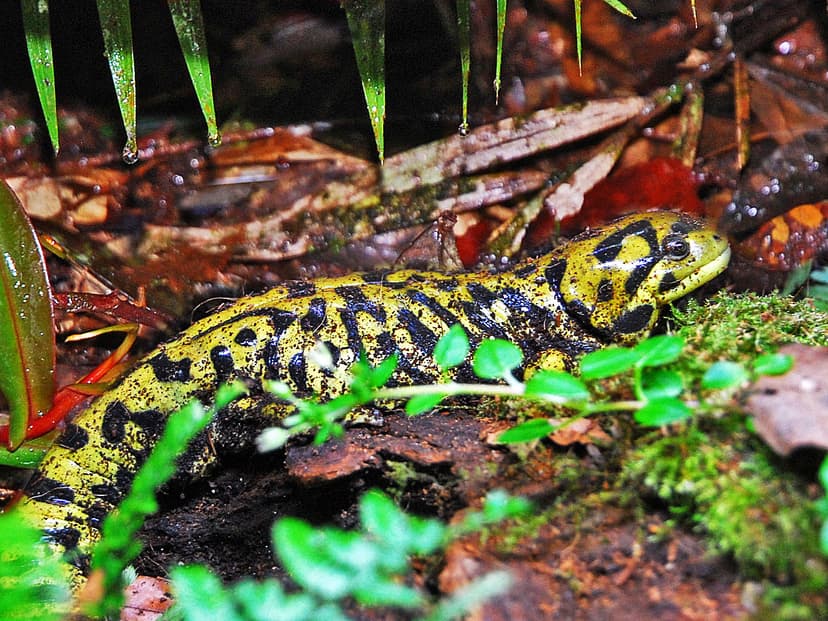
Barred tiger salamander
The barred tiger salamander (Ambystoma mavortium), also known as the western tiger salamander, is a large species of mole salamander found in western North America. It is distinctive for its tiger-like coloring, with bars and spots of muddy yellow on a dark background, and exhibits variable morphologies, including a cannibalistic form.