
Blue-spotted salamander
Oviparous (eggs laid)
The blue-spotted salamander (Ambystoma laterale) is a mole salamander found in the Great Lakes region and northeastern United States, as well as parts of Ontario and Quebec in Canada. Its most distinctive feature is its bluish-black skin adorned with blue and white flecks and spots. This species is notable for its complex reproductive strategies, including unisexual lineages that can reproduce through gynogenesis.
Key Facts
- ›The blue-spotted salamander has bluish-black skin with characteristic blue and white flecks and spots.
- ›They are nocturnal, emerging at night to hunt invertebrates and insects.
- ›Reproduction involves the male depositing a spermatophore, which the female collects to fertilize her eggs.
- ›Blue-spotted salamanders are associated with unisexual populations that can utilize their sperm to initiate egg development.
- ›Defense mechanisms include cryptic coloration and a tail that secretes a harmful milky substance.
- ›They prefer moist deciduous forests and swampy woodlands, often near vernal pools.

Blue-Spotted Salamander
Moist, Deciduous Hardwood Forests, Swampy Woodlands, Coniferous Forests, Fields, Vernal Pools
United States, Canada
- Length: 10-14 Cm
- Tail Comprises 40% of Length
- Bluish-Black Skin With Blue and White Flecks On Back
- Bluish-White Spots On Sides and Tail
- Elongated Bodies
- Vent Is Typically Black, Contrasting With Paler Belly
- Larvae May Have Yellow Splotches That Turn Blue Upon Becoming Terrestrial
- Long Toes: Four On Front Feet, Five On Hind Feet
- Males Tend To Be Smaller Than Females With Longer, Flattened Tails
Invertebrates, Insects
- Nocturnal, Stay Underground During the Day
- Emerge At Night To Find Food
- Mate Through Depositing and Collecting A Spermatophore
- Philopatric, Dependent On Ephemeral Pools
- Use Underbrush, Leaf Litter, Rocks, and Logs For Shelter
- Defense Mechanisms Include Cryptic Coloration and Tail Secretions
- Interact With Unisexual Populations, Sometimes Through Kleptogenesis
Habitat Loss, Light Pollution, Chemical Hues
About Blue-spotted salamander
The blue-spotted salamander, scientifically known as Ambystoma laterale, is a species of mole salamander native to the northeastern regions of North America. Its natural range encompasses the Great Lakes states and northeastern United States, extending into parts of Ontario and Quebec in Canada, with its distribution reaching as far north as James Bay and as far west as southeastern Manitoba.
Description and Appearance
Adult blue-spotted salamanders typically measure between 10 and 14 cm in length, with their tail accounting for approximately 40% of their total body size. They possess a striking bluish-black skin marked by distinct blue and white flecks on their backs and bluish-white spots along the sides of their bodies and tails. Males are generally smaller than females and often have longer, more flattened tails. The ventral side, or belly, is typically paler, contrasting with the black vent. Larval forms may exhibit yellow splotches which mature into the characteristic blue coloration as the individual transitions to a terrestrial existence.
Habitat and Distribution
These salamanders are primarily found in moist environments, preferring deciduous hardwood forests and swampy woodlands, often with sandy soil. They can also inhabit coniferous forests and open fields. A critical element of their habitat preference is the availability of vernal pools, which are temporary bodies of water that retain moisture into the mid-summer months. This dependence on ephemeral pools makes them particularly sensitive to habitat availability and quality. Underbrush, leaf litter, rocks, and fallen logs commonly serve as shelter for the species. Emerging research suggests that factors such as light pollution and chemical cues may also influence their habitat selection.
Behavior and Reproduction
Blue-spotted salamanders are nocturnal creatures, spending their daylight hours concealed underground and emerging at night to forage. Their diet consists of invertebrates such as worms, snails, slugs, centipedes, and spiders, as well as various insects. Reproduction involves a unique process where the male deposits a spermatophore, a packet of sperm, which the female then collects. Fertilization occurs internally, but the female must be in close proximity to the spermatophore for the process to initiate. Mating typically begins when individuals are around two years old, occurring in early spring near the aforementioned vernal pools. Eggs, averaging about a dozen per clutch, are laid in small clusters attached to submerged vegetation, rocks, or twigs. Females can lay up to 500 eggs annually.
Unique Reproductive Strategies and Defense
A fascinating aspect of the blue-spotted salamander's biology is its association with unisexual (all-female) lineages. These unisexual populations often resemble Ambystoma laterale but possess hybrid genomes and require sperm from a co-occurring species, such as the blue-spotted salamander, to stimulate egg development through a process known as gynogenesis or kleptogenesis. While the sperm's genetic material is often discarded, it can sometimes be incorporated into the offspring's genome, leading to polyploidy. This interaction can, however, create competition that may be detrimental to pure-diploid blue-spotted salamander populations, which are considered rare.
For defense, blue-spotted salamanders rely on their cryptic coloration, making them difficult for predators to spot. Additionally, specialized glands on their tails secrete a milky substance that is harmful to potential predators. Their substantial tails also serve as a physical shield, presenting the toxic secretion as the first point of contact for an attacking predator.
Conservation Concerns
Habitat loss is a primary threat to the survival of blue-spotted salamanders, directly impacting their access to essential breeding grounds like vernal pools. Emerging research also indicates that factors such as light pollution and chemical alterations in their environment may negatively affect their habitat selection and overall well-being.
Source: Wikipedia ↗
Frequently Asked Questions
What is the scientific name for the blue-spotted salamander?
The scientific name for the blue-spotted salamander is Ambystoma laterale. This binomial name is used to classify this specific amphibian species within the scientific community.
What does a blue-spotted salamander look like?
Blue-spotted salamanders are typically between 10 and 14 cm in length. Their skin is bluish-black with distinctive blue and white flecks on the back and bluish-white spots on the sides and tail. They have elongated bodies and long toes.
Where are blue-spotted salamanders found?
These salamanders are native to the Great Lakes states and northeastern United States, extending into parts of Ontario and Quebec in Canada. Their range includes areas from James Bay to the north and southeastern Manitoba to the west.
What do blue-spotted salamanders eat?
Blue-spotted salamanders are carnivorous and feed on a variety of invertebrates, including worms, snails, slugs, centipedes, and spiders, as well as insects. They hunt these prey items during their nocturnal foraging periods.
How do blue-spotted salamanders reproduce?
Males deposit a spermatophore, a packet of sperm, which females collect to fertilize their eggs. While pure-diploid blue-spotted salamanders reproduce this way, they also interact with unisexual populations where their sperm can initiate egg development in other species.
What are the threats to blue-spotted salamanders?
One significant threat to blue-spotted salamanders is habitat loss. Their reliance on specific habitats like vernal pools makes them vulnerable to environmental changes and human development.
Related Salamander and Newt species
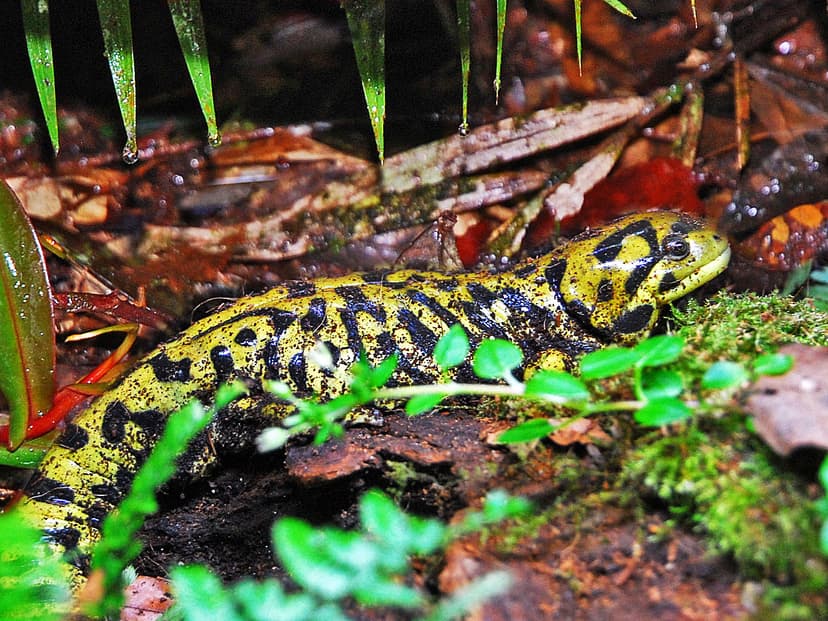
Barred tiger salamander
The barred tiger salamander (Ambystoma mavortium), also known as the western tiger salamander, is a large species of mole salamander found in western North America. It is distinctive for its tiger-like coloring, with bars and spots of muddy yellow on a dark background, and exhibits variable morphologies, including a cannibalistic form.

Aneides lugubris
The arboreal salamander (Aneides lugubris) is a species of climbing salamander native to California and Baja California. It is distinguished by its prehensile tail, sharp teeth, and unique arboreal adaptations, including gliding behavior when falling from trees. This lungless salamander is primarily nocturnal and insectivorous, inhabiting oak and sycamore woodlands and chaparral.
Arboreal salamander
The arboreal salamander (Aneides lugubris) is a lungless salamander species native to California and Baja California, known for its climbing ability and distinctive prehensile tail. It inhabits oak and sycamore woodlands and chaparral, spending daylight hours in tree cavities and exhibiting unique gliding behaviors when falling.