
Bolitoglossa salvinii
Salvin's salamander (Bolitoglossa salvinii) is a species of salamander native to El Salvador and Guatemala. It inhabits subtropical and tropical moist forests, as well as degraded former forest areas, and is distinguished by its vulnerability to habitat loss and fragmentation.
Key Facts
- ›Found in El Salvador and Guatemala.
- ›Inhabits subtropical/tropical moist lowland and montane forests.
- ›Also found in pastureland, plantations, and degraded forests.
- ›Threatened by habitat loss and fragmentation.
- ›Considered rare in El Salvador with historical records dating back over 50 years.
- ›Faces threats from habitat destruction, climate change, and potential disease.

Salvin's Mushroomtongue Salamander
Subtropical Or Tropical Moist Lowland Forests, Subtropical Or Tropical Moist Montane Forests, Pastureland, Plantations, Heavily Degraded Former Forest
El Salvador, Guatemala
Habitat Loss, Habitat Fragmentation, Climate Change, Human Beliefs, Batrachochytrium Salamandrivorans
About Bolitoglossa salvinii
Salvin's Salamander (Bolitoglossa salvinii)
Salvin's salamander, scientifically known as Bolitoglossa salvinii and sometimes referred to as Salvin's mushroomtongue salamander, is a species of salamander native to the Central American countries of El Salvador and Guatemala. It belongs to the family Plethodontidae, a diverse group of lungless salamanders.
Habitat and Distribution
This species primarily inhabits subtropical and tropical moist lowland and montane forests. Its natural range also extends to areas that have been converted to pastureland, plantations, and even heavily degraded former forest environments. In Guatemala, it is found in the upper coastal plain of the south, and in El Salvador, it occupies specific locations. The elevation range for Bolitoglossa salvinii typically falls between 600 to 1,250 meters above sea level.
Conservation Status and Threats
Bolitoglossa salvinii is classified as Vulnerable by the International Union for Conservation of Nature due to significant threats to its survival. The species faces a severely fragmented range, covering approximately 7,329 square kilometers. Ongoing habitat decline and fragmentation, particularly in El Salvador where it is considered rare with historical records over 50 years old, contribute to a suspected population decrease. Urbanization is a significant concern, especially in El Salvador, impacting its continued existence. Additional threats include climate change and the potential introduction of the deadly amphibian chytrid fungus, Batrachochytrium salamandrivorans.
Source: Wikipedia ↗
Frequently Asked Questions
Where is Salvin's salamander found?
Salvin's salamander is found in El Salvador and Guatemala, primarily in the upper coastal plain of southern Guatemala and specific locations within El Salvador.
What kind of forests does Salvin's salamander live in?
This species inhabits subtropical or tropical moist lowland forests and subtropical or tropical moist montane forests. It can also be found in pastureland, plantations, and heavily degraded former forest areas.
What are the main threats to Salvin's salamander?
The primary threats to Salvin's salamander include habitat loss and fragmentation, climate change, and human beliefs. The potential introduction of the fungus Batrachochytrium salamandrivorans is also a concern.
What is the conservation status of Salvin's salamander?
Salvin's salamander is designated as vulnerable to extinction by the International Union for Conservation of Nature. Its range is severely fragmented, and ongoing habitat decline may be causing a decrease in its population.
What elevation range does Salvin's salamander occupy?
Bolitoglossa salvinii typically resides at elevations ranging from 600 to 1,250 meters above sea level.
Related Salamander and Newt species

Bolitoglossa mombachoensis
Bolitoglossa mombachoensis, also known as the Mombacho salamander, is a species of salamander endemic to Nicaragua. It is found exclusively on Volcán Mombacho and in surrounding heavily degraded forests. The species is primarily threatened by habitat loss.
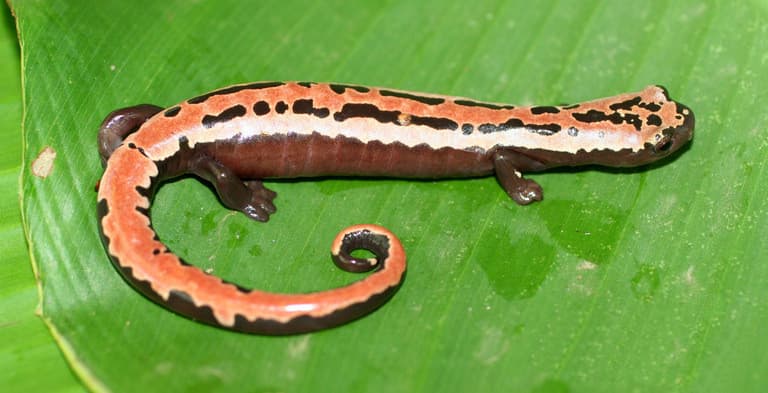
Bolitoglossa mexicana
The Mexican climbing salamander (Bolitoglossa mexicana) is a lungless salamander species found in Central America, inhabiting diverse forests and gardens. It is distinguished by its direct development, where young hatch as miniature adults, and its reliance on cutaneous respiration, necessitating moist environments.

Bolitoglossa macrinii
The Oaxacan climbing salamander (Bolitoglossa macrinii) is a species of salamander endemic to Mexico, found in subtropical or tropical moist montane forests and plantations. It is distinguished by its scientific name, which honors Emil Macrinius, a collector of natural history specimens.