
Bolitoglossa compacta
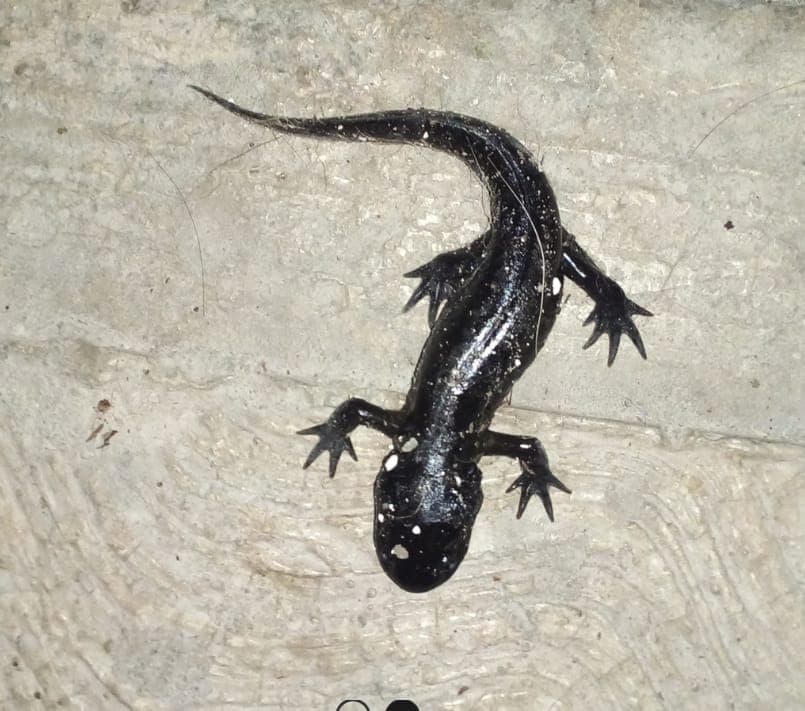
The Cerro Pando salamander, scientifically known as Bolitoglossa compacta, is a medium-sized salamander found in the montane rainforests along the Costa Rica-Panama border. It is distinguished by its predominantly dark black coloration, often accented with pale orange or yellow splotches on its upper sides, and its slightly webbed feet. This species is currently classified as endangered due to its restricted geographic range and the ongoing degradation of its habitat.
Key Facts
- ›Medium-sized for its genus, with females reaching up to 2.9 inches snout-to-vent length.
- ›Predominantly dark black with occasional pale orange or yellow markings on the upper sides.
- ›Inhabits moist montane rainforests at elevations between 1,650 and 2,780 meters.
- ›Found in the border region between Costa Rica and Panama.
- ›Classified as endangered by the IUCN due to limited range and habitat degradation.
- ›Has slightly webbed feet.

Cerro Pando Salamander, Cerro Pando Mushroomtongue Salamander
Moist Montane Rainforests, Low Vegetation Such As Palm Stems, Below Dilapidated Roofs
Costa Rica-Panama Border Region
- Medium-Sized Species For Its Genus.
- Females Reach A Snout–Vent Length of 68.5–74.2 Mm ; Males Reach 53.4 Mm .
- Mostly Dark Black In Color.
- Possess Pale Orange Or Yellow Splotches On the Upper Sides.
- Splotches May Be Connected To Form Two Ill-Defined Lines Or A Band Across the Back.
- Slightly Webbed Feet.
- Medium-Sized Tails.
Montane Rainforest
Logging, Development, Habitat Degradation, Changes In Habitat, Salamander Chytrid Fungus
About Bolitoglossa compacta
Bolitoglossa compacta: The Cerro Pando Salamander
The Cerro Pando salamander, scientifically classified as Bolitoglossa compacta, is a species of salamander belonging to the Plethodontidae family. This medium-sized amphibian is native to the moist montane rainforests found along the border region between Costa Rica and Panama. Its appearance is marked by a predominantly dark black coloration, often adorned with distinctive pale orange or yellow splotches along its upper sides, and it possesses slightly webbed feet.
Distribution and Habitat
Bolitoglossa compacta inhabits a specific ecological niche within high-altitude rainforests, typically found at elevations ranging from 1,650 to 2,780 meters. Its preferred environment includes areas with dense vegetation, where it has been observed residing on low-growing plants such as palm stems. It can also be found in less natural settings, such as under dilapidated roofs, suggesting some adaptability to altered landscapes.
Conservation Status
The species is currently listed as Endangered by the International Union for Conservation of Nature (IUCN). This classification is primarily due to its restricted geographic range and the ongoing degradation of its montane rainforest habitat. Threats such as logging and development pose significant risks to its survival, and the species appears to struggle when its environment undergoes changes. While strong protection measures are in place in Costa Rica, enforcement in Panamanian protected areas is noted as being less effective. A potential future threat that looms over salamander populations globally is the salamander chytrid fungus, which, if it were to spread to the Americas, could pose a severe risk to Bolitoglossa compacta.
Source: Wikipedia ↗
Frequently Asked Questions
What is the scientific name for the Cerro Pando salamander?
The scientific name for the Cerro Pando salamander is Bolitoglossa compacta. It was formally described in 1973 based on a specimen collected from Cerro Pando, a mountain in Panama.
What does the Cerro Pando salamander look like?
Bolitoglossa compacta is a medium-sized salamander that is mostly dark black. It has a few pale orange or yellow splotches on its upper sides, which can sometimes form ill-defined lines or a band across its back. It also possesses slightly webbed feet.
Where does the Cerro Pando salamander live?
This species inhabits moist montane rainforests in the border region of Costa Rica and Panama. It is typically found at elevations ranging from 1,650 to 2,780 meters and has been observed on low vegetation like palm stems, as well as under dilapidated roofs.
Why is the Cerro Pando salamander considered endangered?
The IUCN classifies Bolitoglossa compacta as endangered primarily because of its limited geographic range and the continuous degradation of its habitat. Threats include logging and development, and the species does not adapt well to habitat changes.
What are the main threats to the Cerro Pando salamander?
Major threats include logging and development, which lead to ongoing habitat degradation. The species is also sensitive to changes in its environment. A future threat, if it spreads to the Americas, is the salamander chytrid fungus.
Related Salamander and Newt species
Ambystoma lermaense
The Lake Lerma salamander (Ambystoma lermaense) is an extremely rare mole salamander species native to the Toluca Valley in central Mexico. This species is characterized by its neotenic tendencies and has faced a catastrophic decline due to habitat destruction, pollution, and dam construction in its native Lerma River and Lake Lerma wetlands.

Aneides iecanus
The Shasta black salamander (Aneides iecanus) is a species of salamander found only in Shasta County, California. It is distinguished by its large size, black coloration with white spots, and a heavily speckled body, head, and tail.

Aneides niger
The Santa Cruz black salamander (Aneides niger) is a species of salamander found exclusively in the San Francisco Peninsula of California. It is distinguished from other members of its complex by its predominantly black coloration in adulthood, a trait that develops as it matures from a spotted juvenile. This species faces significant threats due to its limited range, which has been impacted by development, water diversions, and wildfires.