
Aneides niger
The Santa Cruz black salamander (Aneides niger) is a species of salamander found exclusively in the San Francisco Peninsula of California. It is distinguished from other members of its complex by its predominantly black coloration in adulthood, a trait that develops as it matures from a spotted juvenile. This species faces significant threats due to its limited range, which has been impacted by development, water diversions, and wildfires.
Key Facts
- ›Endemic to the San Francisco Peninsula in California.
- ›Adults are almost uniformly black; juveniles have tiny white spots.
- ›Classified as Endangered on the IUCN Red List.
- ›Its limited range is threatened by development, water diversions, and wildfires.
- ›Faces potential impacts from climate change due to its arid habitat.

Santa Cruz Black Salamander
San Francisco Peninsula
United States
- Adult Individuals Have An Almost Uniformly Black Coloration.
- Juveniles Have Numerous Tiny White Spots That Are Lost As They Mature.
Habitat Development, Water Diversions, Wildfires, Climate Change
About Aneides niger
The Santa Cruz Black Salamander (Aneides niger)
The Santa Cruz black salamander, scientifically known as Aneides niger, is a unique species of salamander found exclusively within the San Francisco Peninsula of California. It belongs to the family Plethodontidae, a group characterized by lungless salamanders.
Taxonomy and Distribution
Originally described in 1948 as a subspecies of the speckled black salamander (A. flavipunctatus), a 2019 taxonomic revision recognized Aneides niger as a distinct species. It represents the southernmost member of the A. flavipunctatus complex and is geographically isolated from other related species. Its natural range is confined to San Mateo, Santa Cruz, and western Santa Clara counties.
Physical Characteristics
A key distinguishing feature of Aneides niger is its coloration. Unlike other members of the Aneides flavipunctatus complex, adult individuals typically exhibit a nearly uniform black appearance. Juvenile salamanders, however, are born with numerous small white spots, which gradually fade as they mature.
Conservation Status and Threats
The Santa Cruz black salamander is classified as Endangered on the IUCN Red List. This designation is due to its limited geographic distribution, which has been significantly impacted by human development. Furthermore, the species' habitat has been affected by alterations in water availability and recent severe wildfires, such as the CZU complex fires. Climate change poses an additional threat, as the region it inhabits is already experiencing hotter and drier conditions compared to areas occupied by other Aneides species.
Source: Wikipedia ↗
Frequently Asked Questions
What is the scientific name of the Santa Cruz black salamander?
The scientific name of the Santa Cruz black salamander is Aneides niger. It was originally described as a subspecies but is now recognized as a distinct species.
Where can the Santa Cruz black salamander be found?
Aneides niger is found only in the San Francisco Peninsula of California, specifically in San Mateo, Santa Cruz, and western Santa Clara counties. It is the southernmost member of its species complex and its range is disjunct from other related salamanders.
How can I identify a Santa Cruz black salamander?
Adult Santa Cruz black salamanders are notable for their nearly uniform black coloration. In contrast, juveniles display numerous small white spots, which gradually disappear as they grow and mature.
What are the main threats to the Santa Cruz black salamander?
The species is classified as Endangered due to its restricted distribution. Major threats include habitat development, alterations in water availability, and recent severe wildfires. Climate change is also a potential concern, as it inhabits an area already experiencing hotter and drier conditions compared to other Aneides species.
Related Salamander and Newt species
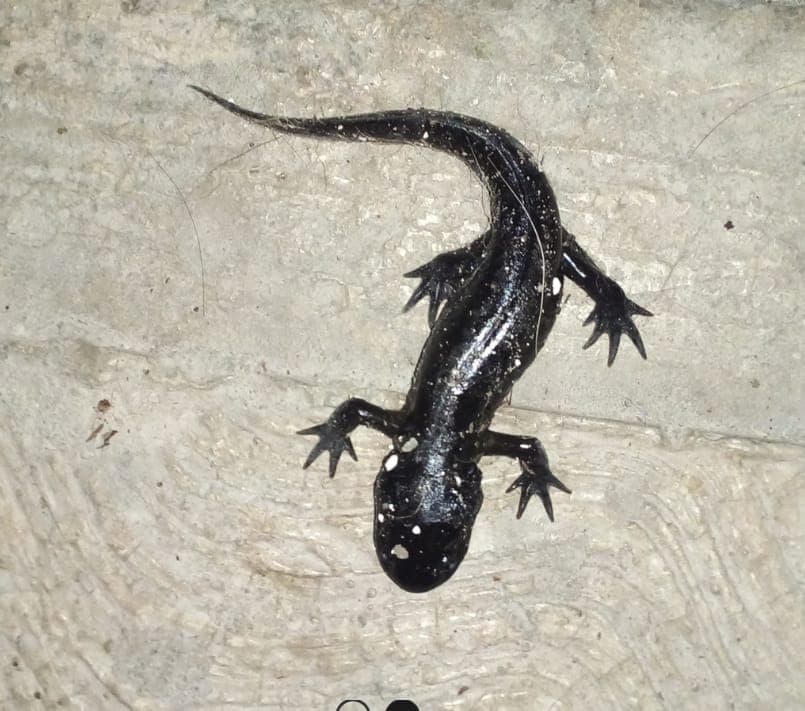
Ambystoma lermaense
The Lake Lerma salamander (Ambystoma lermaense) is an extremely rare mole salamander species native to the Toluca Valley in central Mexico. This species is characterized by its neotenic tendencies and has faced a catastrophic decline due to habitat destruction, pollution, and dam construction in its native Lerma River and Lake Lerma wetlands.

Aneides iecanus
The Shasta black salamander (Aneides iecanus) is a species of salamander found only in Shasta County, California. It is distinguished by its large size, black coloration with white spots, and a heavily speckled body, head, and tail.
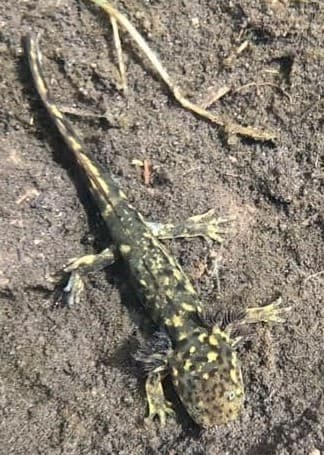
Ambystoma altamirani
The mountain stream salamander (Ambystoma altamirani) is a species of mole salamander native to central Mexico. It is distinguished by its purplish-black dorsal coloration, purplish-lavender belly, and cream-colored accents on its lips, digit tips, and tail fin. This species inhabits high-elevation pine and pine-oak woodlands, breeding in small streams where both larvae and some adults reside, while other adults venture onto land.