
Bolitoglossa macrinii
Bolitoglossa macrinii·Plethodontidae
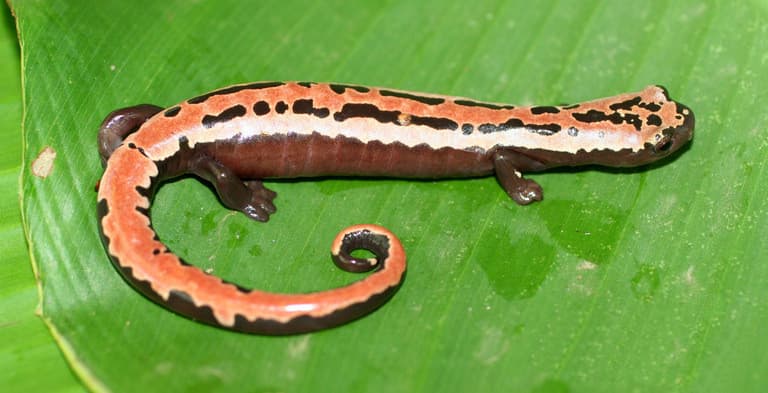
The Oaxacan climbing salamander (Bolitoglossa macrinii) is a species of salamander endemic to Mexico, found in subtropical or tropical moist montane forests and plantations. It is distinguished by its scientific name, which honors Emil Macrinius, a collector of natural history specimens.
Key Facts
- ›Endemic to Mexico, specifically the Sierra Madre del Sur in Oaxaca.
- ›Inhabits subtropical or tropical moist montane forests and plantations.
- ›Found at elevations ranging from 550 to 2,500 meters.
- ›Threatened primarily by habitat loss.
- ›Belongs to the Plethodontidae family, known as lungless salamanders.

Oaxacan Mushroom Tongue Salamander
Subtropical Or Tropical Moist Montane Forests, Plantations
Mexico
Habitat Loss
About Bolitoglossa macrinii
Bolitoglossa macrinii: The Oaxacan Climbing Salamander
The Oaxacan climbing salamander, scientifically designated as Bolitoglossa macrinii, is a species of salamander endemic to Mexico. This amphibian belongs to the Plethodontidae family, commonly known as lungless salamanders. The specific epithet, macrinii, serves as an honorific for Emil Macrinius, a notable collector of natural history specimens in Mexico.
Habitat and Distribution
The natural habitat of Bolitoglossa macrinii is characterized by subtropical or tropical moist montane forests. However, the species has also been documented in plantation environments, suggesting a degree of adaptability to human-altered landscapes. Geographically, Bolitoglossa macrinii is found along the Pacific slope of the Sierra Madre del Sur mountain range in Oaxaca, Mexico. Its distribution includes areas around San Miguel Suchixtepec and San Gabriel Mixtepec, as well as the region between San Gabriel Mixtepec and Pochutla. The species is most frequently encountered at elevations ranging from 550 to 1,860 meters (approximately 1,800 to 6,100 feet), with occasional sightings up to 2,500 meters (about 8,200 feet).
Conservation Concerns
The primary threat identified for Bolitoglossa macrinii is habitat loss. This ongoing issue poses a significant risk to the long-term survival and stability of its populations within its native range.
Source: Wikipedia ↗
Frequently Asked Questions
What is the Oaxacan climbing salamander?
The Oaxacan climbing salamander, scientifically known as Bolitoglossa macrinii, is a species of salamander belonging to the Plethodontidae family. It is native to Mexico and is found in specific forest and plantation habitats.
Where is Bolitoglossa macrinii found?
This species is endemic to Mexico, inhabiting the Pacific slope of the Sierra Madre del Sur in Oaxaca. It is found in and around specific locations such as San Miguel Suchixtepec and San Gabriel Mixtepec.
What kind of habitat does the Oaxacan climbing salamander prefer?
Bolitoglossa macrinii thrives in subtropical or tropical moist montane forests. It has also been observed in plantation areas, indicating some adaptability to human-modified landscapes.
At what elevations can Bolitoglossa macrinii be found?
The Oaxacan climbing salamander is typically found at elevations between 550 and 1,860 meters (1,800 to 6,100 feet). In some instances, it has been observed at higher elevations, occasionally reaching up to 2,500 meters (8,200 feet).
What are the main threats to Bolitoglossa macrinii?
The primary threat to the survival of Bolitoglossa macrinii is habitat loss. This loss can stem from various factors affecting its montane forest and plantation environments.
What does the scientific name 'macrinii' refer to?
The specific name, macrinii, is an honorific dedicated to Emil Macrinius. He was known for his work as a collector of natural history specimens within Mexico.
Related Salamander and Newt species

Bolitoglossa salvinii
Salvin's salamander (Bolitoglossa salvinii) is a species of salamander native to El Salvador and Guatemala. It inhabits subtropical and tropical moist forests, as well as degraded former forest areas, and is distinguished by its vulnerability to habitat loss and fragmentation.
Bolitoglossa mexicana
The Mexican climbing salamander (Bolitoglossa mexicana) is a lungless salamander species found in Central America, inhabiting diverse forests and gardens. It is distinguished by its direct development, where young hatch as miniature adults, and its reliance on cutaneous respiration, necessitating moist environments.

Bolitoglossa subpalmata
The La Palma salamander (Bolitoglossa subpalmata) is a species of salamander native to Costa Rica and western Panama. It is distinguished by its preference for high-elevation, cold montane forests, a habitat unusual for many other plethodontid salamanders. The species is currently threatened by the loss of its natural environment.