
Bolitoglossa synoria
The Cerro Pital salamander (Bolitoglossa synoria) is a species of plethodontid salamander found along the Honduras-El Salvador border, specifically on the mountain of Cerro El Pital. It is a medium-sized salamander characterized by its dark grayish-brown uppersides, pale brown undersides with whitish spots, and clay-colored markings on its sides. This species is critically endangered due to its limited range and ongoing habitat degradation.
Key Facts
- ›Found on the mountain of Cerro El Pital along the Honduras-El Salvador border.
- ›Inhabits cloud forests at elevations between 2,150 and 2,750 meters.
- ›Medium-sized for its genus, with a snout-vent length of 37.4–52.0 MM.
- ›Its coloration includes dark grayish-brown uppersides and pale brown undersides with whitish spots.
- ›Classified as critically endangered by the IUCN.
- ›Threatened by habitat loss due to agriculture, wildfires, and human activity.

Cerro Pital Salamander, Pital Mushroomtongue Salamander, Salamandra Pitalense
Cloud Forests
Honduras, El Salvador
- Medium-Sized Salamander For Its Genus.
- Snout-Vent Length: 37.4–52.0 Mm .
- Dark Grayish-Brown Uppersides.
- Pale Brown Undersides With Whitish Spots.
- Sides Are Dark Grayish-Brown With Clay-Colored Markings.
- Underside of the Tail Is Dark Grayish-Brown.
Habitat Loss, Agricultural Expansion, Coffee Cultivation, Wildfires, Road Construction, Human Activity, Climate Change, Pesticide Use, Herbicide Use
About Bolitoglossa synoria
Bolitoglossa synoria: The Cerro Pital Salamander
The Cerro Pital salamander, scientifically known as Bolitoglossa synoria, is a species of salamander belonging to the Plethodontidae family. This species is notable for its restricted range, found exclusively on and around the mountain of Cerro El Pital, which lies on the border between Honduras and El Salvador. It is a medium-sized salamander within its genus, typically measuring between 37.4 and 52.0 mm in snout-vent length.
Description and Habitat
Bolitoglossa synoria exhibits distinct coloration, with dark grayish-brown uppersides and paler brown undersides adorned with whitish spots. The sides of its body are also dark grayish-brown, featuring clay-colored markings, and the underside of its tail is similarly dark grayish-brown. This salamander makes its home in cloud forests, thriving at high elevations ranging from 2,150 to 2,750 meters (7,050 to 9,020 feet) above sea level. It requires substantial forest cover and appears to be sensitive to human interference within its environment.
Distribution and Conservation Status
The species' distribution is concentrated on Cerro El Pital, with additional populations found in the Güisayote Biological Reserve in Honduras. Despite its presence in protected areas within Honduras, the El Salvadoran portion of its range is in a privately managed area facing significant human pressure. Bolitoglossa synoria is classified as critically endangered by the International Union for Conservation of Nature (IUCN). This designation is due to its extremely small geographical range, estimated to be only 99 km², and the ongoing degradation of its vital cloud forest habitat. Threats include habitat loss driven by agricultural expansion, particularly coffee cultivation, as well as wildfires, construction, and general human activity. Climate change also poses a severe risk by impacting its preferred cloud forest ecosystems, and the use of pesticides and herbicides further endangers the species. The collection of wood for fuel by visitors to Cerro El Pital also contributes to the destruction of the salamander's microhabitat.
Source: Wikipedia ↗
Frequently Asked Questions
What is the scientific name for the Cerro Pital salamander?
The scientific name for the Cerro Pital salamander is Bolitoglossa synoria. It was formally described in 1999 based on specimens previously misidentified as other species.
Where is the Bolitoglossa synoria found?
Bolitoglossa synoria is found on the mountain of Cerro El Pital, straddling the border between Honduras and El Salvador. It is also present in the Güisayote Biological Reserve in Honduras.
What kind of habitat does the Cerro Pital salamander prefer?
This species inhabits cloud forests at high elevations, typically between 2,150 and 2,750 meters (7,050 to 9,020 feet). It requires good forest cover to survive.
What are the physical characteristics of Bolitoglossa synoria?
Bolitoglossa synoria is a medium-sized salamander for its genus, reaching a snout-vent length of 37.4–52.0 mm. It has dark grayish-brown uppersides, pale brown undersides with whitish spots, and clay-colored markings along its sides.
Why is the Cerro Pital salamander considered critically endangered?
The species is classified as critically endangered by the IUCN due to its very small range, estimated at only 99 km², and continuous habitat degradation. It is sensitive to human disturbance.
What are the main threats to Bolitoglossa synoria?
Major threats include habitat loss from agricultural expansion, coffee cultivation, wildfires, road construction, and increasing human activity. Pesticide and herbicide use, as well as climate change affecting its cloud forest habitat, also pose significant risks.
Related Salamander and Newt species
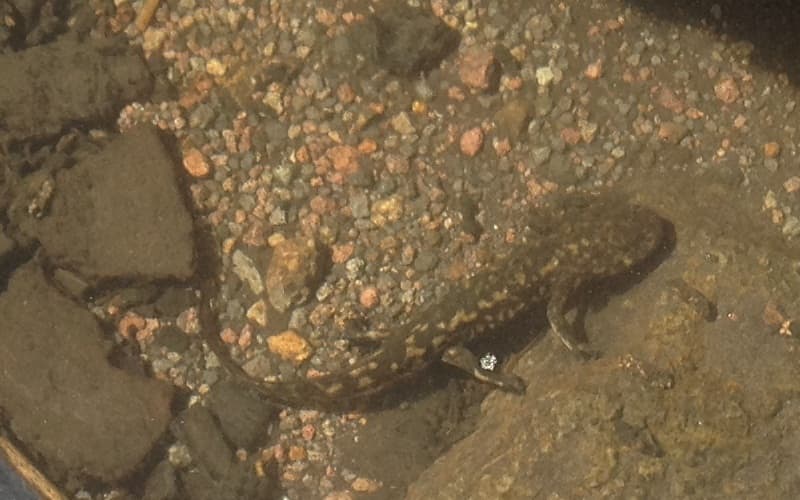
Ambystoma leorae
The Leora's stream salamander (Ambystoma leorae) is a critically endangered mole salamander endemic to a very small region within Mexico's Iztaccihuatl-Popocatepetl National Park. Its survival is threatened by its specific water quality requirements and human activities such as water extraction, cattle grazing, and direct consumption, leading to a single known population persisting on Mount Tlaloc.

Chinese giant salamander
The Chinese giant salamander (Andrias davidianus) is one of the largest amphibians in the world, inhabiting rocky mountain streams and lakes in central China. This fully aquatic species is distinguished by its large head, small eyes, wrinkly dark skin, and its classification as a "living fossil". It is critically endangered in the wild due to significant habitat loss, pollution, and overcollection for food and traditional medicine.
Andrias davidianus
The Chinese giant salamander (Andrias davidianus) is one of the largest salamanders and amphibians globally, endemic to the Yangtze river basin in China. It is a fully aquatic species known for its large size, dark, wrinkly skin, and distinctive vocalizations that resemble a human infant's cry, earning it the nickname "infant fish." Critically endangered in the wild, its populations have drastically declined due to habitat loss, pollution, and overcollection for food and traditional medicine.