
Carolina Sandhills salamander
Watch list (North Carolina Natural Heritage Program)
The Carolina Sandhills salamander is a lungless salamander species endemic to the Sandhills region of North Carolina, United States. Distinctive for its dark-spotted, orange-to-red coloration in mature individuals, it is closely related to Eurycea cirrigera but differs in coloring, size, and natural history, generally possessing shorter bodies, tails, and heads.
Key Facts
- ›Endemic to the Sandhills region of North Carolina, USA.
- ›Characterized by dark-spotted, orange-to-red coloration in adults.
- ›Closely related to Eurycea cirrigera, but distinguished by coloration and body proportions.
- ›Inhabits the longleaf pine ecosystem, found in springs and blackwater rivers.
- ›Has been on a watch list by the North Carolina Natural Heritage Program due to population declines.
- ›Threatened by habitat alteration and loss.

Springs, Blackwater Rivers
North Carolina, United States
- Dark-Spotted, Orange-To-Red Coloration of Mature Individuals
- Shorter Bodies, Tail, and Heads Compared To E. Cirrigera
Habitat Alteration, Habitat Loss
About Carolina Sandhills salamander
The Carolina Sandhills salamander, scientifically known as Eurycea arenicola, is a species of lungless salamander that is endemic to the Sandhills region of North Carolina in the United States. These salamanders are notable for their distinctive coloration and ecological niche within their specific habitat.
Taxonomy and Distinguishing Features
This species belongs to the "two-lined salamander" complex, a group that includes several related Eurycea species. It shares a close relationship with Eurycea cirrigera, but the Carolina Sandhills salamander can be identified by the dark-spotted, orange-to-red coloration of its mature individuals, a stark contrast to the more yellowish hue of E. cirrigera. Furthermore, Carolina Sandhills salamanders are characterized by having shorter bodies, tails, and heads when compared to their close relative.
Discovery and Description
The first known specimen of the Carolina Sandhills salamander was collected in 1969 by Alvin Braswell. Initially, it was believed to be an unusual southern two-lined salamander. However, subsequent discoveries of similar specimens suggested the existence of a distinct population that might represent an undescribed species. Braswell began efforts to formally describe the species in the 1980s, but his research was interrupted. The project was later taken over by his successor, Bryan Stuart, who, with the aid of technological advancements in DNA sequencing, finally led to the species' formal description in 2020.
Distribution and Habitat
The Carolina Sandhills salamander is exclusively found within the Carolina Sandhills. Its habitat is the longleaf pine ecosystem, where it resides in springs and blackwater rivers. This specialized habitat preference aligns with other amphibians that are restricted to this ecosystem, such as the Pine Barrens tree frog. While all documented records are from North Carolina, one specimen was found just two miles from the South Carolina border, suggesting its potential presence in that state as well.
Conservation Concerns
Despite being considered common within their range, populations of the Carolina Sandhills salamander have experienced declines. For over two decades, the North Carolina Natural Heritage Program has maintained the species on a watch list to monitor its survival. The primary threats contributing to this decline are general habitat alteration and loss, underscoring the vulnerability of this specialized species to environmental changes.
Source: Wikipedia ↗
Frequently Asked Questions
What makes the Carolina Sandhills salamander distinctive?
The Carolina Sandhills salamander is distinguished by its coloration, typically featuring dark spots on an orange-to-red background in mature individuals. It also has shorter bodies, tails, and heads compared to its close relative, Eurycea cirrigera.
Where is the Carolina Sandhills salamander found?
This species is endemic to the Sandhills region of North Carolina in the United States. It is found within the longleaf pine ecosystem, specifically in springs and blackwater rivers.
What is the conservation status of the Carolina Sandhills salamander?
The Carolina Sandhills salamander has been on a watch list by the North Carolina Natural Heritage Program for over 20 years. This designation reflects concerns for its population survival.
What are the main threats to the Carolina Sandhills salamander?
The primary threats to the Carolina Sandhills salamander are general habitat alteration and loss. These factors have contributed to a decline in its population.
How is the Carolina Sandhills salamander related to other species?
It is a member of the 'two-lined salamander' complex and is most closely related to Eurycea cirrigera. However, it can be distinguished from E. cirrigera by its coloration and body proportions.
Related Salamander and Newt species
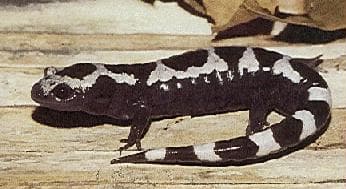
Ambystoma opacum
The marbled salamander (Ambystoma opacum) is a stout, terrestrial salamander found in the eastern United States, distinguished by its striking black and white banded pattern. Females typically have light gray bands, while males exhibit bright white bands, with males also possessing a larger proportion of white on their dorsal surface. This species spends most of its life under logs or in burrows and relies on seasonally flooded areas for breeding.
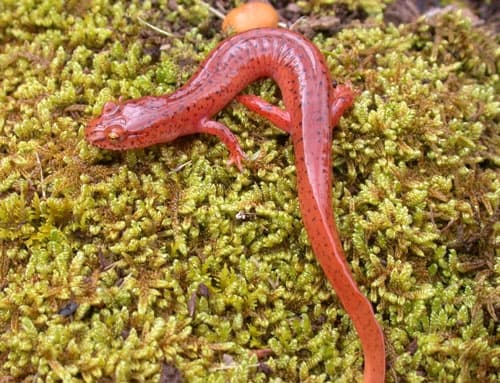
Blue Ridge spring salamander
The Blue Ridge spring salamander, a subspecies of the spring salamander (Gyrinophilus porphyriticus), is found in the southern Appalachian Mountains and adjacent Piedmont regions of the United States. This species is distinguished by a distinctive white line from its eye to its nostril, bordered by a dark line, and its varied dorsal coloration ranging from reddish to orange-yellow with black or brown spots. They inhabit cool springs, mountain springs, and moist forest areas, and are notable for their diet which can include other salamanders.

Blackbelly salamander
The blackbelly salamander, formerly classified as Desmognathus quadramaculatus, is a medium-sized salamander endemic to the Appalachian Mountains of the southeastern United States. It is distinguished by its dark brown to black coloration, often with pale spots, and its predominantly aquatic lifestyle, inhabiting cold mountain streams. Recent research has reclassified this group, splitting it into multiple distinct species.