
Central Asian salamander
The Central Asian salamander (Ranodon sibiricus) is the sole species within the monotypic genus Ranodon, belonging to the family Hynobiidae. This amphibian is distinguished by its reduced lungs and is found in temperate forests, grasslands, and freshwater habitats along the Dzungarian Alatau mountains, straddling the border of China and Kazakhstan. Its reproductive method, once thought to be unique, is now understood to involve external fertilization after egg-laying.
Key Facts
- ›It is the only species in the genus Ranodon.
- ›Found in the Dzungarian Alatau mountains.
- ›Inhabits temperate forests, tundra, grasslands, rivers, and marshes.
- ›Possesses reduced lungs.
- ›Threatened by habitat loss.

Central Asian Salamander
Streams, Temperate Forest, Tundra, Temperate Grassland, Rivers, Freshwater Marshes, Springs
China, Kazakhstan
Reduced Lungs
External Fertilization
Habitat Loss
About Central Asian salamander
The Central Asian Salamander
The Central Asian salamander (Ranodon sibiricus) is a unique amphibian, holding the distinction of being the sole species within the genus Ranodon. This salamander belongs to the Hynobiidae family and is notable for possessing reduced lungs, a distinctive physiological trait. Its natural range is confined to the Dzungarian Alatau mountains, an area that straddles the border between China and Kazakhstan.
Habitat and Distribution
This species thrives in a variety of environments, including temperate forests, tundra regions, temperate grasslands, and along rivers and freshwater marshes. Springs also form part of its natural habitat. The Central Asian salamander's existence is closely tied to these temperate and aquatic landscapes.
Reproduction
Historically, the reproductive strategy of the Central Asian salamander was misunderstood. It was once thought to have a unique form of fertilization where the male would first deposit a large sperm mass, onto which the female would then lay her eggs. However, current understanding clarifies that this is an instance of external fertilization, with the male fertilizing the eggs only after the female has deposited them.
Conservation Concerns
Regrettably, the Central Asian salamander faces significant threats, with habitat loss being the primary concern documented. The degradation and destruction of its natural environments place considerable pressure on its populations, highlighting the need for conservation efforts in its native regions.
Source: Wikipedia ↗
Frequently Asked Questions
Where is the Central Asian salamander found?
The Central Asian salamander is distributed in the Dzungarian Alatau mountains, which lie on the border between China and Kazakhstan. Its natural habitat includes temperate forests, tundra, grasslands, rivers, freshwater marshes, and springs.
What are some distinctive physical features of the Central Asian salamander?
One notable physical characteristic of the Central Asian salamander is its reduced lungs. Specific details on its size, coloration, or skin texture are not provided in available records.
How does the Central Asian salamander reproduce?
Reproduction involves external fertilization. Previously, it was believed the male deposited sperm before the female laid eggs, but current understanding indicates the male fertilizes the eggs after they have been laid by the female.
What are the primary threats to the Central Asian salamander?
The main threat documented for the Central Asian salamander is habitat loss. Further details on other potential threats are not specified.
What is the taxonomic family of the Central Asian salamander?
The Central Asian salamander belongs to the family Hynobiidae.
Related Salamander and Newt species

Apalachicola dusky salamander
The Apalachicola dusky salamander is a species of salamander found in the Southeastern United States, specifically in Alabama, Florida, and Georgia. It inhabits temperate forests, intermittent rivers, and freshwater springs. This species is currently threatened by habitat loss.

Blue Ridge two-lined salamander
The Blue Ridge two-lined salamander (Eurycea wilderae) is a species of salamander native to the southern Appalachian Mountains in the United States. It is distinguished by two black dorsolateral lines that run along its back, often breaking into dots. This species inhabits moist, cool environments near streams and is named after zoologist Inez Whipple Wilder.
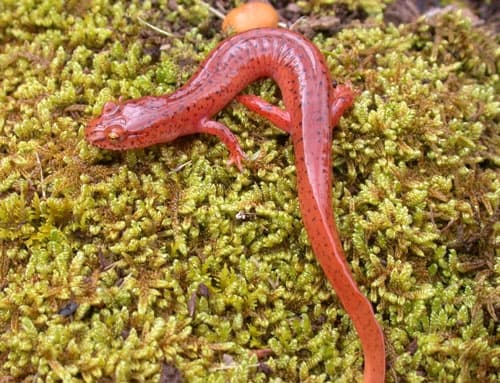
Blue Ridge spring salamander
The Blue Ridge spring salamander, a subspecies of the spring salamander (Gyrinophilus porphyriticus), is found in the southern Appalachian Mountains and adjacent Piedmont regions of the United States. This species is distinguished by a distinctive white line from its eye to its nostril, bordered by a dark line, and its varied dorsal coloration ranging from reddish to orange-yellow with black or brown spots. They inhabit cool springs, mountain springs, and moist forest areas, and are notable for their diet which can include other salamanders.