
Corsican brook salamander
The Corsican brook salamander is a species of salamander endemic to the island of Corsica in the Mediterranean Sea. It is primarily found in rocky streams, springs, and rivers at higher altitudes, distinguishing itself with its smooth aquatic skin that becomes granular on land and specific sexual dimorphism in its cloaca.
Key Facts
- ›The Corsican brook salamander is endemic to the island of Corsica.
- ›It inhabits rocky streams, springs, and rivers, typically above 600 meters in altitude.
- ›Adults can grow up to 13 CM in length, with males having hind leg spurs and females having ventral cloaca openings.
- ›The species is mainly aquatic, breathing through its skin, with reduced or absent lungs.
- ›It is classified as 'Least Concern' on the IUCN Red List.
- ›Threats include pollution, introduced trout, and habitat destruction.

Corsican Mountain Newt
Rocky Streams, Springs, Rivers, Forests, Maquis, Lakes, Ponds
Corsica
- Smaller Than Closely Related Species, Growing Up To 13 Cm In Length .
- Long Head With A Rounded Snout.
- Tail Is Oval In Cross Section and As Long As the Rest of the Body.
- Distinct Parotoid Glands On the Side of the Neck.
- Males Have Spurs On Hind Legs and A Backwards-Pointing Conical Cloaca.
- Females Have A Cloaca With A Ventral Opening.
- Skin Is Smooth When Aquatic, Becoming More Granular On Land.
- Coloration Is Brown Or Olive, Sometimes With Mottling of Orange, Red, Or Brown Near the Spine.
- Underside Is Paler and Uniformly Colored, Occasionally With White Flecks, But Not Spotted On the Throat.
Insects, Small Invertebrates
- Mainly Aquatic, Living In Lakes, Ponds, and Slower-Moving Stream Parts.
- Hides Under Stones When In Water.
- When On Land, Stays Close To Water and Inhabits Undergrowth Or Areas Under Fallen Logs and Rocks.
- Hibernates Underground During Winter.
- Enters A Terrestrial Phase After Breeding.
- Mainly Nocturnal.
- Males Grasp Females With Jaws and Wrap Tails Around Them During Mating.
- Females Guard Eggs Until Hatching.
Pollution of Streams and Lakes, Introduction of Trout, Habitat Destruction, Fragmentation of Populations
About Corsican brook salamander
The Corsican Brook Salamander
The Corsican brook salamander, scientifically known as Euproctus montanus, is a unique amphibian endemic to the island of Corsica in the Mediterranean Sea. This species is a member of the Salamandridae family and is distinguished by its habitat preference, primarily residing in rocky streams, springs, and rivers at altitudes generally above 600 meters. Its terrestrial skin texture differs from its smooth aquatic form, and it exhibits specific sexual dimorphism.
Description and Habitat
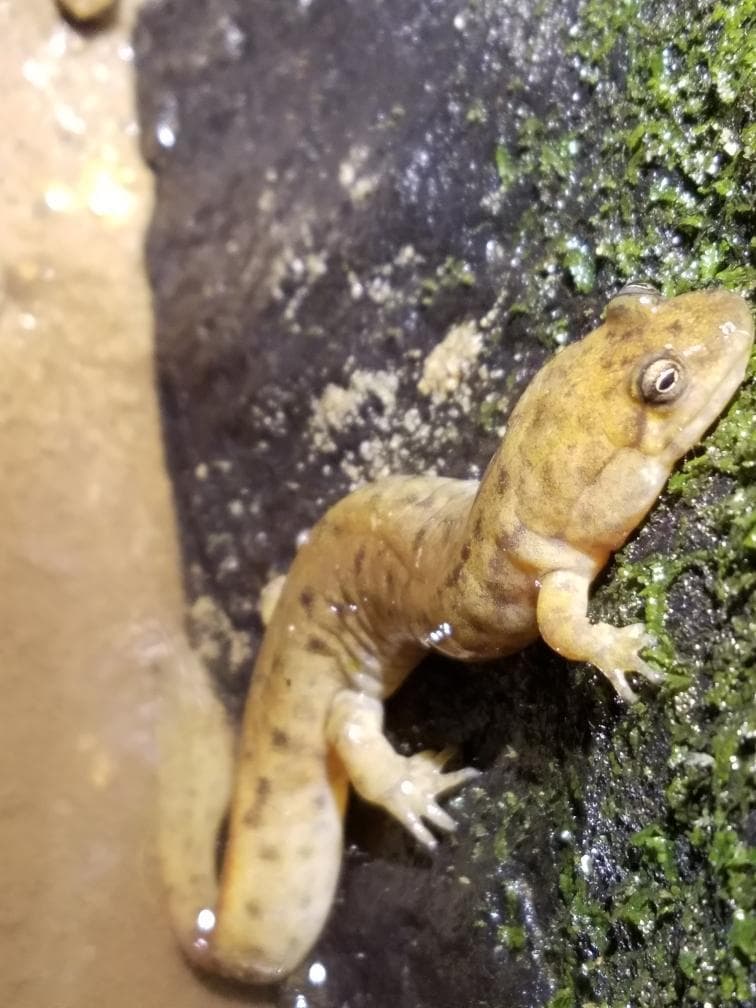
Corsican brook salamanders are relatively small, typically reaching about 10 cm in length, though some individuals can grow up to 13 cm. They possess a long head with a rounded snout and a tail that is oval in cross-section and roughly equal to their body length. Distinct parotoid glands are present on their necks. Males are identifiable by spurs on their hind legs and a conical cloaca that points backward, while females have a cloaca with a ventral opening. The skin is smooth when the salamander is in water but becomes more granular when it ventures onto land. Their coloration is usually brown or olive, often with orange, red, or brown mottling, especially along the spine, and a paler, uniform underside that may have white flecks but lacks spots on the throat.
This species is mainly aquatic, favoring lakes, ponds, and the slower sections of streams, often concealed beneath stones. When on land, it remains close to water sources, inhabiting maquis shrubland and woods, where it can be found undergrowth or beneath fallen logs and rocks. It is not found in eastern lowland areas or much of the coast, preferring higher elevations ranging from 600 to 1,500 meters, and can be found up to 2,250 meters.
Biology and Behavior
The Corsican brook salamander thrives in well-oxygenated waters, relying on cutaneous respiration as its lungs are either absent or vestigial. Despite this, it is capable of terrestrial movement and hibernates underground during winter. Following its breeding period, it enters a terrestrial phase and is primarily nocturnal. Its diet consists of insects and small invertebrates.
Reproduction
Breeding patterns vary with altitude. Near the coast, mating may occur twice annually, in spring and early autumn. At higher elevations, breeding takes place in midsummer. The mating ritual involves the male grasping the female with his jaws and encircling her with his tail while depositing spermatophores into her cloaca. The female then lays approximately 30 large, yolky eggs in secluded crevices or under stones. She actively guards these eggs until they hatch, which occurs about 50 days later. The larval stage, or tadpole phase, lasts for about nine months before metamorphosis into juveniles.
Conservation Status
The Corsican brook salamander is currently listed as 'Least Concern' on the IUCN Red List of Threatened Species. This status is due to its common presence in suitable habitats within its restricted range and the absence of evidence for a significant population decline. However, potential threats exist, including pollution of its aquatic environments, the introduction of competing or predatory species like trout, and habitat destruction which can lead to population fragmentation.
Source: Wikipedia ↗
Frequently Asked Questions
What is the scientific name for the Corsican brook salamander?
The scientific name for the Corsican brook salamander is Euproctus montanus. This binomial nomenclature is used to classify this specific species within the scientific community.
Where can the Corsican brook salamander be found?
This species is found exclusively on the island of Corsica, in the Mediterranean Sea. It is typically located in rocky streams, springs, and rivers at altitudes above 600 meters.
What are the physical characteristics of the Corsican brook salamander?
The Corsican brook salamander is relatively small, reaching up to 13 cm in length, with a rounded snout and an oval tail. Its skin is smooth when aquatic and granular on land, with brown or olive coloration often mottled with orange or red. Males possess hind leg spurs and a unique cloaca shape.
What does the Corsican brook salamander eat?
The Corsican brook salamander is primarily nocturnal and feeds on insects and small invertebrates. It hunts these prey items during its active periods.
How does the Corsican brook salamander reproduce?
Reproduction involves the male grasping the female and depositing spermatophores into her cloaca. The female then lays about 30 large, yolky eggs in crevices or under stones, guarding them until they hatch approximately 50 days later. The larval stage lasts about 9 months.
What is the conservation status of the Corsican brook salamander?
The Corsican brook salamander is listed as 'Least Concern' by the IUCN Red List. Despite its limited range, it is common within suitable habitats, and its population is not considered to be declining.
Related Salamander and Newt species
Black mountain salamander
The black mountain salamander (Desmognathus welteri) is a species of salamander found in the southern Appalachian Mountains of the southeastern United States. It is characterized by its robust body, short limbs, and variable brown coloration. This secretive salamander primarily inhabits temperate forests near swift-flowing streams and is known for its lengthy larval development and dedicated maternal care for its eggs.

Chinese giant salamander
The Chinese giant salamander (Andrias davidianus) is one of the largest amphibians in the world, inhabiting rocky mountain streams and lakes in central China. This fully aquatic species is distinguished by its large head, small eyes, wrinkly dark skin, and its classification as a "living fossil". It is critically endangered in the wild due to significant habitat loss, pollution, and overcollection for food and traditional medicine.

Blue Ridge two-lined salamander
The Blue Ridge two-lined salamander (Eurycea wilderae) is a species of salamander native to the southern Appalachian Mountains in the United States. It is distinguished by two black dorsolateral lines that run along its back, often breaking into dots. This species inhabits moist, cool environments near streams and is named after zoologist Inez Whipple Wilder.