
Del Norte salamander
The Del Norte salamander is a medium-sized, slender terrestrial salamander native to southwestern Oregon and northwestern California. It is characterized by its dark brown or black dorsal coloration, often featuring a straight-edged reddish mid-dorsal stripe, and it inhabits moist talus slopes and rocky substrates within redwood or Douglas fir forests. This species is notable for lacking a free-living larval stage, with juveniles hatching fully metamorphosed.
Key Facts
- ›Adults measure between 6–7.5 CM (snout to vent) and 11–15 CM in total length.
- ›Dorsal coloration is typically dark brown or black, sometimes with a reddish MID-dorsal stripe.
- ›It is a fully terrestrial species, found among moss-covered rocks or under forest litter.
- ›Reproduction involves clutches of three to 11 eggs, with juveniles hatching directly without a larval stage.
- ›The species is threatened by habitat loss, primarily due to logging.

Moist Talus Slopes, Rocky Substrates, Redwood Forests, Douglas Fir Forests, Forest Litter
United States
- Medium-Sized, Slender Salamander
- Adults 6–7.5 Cm Snout To Vent, 11–15 Cm Total Length
- Short Limbs
- Short, Slightly Webbed Toes
- Dorsal Coloration: Dark Brown Or Black
- May Have A Reddish Or Reddish-Brown Straight-Edged Mid-Dorsal Stripe From Head To Tail, Less Pronounced In Older Animals
- Fully Terrestrial
- Typically Encountered Among Moss-Covered Rocks Or Under Bark and Other Forest Litter
- Usually Avoids Very Wet Areas
Habitat Loss, Logging
About Del Norte salamander
The Del Norte salamander (Plethodon elongatus) is a species of terrestrial salamander found in the United States, inhabiting southwestern Oregon and northwestern California. This species is distinguished by its medium size, slender build, and characteristic dark brown or black coloration, often accented by a straight-edged reddish mid-dorsal stripe that may fade with age.
Life History and Habitat
Adult Del Norte salamanders typically range from 6 to 7.5 cm from snout to vent, with a total length of 11 to 15 cm. They possess relatively short limbs and toes. The species is fully terrestrial, preferring moist talus slopes and rocky substrates within the shaded environments of redwood and Douglas fir forests. They are commonly found nestled among moss-covered rocks or concealed beneath forest litter, generally avoiding excessively damp conditions.
A notable aspect of the Del Norte salamander's life cycle is its reproductive strategy. Females lay clutches of three to 11 eggs, and unlike many amphibian species, there is no free-living larval stage. Juveniles hatch from these eggs already fully metamorphosed, measuring approximately 18 mm in snout-vent length.
Conservation Concerns
While the Del Norte salamander can be locally abundant in suitable habitats, it faces significant threats. The primary danger to its survival is habitat loss, which is largely attributed to logging operations. This loss of forest cover and the associated environmental conditions directly impacts the availability of safe and appropriate living spaces for the species.
Source: Wikipedia ↗
Frequently Asked Questions
What is the scientific name for the Del Norte salamander?
The scientific name for the Del Norte salamander is *Plethodon elongatus*. This binomial name is used to classify it within the scientific community and distinguish it from other salamander species.
Where can the Del Norte salamander be found?
The Del Norte salamander is endemic to the United States, specifically in southwestern Oregon and northwestern California. It prefers moist talus slopes and rocky substrates within redwood or Douglas fir forests.
What does the Del Norte salamander look like?
Adult Del Norte salamanders are medium-sized and slender, with dark brown or black dorsal coloration. They may exhibit a straight-edged reddish or reddish-brown mid-dorsal stripe that can be less prominent in older individuals. Their limbs are relatively short, and their toes are short and slightly webbed.
How does the Del Norte salamander reproduce?
The Del Norte salamander reproduces by laying clutches of three to 11 eggs. A distinctive feature of its life history is the absence of a free-living larval stage; juveniles hatch already completely metamorphosed.
What are the main threats to the Del Norte salamander?
The primary threat to the Del Norte salamander is habitat loss, which is largely caused by logging activities. This loss of suitable forest environments impacts their ability to thrive.
Related Salamander and Newt species
Blue Ridge spring salamander
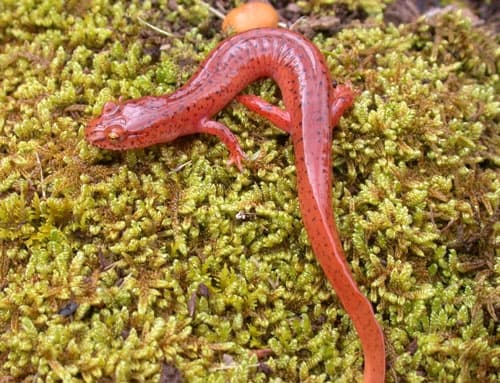
The Blue Ridge spring salamander, a subspecies of the spring salamander (Gyrinophilus porphyriticus), is found in the southern Appalachian Mountains and adjacent Piedmont regions of the United States. This species is distinguished by a distinctive white line from its eye to its nostril, bordered by a dark line, and its varied dorsal coloration ranging from reddish to orange-yellow with black or brown spots. They inhabit cool springs, mountain springs, and moist forest areas, and are notable for their diet which can include other salamanders.

Blackbelly salamander
The blackbelly salamander, formerly classified as Desmognathus quadramaculatus, is a medium-sized salamander endemic to the Appalachian Mountains of the southeastern United States. It is distinguished by its dark brown to black coloration, often with pale spots, and its predominantly aquatic lifestyle, inhabiting cold mountain streams. Recent research has reclassified this group, splitting it into multiple distinct species.

Corsican brook salamander
The Corsican brook salamander is a species of salamander endemic to the island of Corsica in the Mediterranean Sea. It is primarily found in rocky streams, springs, and rivers at higher altitudes, distinguishing itself with its smooth aquatic skin that becomes granular on land and specific sexual dimorphism in its cloaca.