
Fourche Mountain salamander
The Fourche Mountain salamander is a medium-sized salamander found exclusively in the Ouachita Mountains of Arkansas and eastern Oklahoma in the United States. It is characterized by its black coloration with brassy or cream spots and blotches, and it inhabits temperate forests, particularly in ravines and on north-facing slopes. This species is considered near threatened due to habitat loss and its restricted distribution.
Key Facts
- ›Found only in the Ouachita Mountains of Arkansas and eastern Oklahoma.
- ›Possesses a black background color with brassy or cream spots and dorsal blotches.
- ›Inhabits temperate forests, especially ravines and north-facing slopes.
- ›Feeds primarily at night on small invertebrates like insects, spiders, and worms.
- ›Undergoes direct development, bypassing an aquatic larval stage.
- ›Listed as near threatened on the IUCN Red List.

Temperate Forests, Deciduous Woodland, Ravines, North-Facing Slopes, Undergrowth, Under Rocks and Logs
United States
- Medium-Sized
- Black Background Color
- Varying Amounts of Small Brassy Or Cream Colored Spots
- Two Rows of Larger, Irregular Blotches Along the Dorsum
- Dark Underside With Small Lighter Spots
- Pale Chin
Small Invertebrates, Insects, Spiders, Worms
- Hides In Undergrowth, Under Rocks and Logs
- Mainly Feeds At Night
- May Aestivate Underground During Hot, Dry Weather
- Emerges To Forage During Wet Periods
- Probably Hibernates Between November and March
- Females May Breed In the Fall Or Winter In Alternate Years
Habitat Loss, Habitat Degradation, Disturbance
About Fourche Mountain salamander
The Fourche Mountain salamander (Plethodon fourchensis) is a species of salamander endemic to the Ouachita Mountains in the central United States, specifically found in Arkansas and eastern Oklahoma. This species is distinguished by its medium size, black coloration adorned with brassy or cream spots and blotches along its back, and a pale chin.
Habitat and Distribution
This salamander's range is restricted to the Fourche Mountains, Shut-In Mountains, and the eastern side of Iron Fork Mountain within the Ouachita Mountain range. It prefers temperate deciduous woodlands, particularly thriving in ravines and on north-facing slopes. During hot and dry periods, typically from May to September, the Fourche Mountain salamander may aestivate underground, emerging to forage when wetter conditions prevail. It is likely to hibernate from November to March.
Biology and Reproduction
The Fourche Mountain salamander is a terrestrial species that hides under rocks, logs, and in the undergrowth. Its diet consists mainly of small invertebrates such as insects, spiders, and worms, which it hunts at night. Unlike many amphibians, this species undergoes direct development, meaning there is no free-swimming larval stage; juvenile salamanders hatch directly from eggs. Breeding may occur in the fall or winter, potentially in alternate years, with eggs laid in underground chambers and brooded by the female.
Conservation Status
The Fourche Mountain salamander is classified as Near Threatened on the IUCN Red List of Threatened Species. Although it can be locally abundant within its limited geographic area, its restricted distribution makes it vulnerable to threats such as habitat loss and degradation. Fortunately, its entire range falls within the Ouachita National Forest, which offers some degree of protection.
Source: Wikipedia ↗
Frequently Asked Questions
What does the Fourche Mountain salamander look like?
The Fourche Mountain salamander is a medium-sized species with a black background color. It features varying amounts of small brassy or cream-colored spots, along with two rows of larger, irregular blotches on its back. The underside is dark with small lighter spots, and it has a pale chin.
Where can the Fourche Mountain salamander be found?
This salamander is endemic to the Ouachita Mountains in the central United States. Specifically, it occurs in the Fourche Mountains, the Shut-In Mountains, and the eastern side of Iron Fork Mountain, spanning parts of Arkansas and eastern Oklahoma.
What kind of habitat does the Fourche Mountain salamander prefer?
It is found in temperate deciduous woodlands, particularly in mountainous areas. It favors ravines and north-facing slopes, often hiding in the undergrowth or beneath rocks and logs.
What does the Fourche Mountain salamander eat?
The Fourche Mountain salamander primarily feeds at night on small invertebrates. Its diet includes insects, spiders, and worms.
How does the Fourche Mountain salamander reproduce?
Little is specifically known about its breeding habits, but they are believed to be similar to those of the Rich Mountain salamander. Eggs are laid in underground chambers and brooded by the female, with development being direct, meaning there is no aquatic larval stage.
Is the Fourche Mountain salamander endangered?
The Fourche Mountain salamander is listed as near threatened on the IUCN Red List. While it can be locally abundant within its range, its restricted distribution makes it susceptible to habitat disturbance and degradation.
Related Salamander and Newt species
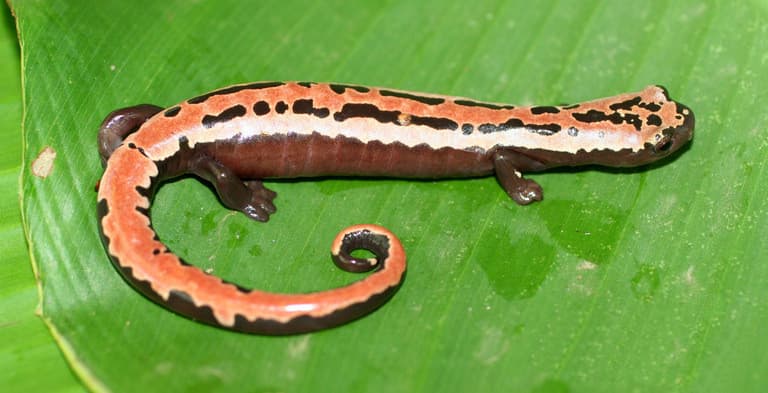
Bolitoglossa mexicana
The Mexican climbing salamander (Bolitoglossa mexicana) is a lungless salamander species found in Central America, inhabiting diverse forests and gardens. It is distinguished by its direct development, where young hatch as miniature adults, and its reliance on cutaneous respiration, necessitating moist environments.

Bolitoglossa rufescens
The northern banana salamander (Bolitoglossa rufescens) is a small, terrestrial and arboreal salamander found in the Atlantic slopes of Meso-America, from Mexico through Guatemala, Belize, and northern Honduras. It is distinctive for its lungless respiration and its adaptation to life within bromeliads in tropical and subtropical moist lowland rain forests and mountain ecosystems.

Batrachoseps gregarius
The gregarious slender salamander (Batrachoseps gregarius) is a species of salamander native to California. It is characterized by its small, slender build, narrow head, short limbs, and a long, tapering tail. This species primarily inhabits chaparral, woodlands, and grasslands in the foothills of the Sierra Nevada and the eastern Central Valley.