
Fuding fire belly newt
The Fuding fire belly newt (Cynops fudingensis) is a rare newt species endemic to China, specifically known from Fuding in northeastern Fujian. It is distinguished by its morphological similarity to the Dayang fire belly newt and its separate geographic range from closely related species. This small newt inhabits small, still-water puddles and ditches in agricultural fields.
Key Facts
- ›Endemic to Fuding, Fujian province, China.
- ›Belongs to the family Salamandridae.
- ›Typically measures less than 100 MM (3.9 in) in total length.
- ›Inhabits small, still-water puddles and ditches in agricultural fields.
- ›Reproduction requires a larger group of newts, with eggs laid singly in water plant leaves in April.
- ›Threatened by habitat destruction, introduced predators, and collection by hobbyists.

Fuding Fire Belly Newt
Small, Still-Water Puddles, Ditches, Deserted Agricultural Fields
China
Small Newt, Usually Less Than 100 Mm In Total Length
- Reproduction Requires A Larger Group of Newts
- Eggs Are Laid Singly In Leaves of Water Plants
Habitat Destruction, Introduced Predators, Collection By Hobbyists
About Fuding fire belly newt
The Fuding fire belly newt (Cynops fudingensis) is a rare species of newt belonging to the family Salamandridae. It is exclusively found in China, with its known range limited to Fuding in northeastern Fujian province. This species was described as new in 2010 and is genetically similar to the Chinese fire belly newt (C. orientalis), though it is morphologically closer to the Dayang fire belly newt (C. orphicus). Its distribution is distinct from these other species.
In a revised taxonomy of Salamandridae, the Fuding fire belly newt, along with other Chinese species of Cynops, is placed in the genus Hypselotriton.
Description and Habitat
The Fuding fire belly newt is a small amphibian, typically measuring less than 100 mm (3.9 inches) in total length. The population from which the species was first described resides in small, still-water puddles and ditches situated within a deserted agricultural field on a hillside near Taimushan (Mt. Taimu), west of Fuding City. Another nearby population is believed to be extinct.
Reproduction
Reproduction for this species necessitates the presence of a larger group of newts. The eggs are laid singly in April and are wrapped individually within the leaves of aquatic plants.
Conservation Concerns
The Fuding fire belly newt is not known from any locations beyond its original description area. The existing known population is under significant threat. Major concerns include habitat destruction, often linked to the development of tourism. Furthermore, the introduction of predatory species, such as bullfrogs and red-eared slider turtles, poses a danger. The species is also collected by herpetological hobbyists, contributing to its precarious status.
Source: Wikipedia ↗
Frequently Asked Questions
What is the scientific name of the Fuding fire belly newt?
The scientific name of the Fuding fire belly newt is Cynops fudingensis. A revised taxonomy also places this species in the genus Hypselotriton.
Where is the Fuding fire belly newt found?
The Fuding fire belly newt is endemic to China and is only known from Fuding in northeastern Fujian. Its known habitat is small, still-water puddles and ditches in a deserted agricultural field on a hillside near Taimushan.
How large does the Fuding fire belly newt get?
The Fuding fire belly newt is a small newt, usually measuring less than 100 mm (3.9 in) in total length.
What are the habitat threats for the Fuding fire belly newt?
The Fuding fire belly newt faces significant threats to its habitat, including destruction associated with tourism, the presence of introduced predators like bullfrogs and red-eared slider turtles, and collection by herpetological hobbyists.
How does the Fuding fire belly newt reproduce?
Reproduction for the Fuding fire belly newt requires the presence of a larger group of newts. Eggs are laid singly in April, wrapped in the leaves of water plants.
Related Salamander and Newt species

Ambystoma texanum
The small-mouth salamander (Ambystoma texanum) is a species of mole salamander native to the central United States and parts of Canada. It is identifiable by its relatively small head, dark coloration with flecking, and a long tail. This species prefers moist habitats and is known for its nocturnal and subterranean lifestyle.

Eurycea bislineata
The northern two-lined salamander (Eurycea bislineata) is a small salamander found in Canada and the United States. It is distinguished by two black stripes running down its back and a preference for habitats near water, such as streams and marshes. This species exhibits complex courtship rituals and a varied diet throughout its life stages.
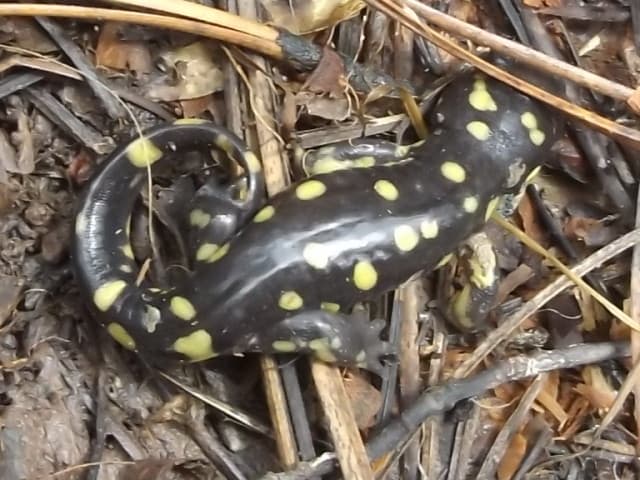
Ambystoma rosaceum
The Tarahumara salamander (Ambystoma rosaceum) is a freshwater mole salamander species endemic to Mexico, found in temperate and montane forests, grasslands, and various aquatic habitats. It is distinguished by its medium size, variable coloration of yellow spots or streaks on a dark background in adults, and the potential for paedomorphosis, where individuals retain larval features. While generally considered Least Concern, it faces threats from habitat loss and introduced species.