
Hemidactylium scutatum
The four-toed salamander, *Hemidactylium scutatum*, is a unique lungless salamander found in eastern North America. It is distinguished by its white, black-dotted belly, elongated body and limbs, and a tail that constricts at the base. This species exhibits specialized defense mechanisms, including tail autotomy and playing dead.
Key Facts
- ›It is the only species in the monotypic genus *Hemidactylium*.
- ›Adults rarely exceed 10 CM (3.9 in) in total length.
- ›Females exhibit both solitary and communal nesting behaviors, with oophagy sometimes observed.
- ›Defense strategies include tail shedding (autotomy), playing dead, and curling with the tail presented.
- ›Its habitat includes sphagnum bogs, grassy areas near beaver ponds, and mossy deciduous or mixed forests.
- ›The posterior limbs possess four toes, a key identification feature.

Four-Toed Salamander
Sphagnum Bogs, Grassy Areas Surrounding Beaver Ponds, Deciduous Or Mixed Forests Rich With Mosses, Terrestrial Habitat For Overwintering
Canada, United States
- White Underbelly Sprinkled With Black Dots
- Back Varies From Orange-Brownish To Red-Brownish
- Grayish Flanks
- Elongated Body and Limbs
- Short Snout
- Prominent Eyes
- Brighter Tail Color Than the Back
- Constriction At the Body/Tail Junction
- Posterior Limbs Have Four Toes
- Juveniles Have A Tail Shorter Than the Body
- Males In Breeding Season Have Enlarged Premaxillary Teeth and Truncated Squarish Snouts
Small Invertebrates, Small Aquatic Crustaceans
- Mating Occurs In Terrestrial Areas During Autumn.
- Females Nest On Land Near Small Ponds In Early Spring.
- Undergoes A Short Aquatic Larval Period .
- Defense Mechanisms Include Tail Autotomy, Playing Dead, and Curling Up With the Tail Presented.
- Can Overwinter In Groups, Sometimes With Other Amphibians.
- Exhibits Solitary Or Communal Nesting Behaviors.
- Oophagy Has Been Reported In Communal Nests.
Bog, Wetland, Forest, Terrestrial
About Hemidactylium scutatum
The Four-Toed Salamander (Hemidactylium scutatum)
The four-toed salamander, scientifically known as Hemidactylium scutatum, is a distinct species of lungless salamander native to the eastern regions of North America. It holds the unique position of being the sole member of its genus, Hemidactylium. Its common name is derived from the fact that its hind limbs possess only four toes, a characteristic that aids in its identification, though it can be difficult to observe in the wild.
Physical Characteristics
This salamander is readily identifiable by its striking white underbelly, which is densely speckled with small black dots. The dorsal side typically ranges in color from orange-brown to red-brown, while its flanks are gray. The body and limbs are notably elongated, contributing to its slender appearance. It features a short snout and prominent eyes. A key distinguishing mark is the constriction found at the junction of the body and its tail, which is often brighter in color than the rest of its back. Adult specimens rarely exceed 10 centimeters (3.9 inches) in length. During the breeding season, which spans from late October to early December, males develop enlarged premaxillary teeth and their snouts become truncated and squarish, contrasting with the rounder snouts of females. Juveniles are characterized by a tail that is shorter than their body.
Habitat and Distribution
The preferred habitats for the four-toed salamander include sphagnum bogs, grassy areas adjacent to beaver ponds, and moist deciduous or mixed forests abundant with mosses. While it utilizes bogs for reproduction, it spends its summer months in forest environments. For overwintering, it retreats to terrestrial habitats, seeking refuge in old burrows or cavities formed by decaying roots, typically below the frost line. It is not uncommon for them to overwinter in groups, sometimes alongside other amphibian species like the red-backed salamander. Geographically, its distribution in Canada encompasses southern Ontario, Quebec, and Nova Scotia, with a single population identified in New Brunswick. In the United States, it is found from Maine westward to Minnesota and extends as far south as Alabama, with occurrences also noted in eastern Kentucky.
Diet and Reproduction
Four-toed salamanders are primarily insectivores, feeding on a variety of small invertebrates such as spiders, worms, ticks, springtails, and ground beetles. Their larvae, however, have a diet consisting of small aquatic crustaceans. Mating takes place on land during the autumn months. In early spring, females lay their eggs on land, typically along the banks of small ponds. Following an embryonic period of approximately four to six weeks, the larvae hatch and migrate to the nearby pond. The aquatic larval stage of the four-toed salamander is relatively short, lasting between three and six weeks, particularly when compared to other species within the same family.
Behavior and Defense
This species exhibits a range of fascinating behaviors, particularly concerning reproduction and defense. Females can nest in one of two ways: solitarily, brooding only their own eggs, or communally, where one female may brood the eggs of two or more other females, sometimes up to fourteen. Communal nesting is quite common, with roughly one-third of nests being joint ventures and a significant majority of females opting to lay their eggs in these shared nests annually. Oophagy, where a female consumes eggs from another female before laying her own in a communal nest, has also been documented. When faced with predators, the four-toed salamander employs three main defense strategies. The first is tail autotomy, where it deliberately sheds its tail, which continues to wiggle, distracting the predator and allowing the salamander to escape. The second is thanatosis, or playing dead, where it thrashes violently for a short period and then freezes until the threat has passed. The third defense involves curling into a ball and presenting its tail to the predator.
Source: Wikipedia ↗
Frequently Asked Questions
What are the key physical characteristics of the four-toed salamander?
The four-toed salamander is recognized by its white belly marked with black dots, an orange-brown to red-brown back, and grayish flanks. It has an elongated body and limbs, prominent eyes, and a short snout. A distinctive feature is the constriction at the junction of the body and tail, and its posterior limbs have four toes.
How does the four-toed salamander defend itself from predators?
This salamander employs three primary defense mechanisms. It can shed its tail, which continues to wiggle to distract predators, allowing the salamander to escape. It also practices thanatosis, or 'playing dead,' by thrashing briefly and then remaining motionless until the threat passes. Finally, it can curl into a ball, presenting its tail as a sacrifice.
Where is the four-toed salamander found?
The four-toed salamander is native to eastern North America. Its range extends from Maine to Minnesota in the United States, south to Alabama, and includes parts of southern Ontario, Quebec, and Nova Scotia in Canada.
What is the diet of the four-toed salamander?
Adult four-toed salamanders primarily consume small invertebrates such as spiders, worms, ticks, springtails, and other insects. The larval stage feeds on small aquatic crustaceans.
What are the nesting behaviors of the four-toed salamander?
Female four-toed salamanders exhibit solitary nesting, brooding only their own eggs, or communal nesting, where one female broods the eggs of multiple females, sometimes including up to 14 others. Oophagy, where a female eats the eggs of another before laying her own, has also been documented in communal nests.
What is the conservation status of the four-toed salamander?
The four-toed salamander is generally considered a species of least concern by the IUCN due to its wide distribution and assumed large population. However, it is listed as rare or at risk in specific Canadian provinces like Quebec and in certain U.S. states such as Illinois, Wisconsin, Ohio, and Missouri.
Related Salamander and Newt species
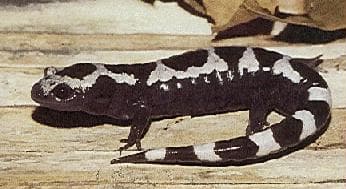
Ambystoma opacum
The marbled salamander (Ambystoma opacum) is a stout, terrestrial salamander found in the eastern United States, distinguished by its striking black and white banded pattern. Females typically have light gray bands, while males exhibit bright white bands, with males also possessing a larger proportion of white on their dorsal surface. This species spends most of its life under logs or in burrows and relies on seasonally flooded areas for breeding.

Eastern red-spotted newt
The eastern newt, scientifically known as Notophthalmus viridescens, is a common amphibian found across eastern North America. This species is distinctive for its three distinct life stages: an aquatic larva, a terrestrial "red eft" juvenile phase, and an aquatic adult form. They are known for producing tetrodotoxin, a potent toxin that deters predators.

Aneides lugubris
The arboreal salamander (Aneides lugubris) is a species of climbing salamander native to California and Baja California. It is distinguished by its prehensile tail, sharp teeth, and unique arboreal adaptations, including gliding behavior when falling from trees. This lungless salamander is primarily nocturnal and insectivorous, inhabiting oak and sycamore woodlands and chaparral.