
Kızören Sinkhole
The Kızören Sinkhole, also known as Kızören Obruğu or Lake Kızören, is a significant karst formation in central Turkey containing a lake. It is notable for its considerable dimensions and its role as the sole source of fresh water for the local community, a fact underscored by the installation of a pump by the State Water Institute. The sinkhole is also a historical site, with evidence of human activity dating back to the Seljuk Empire and the presence of the Obruk Han, a caravanserai that served the Silk Road.
Key Facts
- ›Dimensions: 180 meters long, 150 meters wide, and up to 145 meters deep.
- ›Located 65 km northeast of Konya in central Turkey.
- ›Serves as the only freshwater source for human use in the vicinity.
- ›Features a pump installed by the State Water Institute (DSI) for local water supply.
- ›The nearby Obruk Han, a caravanserai, dates back to the Byzantine era and served the Silk Road.
- ›It is currently the largest sinkhole in Turkey and attracts domestic and international tourism.

Kızören Obruğu, Lake Kızören
Karst Lake, Sole Source of Freshwater, Largest Sinkhole In Turkey, Historical Caravanserai
Freshwater
About Kızören Sinkhole
The Kızören Sinkhole, also referred to as Kızören Obruğu or Lake Kızören, is a prominent geological formation located in the Central Anatolian steppes of Turkey, approximately 65 kilometers northeast of the city of Konya.
Geological Significance
This sinkhole is a type of karst lake, characterized by its substantial dimensions: it spans 180 meters in length, 150 meters in width, and descends to a depth of up to 145 meters. The Turkish term 'obruk' describes vertical depressions formed by karstification, involving both downward infiltration and upward evaporation. Kızören Sinkhole is of particular ecological importance as it serves as the sole source of fresh water for human consumption in its immediate vicinity. Recognizing this vital role, the State Water Institute (DSI) has installed a pump to ensure the local community's access to this essential resource.
Historical Context and Tourism
The area surrounding the Kızören Sinkhole has a rich human history, with settlements dating back to before 7500 BC, including the Neolithic site of Çatalhöyük. Human activity around the lake itself is documented from the Seljuk Empire period. The village of Obruk derives its name from the sinkhole, highlighting its central place in local geography. A significant historical structure, the Obruk Han, a caravanserai likely built during the Byzantine era (circa 1245–1250 AD) and later utilized under Ottoman rule, stands just 30 meters from the lake. The Han's dimensions suggest its importance as a stopping point along the Silk Road.
Today, the Kızören Sinkhole continues to be a point of interest, attracting both domestic and international tourists. Its status as the largest sinkhole in Turkey, combined with its historical context and natural beauty, makes it a notable destination.
Source: Wikipedia ↗
Frequently Asked Questions
What is an 'obruk'?
In Turkish, 'obruk' refers to a vertical depression or shaft found in karst landscapes. These formations are created by two karstification processes: downward infiltration from the surface and upward evaporation from underground cavities.
Where is the Kızören Sinkhole located?
The Kızören Sinkhole is situated in the center of the Central Anatolian steppes, approximately 65 km northeast of the city of Konya in central Turkey.
What are the dimensions of the Kızören Sinkhole?
The sinkhole measures 180 meters in length, 150 meters in width, and reaches a maximum depth of up to 145 meters.
Is the water in the Kızören Sinkhole used by the local community?
Yes, the Kızören Sinkhole is the only source of fresh water for human use in the surrounding area. The State Water Institute (DSI) has installed a pump to provide this water to the local community.
What historical structures are near the Kızören Sinkhole?
The remains of the Obruk Han, a caravanserai, are located about 30 meters from the lake. This inn was likely constructed during the Byzantine era and continued to operate under Ottoman rule, indicating the site's importance on the Silk Road.
Why is the Kızören Sinkhole significant in Turkey?
The Kızören Sinkhole is currently recognized as the largest sinkhole in Turkey. Its unique geological features and its role as a vital water source contribute to its significance.
Related Sinkholes
Cennet and Cehennem
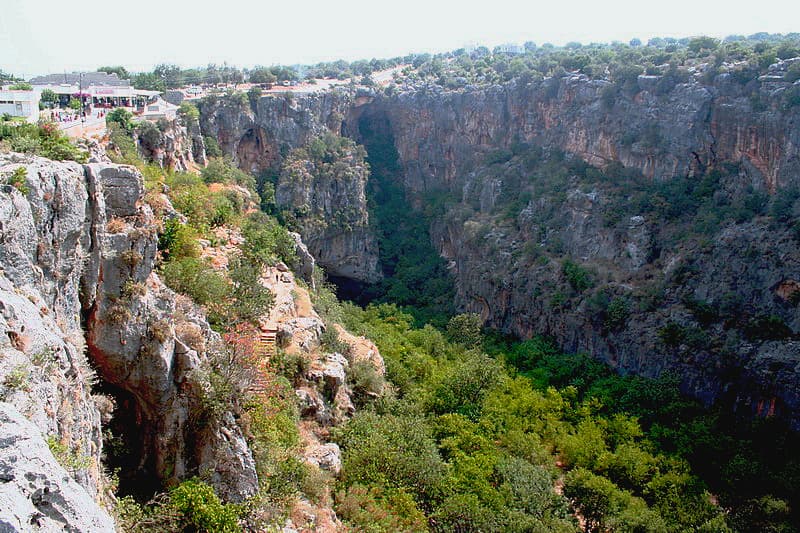
Cennet and Cehennem are two large, adjacent sinkholes located in the Taurus Mountains of Mersin Province, Turkey. Cennet, or 'Heaven,' features a large opening and a staircase leading to ruins of a 5th-century monastery, while Cehennem, or 'Hell,' is a deeper, narrower sinkhole with no access to its bottom. They are significant geological formations and tourist attractions, with mythological associations to the Greek god Zeus.
Kanlıdivane
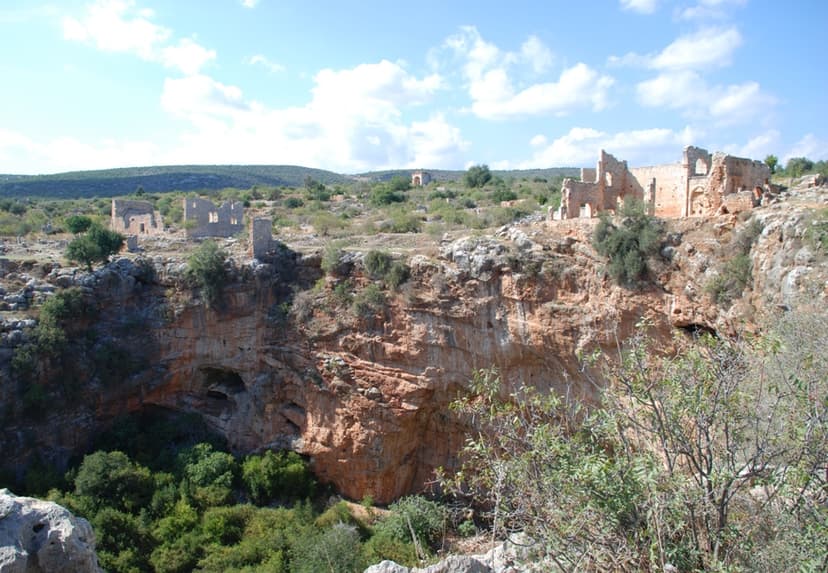
Kanlıdivane is an ancient city site in Mersin Province, Turkey, built around a large sinkhole. Historically known as Canytelis, the site features ruins from various periods, including the Olba Kingdom, Roman, and Byzantine eras, and is notable for its dramatic geological formation and its use as a concert venue.

Akhayat sinkhole
The Akhayat sinkhole, also known as Aşağı Dünya Obruğu, is a significant geological formation located in Mersin Province, Turkey. It is notable for its substantial dimensions and the presence of ancient man-made features, suggesting a historical connection to human activity and potentially a cultic site.