
Lake Guinas
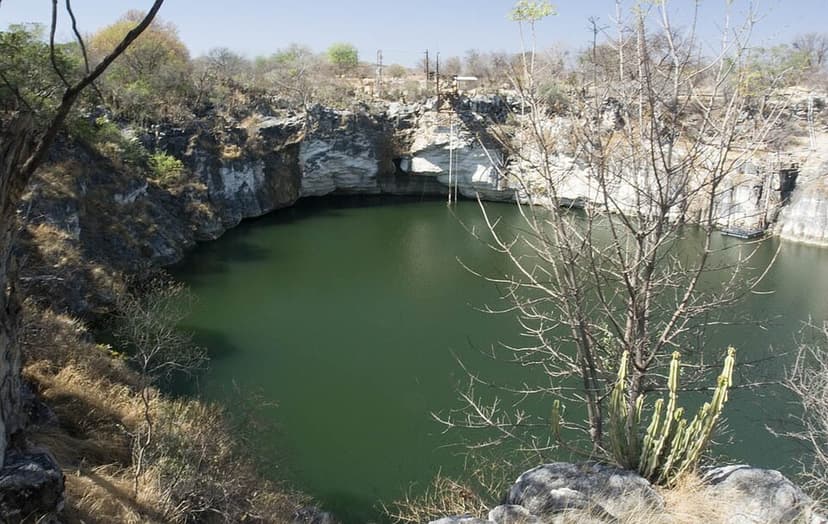
Lake Guinas is a significant geological feature in Namibia, being one of only two permanent natural lakes in the country. It is a sinkhole lake formed by a collapsing karst cave, notable for its impressive depth and for being the sole natural habitat of the critically endangered cichlid fish, Tilapia guinasana. Its unique ecosystem and geological formation make it a site of scientific interest.
Key Facts
- ›It is one of only two permanent natural lakes in Namibia.
- ›The lake is a sinkhole formed by a collapsing karst cave.
- ›It has a maximum depth of 133 meters (435 ft).
- ›The lake's dimensions near the bottom are approximately 300 meters (1,000 ft) long and 175 meters (575 ft) wide.
- ›It is the natural habitat of the critically endangered cichlid fish, Tilapia guinasana.

Endemic Tilapia Guinasana Fish Species, Deep Sinkhole Structure
Freshwater
Tilapia Guinasana
About Lake Guinas
Lake Guinas is a geologically significant sinkhole lake located in Namibia. It holds the distinction of being one of only two permanent natural lakes in the entire country. Its formation is attributed to the collapse of a karst cave, creating a deep and substantial body of water.
Geological Significance and Dimensions
The lake's dimensions are notable, measuring approximately 300 meters (1,000 ft) in length and 175 meters (575 ft) in width near its bottom. Its maximum recorded depth is an impressive 133 meters (435 ft), highlighting the scale of the subterranean collapse that formed it. The geological conditions that led to its creation are characteristic of karst topography, where soluble rocks like limestone are dissolved by water, leading to cave formation and eventual surface collapse.
Unique Ecosystem
Lake Guinas is critically important for its unique and endangered biodiversity. It serves as the exclusive natural habitat for Tilapia guinasana, a species of cichlid fish found nowhere else on Earth. While this endemic fish has been introduced to the nearby Lake Otjikoto and some farm dams, Lake Guinas remains its primary natural sanctuary. The lake's underwater caverns were explored in 2019 by the Sunfish autonomous underwater vehicle, contributing to scientific understanding of its environment.
Location and Access
Situated thirty-eight kilometers west of Tsumeb, Lake Guinas lies on private farmland. Access to the lake is permitted with the consent of the landowner, making it a site that requires specific arrangements for visitation. While not a formally developed tourist attraction, its unique status as a permanent natural lake and its endemic species make it a point of interest for those interested in Namibia's natural wonders and geological formations.
Source: Wikipedia ↗
Frequently Asked Questions
What is Lake Guinas?
Lake Guinas is one of only two permanent natural lakes in Namibia. It is a sinkhole lake, meaning it was formed by the collapse of a karst cave.
Where is Lake Guinas located?
Lake Guinas is located approximately thirty-eight kilometers west of Tsumeb in Namibia, situated on private farmland near the D3043 road.
What are the dimensions of Lake Guinas?
The lake measures about 300 meters (1,000 ft) in length and 175 meters (575 ft) in width near its bottom. Its maximum recorded depth is 133 meters (435 ft).
What is unique about the wildlife in Lake Guinas?
Lake Guinas is the endemic home to Tilapia guinasana, a species of cichlid fish that is critically endangered. This fish has also been introduced to its sister lake, Lake Otjikoto, and some farm dams.
Can Lake Guinas be visited?
The lake is situated on private farmland and can be visited with the permission of the owner.
Has Lake Guinas been explored?
Yes, the lake and its underwater caverns were surveyed in 2019 using the Sunfish autonomous underwater vehicle.
Related Sinkholes
Otjikoto Lake
Otjikoto Lake is one of only two permanent natural lakes in Namibia, formed by a collapsing karst cave. It is notable for its significant depth, historical use as a dumping ground for German troops during World War I, and its unique ecosystem. The lake's name has evolved from the San's "Gaisis" to the Herero's "Otjikoto" (deep hole), which also lent its name to the surrounding region.

Blue Lake
Blue Lake is a significant karst sinkhole located near Imotski, Croatia. It is known for its dramatic seasonal water level fluctuations and its considerable depth, potentially formed by the collapse of a large cave. The lake is a popular site for tourism and outdoor activities.

Kızören Sinkhole
The Kızören Sinkhole, also known as Kızören Obruğu or Lake Kızören, is a significant karst formation in central Turkey containing a lake. It is notable for its considerable dimensions and its role as the sole source of fresh water for the local community, a fact underscored by the installation of a pump by the State Water Institute. The sinkhole is also a historical site, with evidence of human activity dating back to the Seljuk Empire and the presence of the Obruk Han, a caravanserai that served the Silk Road.