
Araneidae
Most species are web builders, constructing spiral orb webs to trap prey. Some species employ unique strategies like using sticky globules with pheromones.
The Araneidae, commonly known as orb-weaver spiders, are a widespread family of spiders renowned for constructing distinctive spiral wheel-shaped webs. Found globally, these spiders are characterized by their eight eyes, hairy or spiny legs, and the absence of stridulating organs. With nearly 5,000 described species, they represent one of the largest spider families, playing a significant role in controlling insect populations.
Key Facts
- ›Araneidae are characterized by their construction of spiral, wheel-shaped orb webs.
- ›The family is cosmopolitan, found in gardens, fields, and forests worldwide.
- ›They possess eight similar eyes, hairy or spiny legs, and lack stridulating organs.
- ›Araneid webs are built in a specific sequence, beginning with a non-sticky framework and ending with a sticky spiral capture silk.
- ›Many species exhibit extreme sexual size dimorphism, with females significantly larger than males.
- ›Some Araneidae species are known for sexual cannibalism, where the female consumes the male after mating.

Orb-Weaver Spiders
Cosmopolitan
Eight Similar Eyes, Hairy Or Spiny Legs, Absence of Stridulating Organs, Construction of Spiral Wheel-Shaped Webs
- Many Build A New Web Each Day.
- Tend To Be Active During the Evening.
- Consume Their Old Web Before Spinning A New One.
- Some Species Exhibit Social Or Communal Living Within Large Webs.
- Some Species Engage In Sexual Cannibalism.
- Males May Use Vibratory Courtship To Attract Females.
About Araneidae
Araneidae: The Orb-Weaver Spiders
The Araneidae family, commonly known as orb-weaver spiders, encompasses a vast and diverse group of arachnids recognized globally for their signature spiral, wheel-shaped webs. These spiders are prevalent in numerous terrestrial habitats, including gardens, fields, and forests, where their intricate constructions are frequently observed.
Description and Characteristics
Araneids are characterized by having eight similar eyes, hairy or spiny legs, and lacking stridulating organs, which are used for sound production in some other spider groups. The family is one of the largest, with nearly 5,000 described species distributed across approximately 200 genera worldwide. Their webs are a marvel of natural engineering, typically built in a specific sequence: a non-sticky framework is established first, followed by radial threads, and finally, a spiral of sticky silk embedded with droplets designed to ensnare prey.
Habitat and Distribution
With a cosmopolitan distribution, Araneidae spiders are found on every continent except Antarctica. They thrive in environments that offer suitable anchor points for their webs, ranging from vegetation in forests and fields to human structures in gardens and urban areas.
Hunting and Diet
The primary hunting strategy for most Araneidae is the construction of their orb webs to passively capture flying insects. When an insect blunders into the sticky capture silk, it is quickly subdued by a bite and then wrapped in silk for later consumption. While most species rely on their webs, some, like the bolas spiders, employ specialized methods, using sticky, pheromone-laced globules to attract specific prey, primarily male moths.
Reproduction and Life Cycle
Reproduction in Araneidae often involves elaborate courtship rituals. Males typically approach females cautiously, sometimes using vibrations on the web to signal their presence and avoid being mistaken for prey. Sexual cannibalism, where the female consumes the male after mating, is a notable behavior in many species, particularly those with extreme sexual size dimorphism. This dimorphism, where females are significantly larger than males, is thought to be an adaptation related to fecundity and reproductive success.
Significance and Adaptations
Orb webs have proven to be highly effective predatory tools, allowing orbicularian spiders to become dominant predators of aerial insects in many ecosystems. The ability of their webs to absorb the impact of flying prey has been a significant factor in their evolutionary success. Some species have developed unique adaptations such as stabilimenta, specialized bands of silk in the web that may serve as lures, warnings to birds, or camouflage for the spider. The diversity within the Araneidae family, from the spiny orb-weavers resembling plant seeds to the communal web-builders, highlights their remarkable adaptability and ecological importance.
Source: Wikipedia ↗
Frequently Asked Questions
What defines an orb-weaver spider?
Orb-weaver spiders, belonging to the family Araneidae, are defined by their characteristic construction of spiral, wheel-shaped webs. These webs are a key feature and are commonly found in various natural environments.
Where are Araneidae spiders found?
The Araneidae family has a cosmopolitan distribution, meaning they are found across the globe. They inhabit diverse environments such as gardens, fields, and forests.
How do Araneidae spiders build their webs?
The construction of an orb web is a precise process. It begins with a non-sticky framework, followed by radial threads, and culminates in a spiral of sticky silk designed to capture prey.
Do all Araneidae spiders build webs?
No, not all Araneidae spiders are web-builders. Some species, like the bolas spiders, use sticky globules containing pheromones to attract and capture prey instead of constructing a traditional orb web.
What is sexual size dimorphism in Araneidae?
Sexual size dimorphism refers to the significant physical differences in size between male and female orb-weaver spiders. In many Araneidae species, females are considerably larger than males, a trait often linked to reproductive success.
What is sexual cannibalism in Araneidae?
Sexual cannibalism is a behavior observed in some Araneidae species where the female consumes the male, typically after or during mating. This phenomenon is often linked to sexual size dimorphism and mating strategies.
Are Araneidae spiders dangerous to humans?
While Araneidae spiders are venomous, their venom is generally not considered medically significant to humans. Bites are typically not a cause for serious concern, though reactions can vary.
Related Spider species

Deinopidae
Deinopidae, commonly known as net-casting spiders, are a family of circumtropical cribellate spiders recognized for their unique hunting strategy. These stick-like spiders catch prey by stretching a specialized web between their front legs and then propelling themselves forward, entangling their victims. Their exceptional night vision, facilitated by large posterior median eyes, allows them to hunt effectively in low-light conditions.
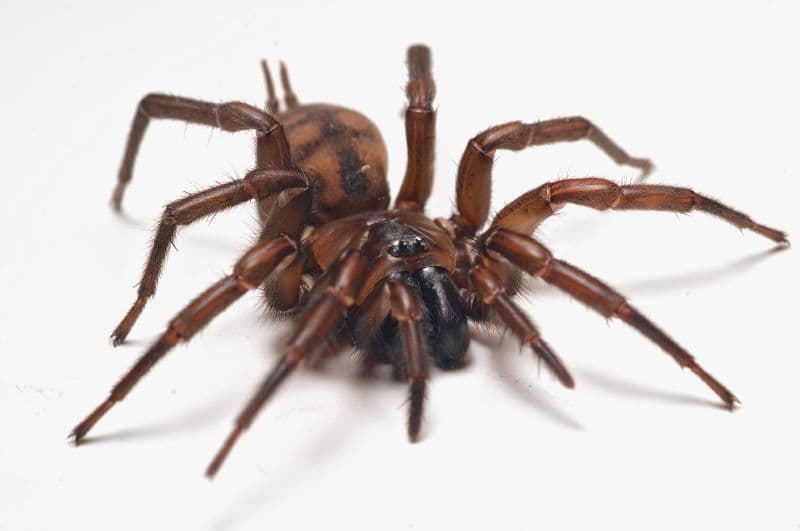
Hexathelidae
Hexathelidae is a family of mygalomorph spiders, commonly referred to as tunnelweb or funnel-web spiders. These spiders are characterized by their medium to large size, dark coloration, and powerful chelicerae and fangs. Historically, the family was much larger, but in 2018, several genera were moved to new families, significantly reducing its scope.

Scytodidae
Scytodidae, commonly known as spitting spiders, are a family of araneomorph spiders distinguished by their unique hunting method of spitting a venomous, sticky fluid to immobilize prey. These spiders are typically found in ground and plant habitats across various biomes and are known for their nocturnal activity.