
Hexathelidae
Hexathelids are web builders that construct funnel-shaped webs. They remain in the narrow end of the funnel and ambush prey that enters their web.
Hexathelidae is a family of mygalomorph spiders, commonly referred to as tunnelweb or funnel-web spiders. These spiders are characterized by their medium to large size, dark coloration, and powerful chelicerae and fangs. Historically, the family was much larger, but in 2018, several genera were moved to new families, significantly reducing its scope.
Key Facts
- ›Hexathelidae spiders are medium to large, with body lengths between 1 to 5 CM.
- ›They are typically darkly colored, ranging from black to brown, with a glossy carapace.
- ›These spiders construct burrows in the ground or tree hollows, often with an elaborately constructed entrance.
- ›They build funnel-shaped webs to trap prey and are most active at night.
- ›Hexathelids are found in Australia, New Zealand, Argentina, and Chile.
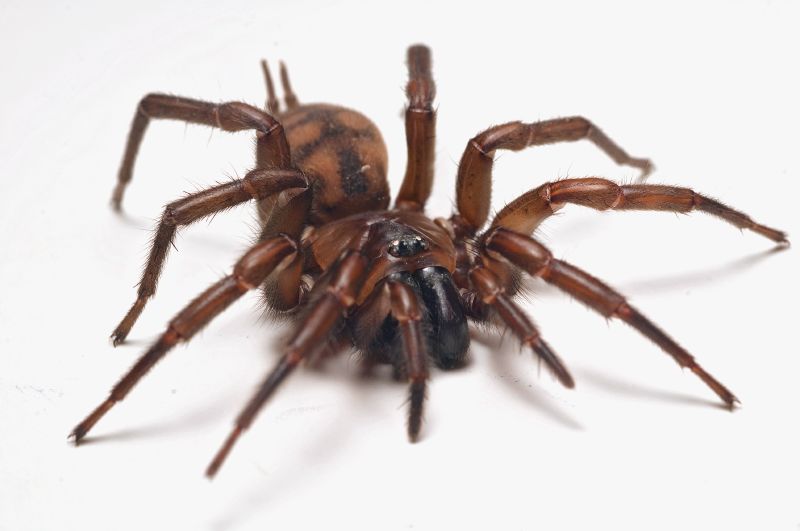
Tunnelweb Spiders, Funnel-Web Spiders
Australia, New Zealand, Argentina, Chile
- Long Spinnerets
- Fangs That Point Straight Down and Do Not Cross
- Large and Powerful Chelicerae and Fangs
Construct Burrows, Most Active At Night, Lurk For Prey In Funnel Webs
About Hexathelidae
Hexathelidae is a family of mygalomorph spiders that are commonly known as tunnelweb or funnel-web spiders. These arachnids are recognized for their medium to large size, typically ranging from 1 to 5 centimeters in body length, and their distinctive dark coloration, which varies from black to brown, often complemented by a glossy carapace. A significant taxonomic revision occurred in 2018, leading to the relocation of several genera to new families, thereby reducing the scope of the Hexathelidae family.
Description and Anatomy
The body of Hexathelidae spiders is generally three times longer than it is wide. They possess generally long spinnerets, a characteristic shared with related diplurid spiders, which contributed to their historical classification within that family. Like all Mygalomorphae, their fangs point downwards and do not cross, and they have substantial venom glands situated entirely within their powerful chelicerae. Their chelicerae and fangs are notably large and robust.
Distribution and Habitat
Hexathelidae spiders are found in the Southern Hemisphere, with five of their seven genera inhabiting Australia and New Zealand, and two genera originating from Argentina and Chile in South America. Their preferred habitat involves constructing burrows, which can be situated in the ground or within tree hollows. These burrows often feature an elaborately constructed entrance. They are commonly found seeking nesting sites under human dwellings, or beneath nearby rocks, logs, and similar objects. These spiders exhibit a preference for cooler climates, leading to their prevalence in rainforests in Australia, where they inhabit both the soil and tree hollows. Some species construct their burrows entirely in sand.
Behavior and Hunting
Hexathelidae spiders are primarily nocturnal, meaning they are most active during the night. They are known for constructing funnel-shaped webs, from which they derive their common name. These spiders lurk in the narrow end of the funnel, waiting to ambush prey that enters their web. Their hunting strategy relies on the construction of these specialized webs to capture their food, which typically consists of insects and other small invertebrates.
Source: Wikipedia ↗
Frequently Asked Questions
What are Hexathelidae spiders?
Hexathelidae spiders are a family of mygalomorph spiders, often known by the common names tunnelweb or funnel-web spiders. They are characterized by their size, dark coloration, and burrowing habits.
Where do Hexathelidae spiders live?
Their distribution includes Australia, New Zealand, Argentina, and Chile. They typically inhabit burrows dug into the ground or found within tree hollows, and are often found under human dwellings, rocks, or logs.
What do Hexathelidae spiders eat?
These spiders are predators that construct funnel-shaped webs. They lurk in the narrow end of the funnel, waiting for unsuspecting prey, which generally consists of insects and other small invertebrates that wander into their web.
Are Hexathelidae spiders venomous?
Yes, Hexathelidae spiders possess ample venom glands within their chelicerae, and their fangs are large and powerful. While the text states they are venomous, it does not specify the effects of their venom on humans or if it is medically significant.
What is the size of Hexathelidae spiders?
Hexathelidae spiders are considered medium to large, with body lengths typically ranging from 1 to 5 centimeters (0.5 to 2 inches). Their bodies are generally about three times longer than they are wide.
Related Spider species

Deinopidae
Deinopidae, commonly known as net-casting spiders, are a family of circumtropical cribellate spiders recognized for their unique hunting strategy. These stick-like spiders catch prey by stretching a specialized web between their front legs and then propelling themselves forward, entangling their victims. Their exceptional night vision, facilitated by large posterior median eyes, allows them to hunt effectively in low-light conditions.

Araneidae
The Araneidae, commonly known as orb-weaver spiders, are a widespread family of spiders renowned for constructing distinctive spiral wheel-shaped webs. Found globally, these spiders are characterized by their eight eyes, hairy or spiny legs, and the absence of stridulating organs. With nearly 5,000 described species, they represent one of the largest spider families, playing a significant role in controlling insect populations.

Scytodidae
Scytodidae, commonly known as spitting spiders, are a family of araneomorph spiders distinguished by their unique hunting method of spitting a venomous, sticky fluid to immobilize prey. These spiders are typically found in ground and plant habitats across various biomes and are known for their nocturnal activity.