
Scytodidae
Spitting a venomous and sticky fluid that congeals on contact to immobilize and envenom prey, followed by a bite and silk wrapping.
Scytodidae, commonly known as spitting spiders, are a family of araneomorph spiders distinguished by their unique hunting method of spitting a venomous, sticky fluid to immobilize prey. These spiders are typically found in ground and plant habitats across various biomes and are known for their nocturnal activity.
Key Facts
- ›Spitting spiders belong to the family Scytodidae, described by John Blackwall in 1864.
- ›They possess a unique hunting technique involving spitting a congealed, venomous, and sticky mass to capture prey.
- ›These spiders have six eyes arranged in three pairs and a dome-shaped cephalothorax.
- ›Scytodidae are ground and plant dwellers, typically active at night.
- ›The family comprises over 250 species across four genera, with Scytodes being the most recognized.
- ›Some species exhibit presocial behavior, where adults assist in feeding the young.

Spitting Spiders
Six Eyes Arranged In Three Pairs, Dome-Shaped Cephalothorax, Ability To Spit A Venomous, Sticky Fluid
Free-Running, Nocturnal, Presocial Behavior In Some Species
About Scytodidae
Scytodidae: The Spitting Spiders
Scytodidae, more commonly known as spitting spiders, constitute a distinct family of araneomorph spiders. First described in 1864, this family is notable for its unique method of capturing prey. They are found globally in various habitats and are characterized by their specialized hunting technique, their physical attributes, and their nocturnal lifestyle.
Description and Hunting Technique
Spitting spiders are haplogyne, meaning they lack hardened female genitalia. A defining characteristic is their possession of six eyes, arranged in three pairs, unlike the typical eight found in many spider families. They have long legs and a dome-shaped cephalothorax, with coloration usually ranging from yellow to light brown, often adorned with black spots or markings. Their most remarkable feature is their hunting strategy: they spit a fluid that congeals upon contact, forming a sticky and venomous mass. This fluid, produced in their chelicerae, contains both venom and liquid silk. The spider typically strikes from a short distance, launching a rapid criss-crossed pattern of this substance to immobilize and envenom prey, such as silverfish. After capture, they often deliver a venomous bite and wrap the prey in silk spun from their spinnerets.
Habitat and Behavior
These spiders are ground and plant dwellers, preferring to live freely rather than constructing elaborate webs for capture. They are typically found in all biomes, inhabiting vegetation, areas under stones, and other dark terrestrial locations. Spitting spiders are primarily nocturnal, exhibiting their activity during the night. Interestingly, some species demonstrate presocial behavior, where mature spiders live communally and even assist younger spiders with food, a trait not commonly observed in the spider world.
Diversity
The Scytodidae family includes over 250 species, organized into four genera. The genus Scytodes is the most well-known and contains the majority of the described species. While specific geographic distributions are not detailed, their presence across various biomes suggests a wide natural range.
Source: Wikipedia ↗
Frequently Asked Questions
What makes spitting spiders unique?
Spitting spiders are unique because they hunt by spitting a fluid that hardens on contact, immobilizing and envenoming their prey. This fluid is a combination of venom and liquid silk produced in their chelicerae.
How do spitting spiders hunt?
They hunt by spitting a venom-laced silk fluid from their chelicerae, which congeals on contact. This rapid attack immobilizes prey like silverfish. They then typically bite the prey and wrap it in silk.
What is the typical habitat of Scytodidae?
Scytodidae spiders are ground and plant dwellers. They are found in various biomes, often collected from vegetation, under stones, and in dark places on the soil surface.
Are spitting spiders venomous?
Yes, spitting spiders are venomous. The fluid they spit contains venom that helps to immobilize their prey.
What do spitting spiders eat?
Their diet primarily consists of small insects and other invertebrates. They are known to prey on creatures such as silverfish, which they immobilize with their spitting technique.
When are spitting spiders most active?
Spitting spiders are nocturnal, meaning they are primarily active during the night.
How many eyes do spitting spiders have?
Spitting spiders typically have six eyes, arranged in three pairs.
Related Spider species

Araneidae
The Araneidae, commonly known as orb-weaver spiders, are a widespread family of spiders renowned for constructing distinctive spiral wheel-shaped webs. Found globally, these spiders are characterized by their eight eyes, hairy or spiny legs, and the absence of stridulating organs. With nearly 5,000 described species, they represent one of the largest spider families, playing a significant role in controlling insect populations.

Deinopidae
Deinopidae, commonly known as net-casting spiders, are a family of circumtropical cribellate spiders recognized for their unique hunting strategy. These stick-like spiders catch prey by stretching a specialized web between their front legs and then propelling themselves forward, entangling their victims. Their exceptional night vision, facilitated by large posterior median eyes, allows them to hunt effectively in low-light conditions.
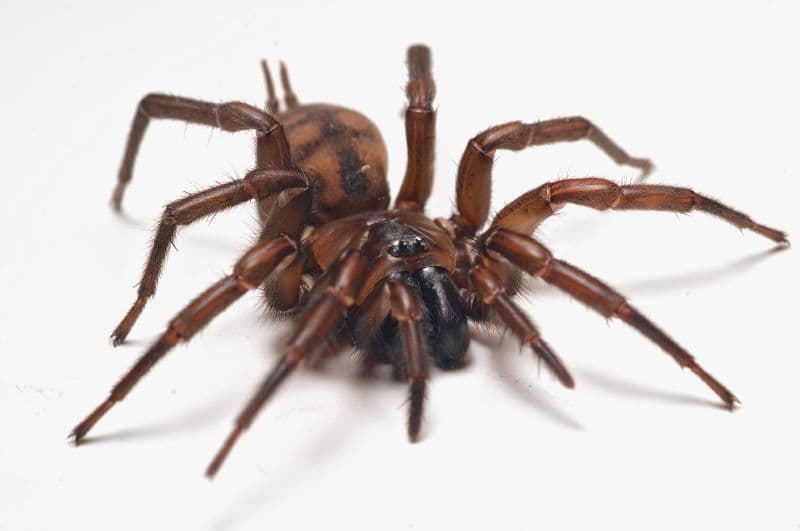
Hexathelidae
Hexathelidae is a family of mygalomorph spiders, commonly referred to as tunnelweb or funnel-web spiders. These spiders are characterized by their medium to large size, dark coloration, and powerful chelicerae and fangs. Historically, the family was much larger, but in 2018, several genera were moved to new families, significantly reducing its scope.