
Archaeidae
Assassin spiders use their elongated jaws and necks to catch their prey, which are other spiders.
Archaeidae, commonly known as assassin spiders or pelican spiders, are a family of small spiders found in South Africa, Madagascar, and Australia. They are distinguished by their elongated jaws and necks, which they use to prey exclusively on other spiders. The family's fossil record dates back to the Middle Jurassic, with living species first discovered in 1881.
Key Facts
- ›Prey exclusively on other spiders.
- ›Possess distinctive elongated jaws and necks.
- ›Found in South Africa, Madagascar, and Australia.
- ›Fossil record extends to the Middle Jurassic period.
- ›Range in size from 2 to 8 millimeters.

Assassin Spiders, Pelican Spiders
South Africa, Madagascar, Australia
Elongated Jaws, Elongated Necks
Specialized Predators
About Archaeidae
Archaeidae, often referred to as assassin spiders or pelican spiders, represent a distinctive family of arachnids, comprising approximately ninety described species across five genera. These spiders are notably small, with individuals ranging from 2 to 8 millimeters in body length. Their most striking characteristic is their specialized anatomy, featuring elongated jaws and necks, which they employ for their unique predatory lifestyle: they exclusively hunt and feed on other spiders.
Distribution and Discovery
Living representatives of the Archaeidae family are found in the southern hemisphere, specifically in South Africa, Madagascar, and Australia. The family's evolutionary history is substantial, with fossil evidence dating back to the Middle Jurassic period. The earliest known fossil of the group is Patarchaea muralis, discovered in China and dating to the Oxfordian/Callovian stages of the Middle Jurassic. More recent fossil discoveries include species found in Eocene Baltic amber and Cretaceous Burmese amber, such as Burmesarchaea grimaldii. The existence of living species was not recognized until 1881, when the first living assassin spider was collected in Madagascar, long after fossil specimens from European amber had been studied since the 1840s.
Taxonomy and Phylogeny
The family Archaeidae was formally established in 1854 by C. L. Koch and G. K. Berendt, initially encompassing the extinct genus Archaea, based on specimens found in amber. While many fossil taxa from these early deposits have since been reassigned to other families, valid species like Archaea levigata and Archaea paradoxa are recognized from Baltic amber. Phylogenetic analyses, combining molecular and morphological data, have explored the relationships within the family, revealing insights into the evolutionary connections between modern genera and their ancient fossil relatives. The fossil species Burmesarchaea grimaldii from Burmese amber appears to be basal to the modern genera, suggesting an ancient lineage.
Physical Characteristics and Behavior
The defining physical traits of Archaeidae are their elongated jaws and necks, which vary in length from slender to thick depending on the species. These structures are integral to their method of capturing prey. Their diet is highly specialized, consisting solely of other spiders. While venomous, their venom is not considered medically significant to humans. The family is not known to build webs for prey capture, relying instead on active hunting strategies facilitated by their unique morphology.
Source: Wikipedia ↗
Frequently Asked Questions
What are assassin spiders?
Assassin spiders, also known as pelican spiders, are a family of small spiders that have a unique hunting strategy. They are characterized by their elongated jaws and necks, which they use to capture other spiders.
Where do Archaeidae spiders live?
Living species of Archaeidae are found in South Africa, Madagascar, and Australia. Their extinct relatives have been found in fossilized amber deposits in Europe and Asia.
What makes pelican spiders distinctive?
Pelican spiders are easily recognized by their elongated jaws and necks, which give them a unique appearance. These features are crucial for their specialized predatory behavior.
What do Archaeidae spiders eat?
Archaeidae spiders have a very specialized diet, preying exclusively on other spiders. They use their elongated mouthparts to capture and consume their prey.
How old is the fossil record of Archaeidae?
The fossil record of Archaeidae is extensive, with the oldest known fossil dating back to the Middle Jurassic period. Fossils have also been found in Eocene Baltic amber and Cretaceous Burmese amber.
Related Spider species
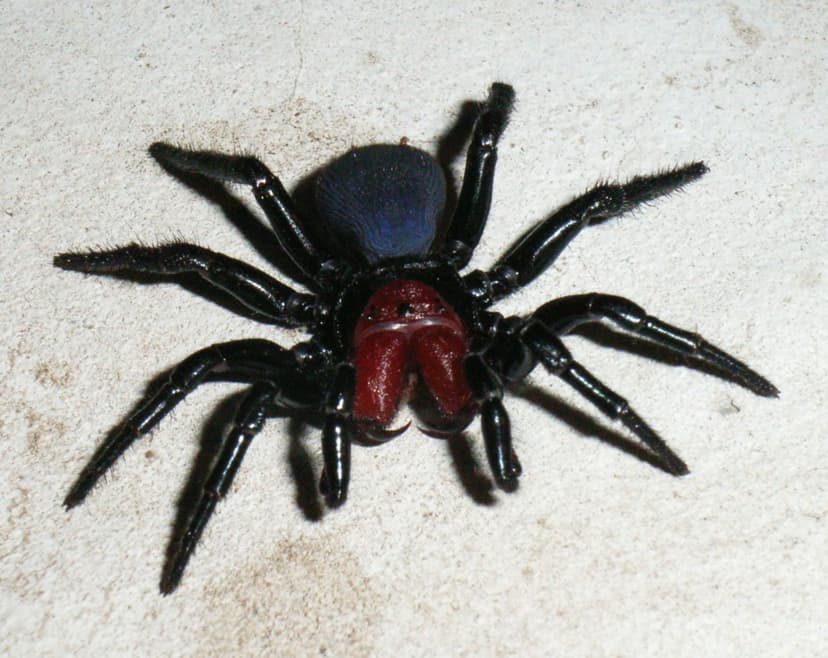
Actinopodidae
Actinopodidae is a family of mygalomorph spiders native to mainland Australia and South America, typically inhabiting open forests. This family includes the mouse spiders (Missulena species), which are notable for their medically significant and potentially dangerous bites.

Agelenidae
The Agelenidae, commonly known as funnel weavers, are a large family of spiders found globally. They are distinguished by their fast running speeds and the construction of flat sheet webs with a funnel-shaped retreat. While most species are solitary, some African species exhibit parasocial behavior, living in communal webs.
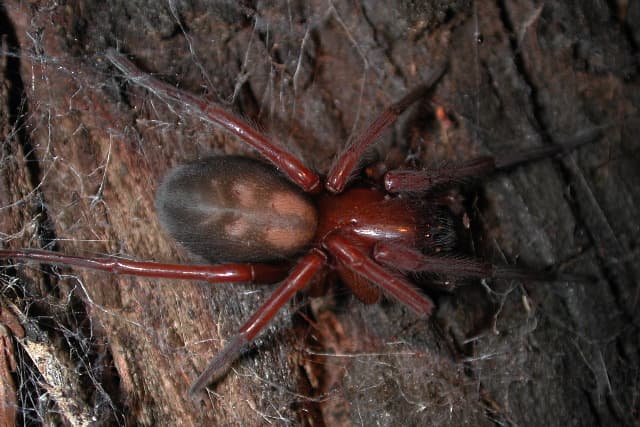
Amaurobiidae
Amaurobiidae is a family of spiders characterized by their three-clawed feet and the presence of either a cribellum or its absence. These spiders are typically found in crevices, hollows, or under stones, where they construct retreats and are often captured in pitfall traps. While widespread, they can be challenging to distinguish from closely related spider families.