
Atypidae
Ambush predator utilizing a silken purseweb tube to capture prey.
Atypidae, also known as atypical tarantulas or purseweb spiders, is a family of spiders renowned for their sophisticated ambush hunting techniques. These spiders construct unique silken retreats, often described as sock-like or purse-like tubes, from which they capture their prey. They are found across North America, Asia, and Africa, with certain species being the only mygalomorphs present in Central Europe.
Key Facts
- ›Atypidae spiders are accomplished ambush predators.
- ›They reside in sock-like, silken retreats attached to the ground or tree trunks.
- ›Prey is captured by stabbing through the silken tube and then being dragged inside.
- ›Males are sometimes brightly colored and actively search for females.
- ›Females lay eggs in an egg sac within their burrow, and consume the male after mating.
- ›The family comprises three genera: Sphodros, Atypus, and Calommata.
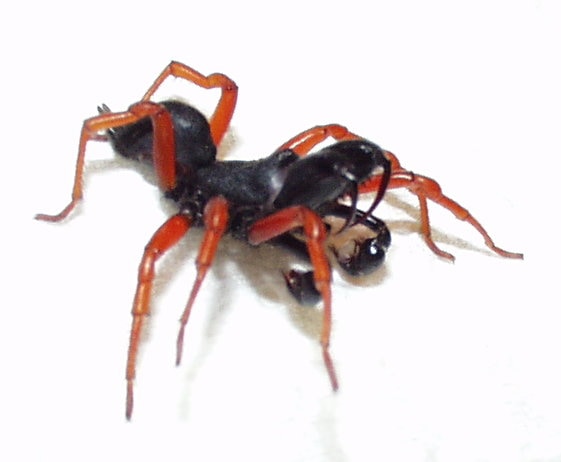
Atypical Tarantulas, Purseweb Spiders
North America, Asia, Africa, Europe
Huge Chelicerae For Their Size, Relatively Long Spinnerets
- Spend Most of Their Time In A Silken Retreat.
- Males Wander In Search of Females.
- Females Consume Males After Mating.
- Spiderlings Leave Their Mother's Burrow To Build Their Own Lair.
About Atypidae
Atypidae: The Purseweb Spiders
Atypidae, commonly known as atypical tarantulas or purseweb spiders, represent a distinct family of spiders recognized for their specialized hunting techniques and unique silken retreats. These arachnids are accomplished ambush predators, dedicating a significant portion of their lives within sock-like, silken tubes constructed on or near the ground. From these strategic positions, they effectively capture unsuspecting prey.
Distribution and Habitat
The family Atypidae is geographically widespread, with members found across North America, Asia, and Africa. The genera Sphodros and Atypus are native to North America, while Atypus and Calommata inhabit Asia and Africa. Notably, Atypus species are the sole mygalomorph spiders found in Central Europe. Their typical habitat involves constructing silken tubes parallel to the ground surface, with a portion exposed above ground and a much longer section extending vertically below. Some species, like Sphodros, may anchor their tubes against tree trunks, while Calommata species opt for living within burrows instead of constructing pursewebs.
Biology and Behavior
Atypidae spiders possess impressive chelicerae relative to their body size and have notably long spinnerets. Their hunting strategy is passive yet effective: when prey steps on the exposed part of their silken tube, the vibrations alert the spider. It then swiftly stabs the prey through the silk, severs the web, and pulls the victim into its retreat for consumption. The coloration of these spiders varies, with females typically being reddish-brown or dark, while males can exhibit brighter hues. During the breeding season, males embark on journeys to find females. Upon locating a female's burrow, the male cautiously taps the purseweb wall. If the female is receptive, the male enters, and mating occurs. Following mating, the spiders cohabit until the male's demise, after which the female consumes him. The female then produces an egg sac, which she suspends within her burrow. The eggs hatch the following summer, and the spiderlings disperse the subsequent spring to establish their own lairs.
Genera and Size
The Atypidae family currently encompasses three genera: Sphodros, Atypus, and Calommata. Body size varies considerably. For instance, females of Southeast Asian Atypus species measure between 7 to 21 mm in body length, with males around 12 mm. In contrast, Calommata species from the same region are larger, with females growing from 23 to 30 mm, while males are only about 7 mm.
Source: Wikipedia ↗
Frequently Asked Questions
What are purseweb spiders?
Purseweb spiders, also known as atypical tarantulas, belong to the family Atypidae. They are characterized by their unique hunting method, which involves constructing silken tubes or retreats from which they ambush prey.
Where are Atypidae spiders found?
The family Atypidae has a wide distribution. Sphodros and Atypus genera are found in North America, while Atypus and Calommata are present in Asia and Africa. Atypus species are the only mygalomorph spiders found in Central Europe.
How do purseweb spiders hunt?
Purseweb spiders are ambush predators that build silken tubes. They wait at the bottom of these tubes, and when prey walks on the exposed part, the spider stabs it through the silk, cuts the web, and pulls the prey into the tube to eat.
What is the typical habitat of Atypidae spiders?
Atypidae spiders typically live in silken retreats constructed on the ground. Some species, like Sphodros, may prop their tubes against tree trunks. Calommata species, however, live in burrows instead of building pursewebs.
Describe the appearance of Atypidae spiders.
These spiders possess large chelicerae relative to their body size and have relatively long spinnerets. Males are sometimes brightly colored, while females are generally reddish-brown or dark-colored. Body lengths vary significantly between species and sexes.
What is the reproductive behavior of Atypus affinis?
During the breeding season, male Atypus affinis seek out females. After a tentative tapping on the female's purseweb, mating occurs. The female then lays an egg sac in her burrow, and the spiderlings hatch the following summer.
Related Spider species

Agelenidae
The Agelenidae, commonly known as funnel weavers, are a large family of spiders found globally. They are distinguished by their fast running speeds and the construction of flat sheet webs with a funnel-shaped retreat. While most species are solitary, some African species exhibit parasocial behavior, living in communal webs.
Amaurobiidae
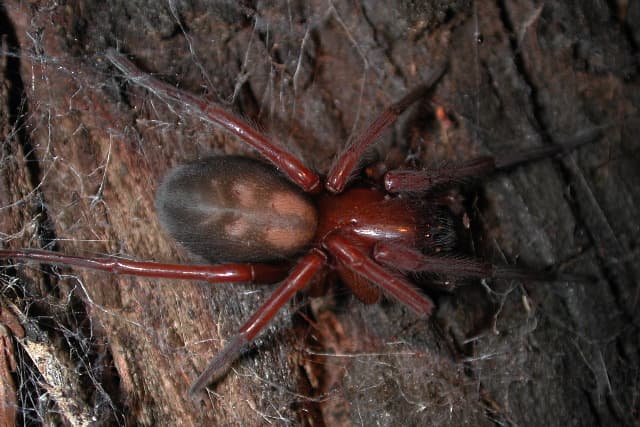
Amaurobiidae is a family of spiders characterized by their three-clawed feet and the presence of either a cribellum or its absence. These spiders are typically found in crevices, hollows, or under stones, where they construct retreats and are often captured in pitfall traps. While widespread, they can be challenging to distinguish from closely related spider families.
Anapidae
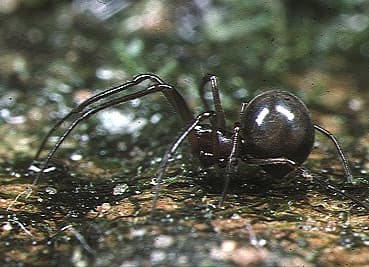
Anapidae is a diverse family of small spiders, with most species measuring less than two millimeters in length. These spiders are found worldwide, inhabiting leaf litter and moss in rainforest environments. A distinctive characteristic of many Anapidae species is their ability to build small orb webs, often less than three centimeters in diameter.