
Barychelidae
Ambush predators that utilize trapdoor burrows to capture prey.
Barychelidae, commonly known as brushed trapdoor spiders, is a family of mygalomorph spiders with approximately 300 species distributed across 39 genera. These spiders are distinguished by their habit of building burrows, often with hinged trapdoors, and some possess specialized structures for burrow construction and the ability to trap air bubbles to survive floods.
Key Facts
- ›Barychelidae is also known as brushed trapdoor spiders.
- ›The family comprises around 300 species in 39 genera.
- ›Most species construct trapdoor burrows.
- ›They are found in diverse regions including Australia, Africa, and South America.
- ›Some species can avoid drowning by trapping air bubbles.
- ›Certain members have a rake on their chelicerae for compacting burrow walls.

Brushed Trapdoor Spiders
Australia, New Caledonia, South America, Africa, Madagascar, India, New Guinea, Pacific Islands
- Hinged Trapdoors On Burrows
- Rake On Chelicerae For Compacting Burrow Walls
- Ability To Trap Air Bubbles Within Body Hairs
- Build Trapdoor Burrows
- Some Can Avoid Flooding By Trapping Air Bubbles
- Some Can Run Up Glass Like Tarantulas
- Some Can Stridulate
About Barychelidae
Barychelidae: The Brushed Trapdoor Spiders
Barychelidae, commonly referred to as brushed trapdoor spiders, represents a family of mygalomorph spiders characterized by their distinctive burrowing habits and specialized adaptations. This family encompasses approximately 300 species distributed across 39 genera, found in diverse geographical locations around the globe.
Behaviour and Habitat
The defining characteristic of most Barychelidae spiders is their construction of trapdoor burrows. These burrows serve as both shelters and strategic hunting grounds. For instance, the species Sipalolasma constructs its burrow in rotted wood, complete with a hinged trapdoor at each end. Another example, Idioctis, builds a burrow about 5 centimeters deep just below the high tide level, sealing the entrance with a thin trapdoor. Some members of this family exhibit remarkable survival strategies, such as plugging their burrows to avoid flooding or trapping air bubbles within the hairs covering their bodies to breathe underwater. Additionally, certain Barychelids possess a specialized rake on their chelicerae, used for compacting the soil of their burrow walls, and some are capable of running vertically on glass surfaces like tarantulas. A few species can also stridulate, producing sounds that are inaudible to human ears.
Distribution
The geographic range of Barychelid spiders is extensive, with species found across Australia, New Caledonia, South America, Africa, Madagascar, India, New Guinea, and various Pacific islands. This wide distribution highlights their adaptability to a range of environmental conditions.
Taxonomy
As of January 2026, the Barychelidae family is recognized to include 39 genera and 294 species. Ongoing research continues to refine the classification and understanding of this diverse spider group.
Source: Wikipedia ↗
Frequently Asked Questions
What are Barychelidae spiders known for?
Barychelidae spiders are primarily known for their construction of trapdoor burrows, which they use as shelters and for ambushing prey. Some species have unique adaptations for burrow maintenance and survival, such as specialized tools for compacting soil and methods for surviving floods.
Where are brushed trapdoor spiders found?
Brushed trapdoor spiders have a wide geographic distribution. They are found in Australia, New Caledonia, South America, Africa, Madagascar, India, New Guinea, and various Pacific islands.
How do Barychelidae spiders build their burrows?
Many Barychelidae spiders build elaborate trapdoor burrows. For instance, Sipalolasma constructs burrows in rotted wood with hinged trapdoors at both ends, while Idioctis creates shallow burrows sealed with a thin trapdoor near the high tide line.
Can Barychelidae spiders survive floods?
Some Barychelid species have developed strategies to survive flooding. They achieve this by plugging their burrows to prevent water ingress or by trapping air bubbles within the hairs covering their bodies, allowing them to breathe underwater temporarily.
Do Barychelidae spiders have any unique physical features for burrowing?
Yes, some members of this family possess a rake-like structure on the front surface of their chelicerae. This specialized tool is used for compacting the walls of their burrows, ensuring structural integrity.
Related Spider species
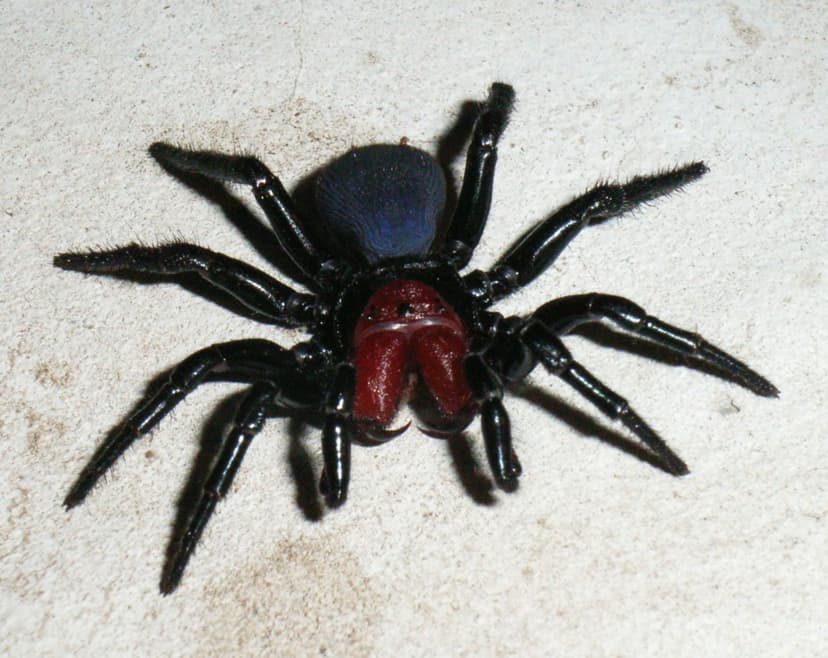
Actinopodidae
Actinopodidae is a family of mygalomorph spiders native to mainland Australia and South America, typically inhabiting open forests. This family includes the mouse spiders (Missulena species), which are notable for their medically significant and potentially dangerous bites.

Agelenidae
The Agelenidae, commonly known as funnel weavers, are a large family of spiders found globally. They are distinguished by their fast running speeds and the construction of flat sheet webs with a funnel-shaped retreat. While most species are solitary, some African species exhibit parasocial behavior, living in communal webs.
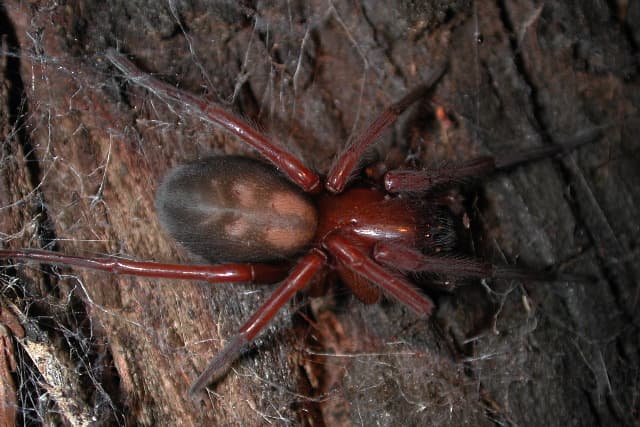
Amaurobiidae
Amaurobiidae is a family of spiders characterized by their three-clawed feet and the presence of either a cribellum or its absence. These spiders are typically found in crevices, hollows, or under stones, where they construct retreats and are often captured in pitfall traps. While widespread, they can be challenging to distinguish from closely related spider families.