
Caponiidae
Their hunting strategy is not fully detailed, but they are known to prey on other spiders.
Caponiidae is a family of haplogyne spiders distinguished by their lack of book lungs and unusual eye arrangements, with most species possessing only two eyes. These small, rarely noticed spiders are found in Africa and the Americas and are notable for their primitive characteristics and phylogenetic placement.
Key Facts
- ›Most Caponiidae species have only two eyes, a significant deviation from the typical eight.
- ›They lack book lungs, a characteristic uncommon among spiders.
- ›Their posterior median spinnerets are anteriorly displaced, forming a transverse row.
- ›Caponiidae spiders are small, generally measuring between 2 to 5 millimeters.
- ›The family is distributed across Africa and the Americas, from Argentina to the United States.

Africa, Americas, Argentina, United States
- Lack of Book Lungs
- Posterior Median Spinnerets Anteriorly Displaced To Form A Transverse Row With Anterior Lateral Spinnerets
- Most Species Have Only Two Eyes; Some Have Four, Six, Or Eight
Habits Are For the Most Part Unknown
About Caponiidae
The family Caponiidae encompasses a group of ecribellate haplogyne spiders that exhibit several unusual characteristics. Distinctive features include the absence of book lungs and a unique arrangement of their spinnerets, where the posterior median spinnerets are shifted forward to form a transverse row with the anterior lateral spinnerets. Perhaps their most striking peculiarity is their eye number; most species possess only two eyes, which is uncommon among spiders. A few species, however, can have four, six, or even eight eyes, with some spiderlings increasing their eye count as they mature.
Description and Diversity
Caponiidae spiders are generally small, measuring about 2 to 5 millimeters in length, making them easily overlooked. They often bear a resemblance to woodlouse hunter spiders of the genus Dysdera, with an orange carapace and a light gray abdomen. The two-eyed species have their eyes positioned in the front-middle of the carapace. The variation in eye number within this family is remarkable, surpassing even families like Cybaeidae. Some species have eyes that meet in the midline, creating the appearance of an odd number of eyes. The family includes numerous genera, such as Calponia, Caponia, Iraponia, Nopsides, Notnops, Cubanops, Diploglena, Laoponia, Medionops, Nops, Nopsma, Nyetnops, Orthonops, Taintnops, Tarsonops, and Tisentnops, each with varying eye arrangements.
Distribution and Habits
The geographic distribution of the Caponiidae family spans across Africa and the Americas, with species found from Argentina to the United States. Information regarding their habits is largely limited, but it is known that at least some species within the family are predatory towards other spiders. Their phylogenetic relationships have been a subject of study, with evidence suggesting they may be a relatively primitive group and a sister group to the Tetrablemmidae and families within the superfamily Dysderoidea.
Naming and Taxonomy
Several genera and species within Caponiidae have been named in honor of individuals or in reference to their geographic origin or taxonomic significance. For instance, the genus Calponia is named after California, and its species Calponia harrisonfordi honors actor Harrison Ford for his conservation efforts. The naming of genera like Notnops, Taintnops, and Tisentnops reflects the distinctiveness of the Chilean caponiid fauna. As of recent records, the family comprises 21 genera and 157 species.
Source: Wikipedia ↗
Frequently Asked Questions
What makes Caponiidae spiders unusual?
Caponiidae spiders are unusual due to their lack of book lungs and their variable number of eyes, with most species possessing only two. Their posterior median spinnerets are also uniquely positioned.
How many eyes do Caponiidae spiders typically have?
Most species within the Caponiidae family have only two eyes. However, some species can have four, six, or even eight eyes, and in certain species, the number of eyes can increase as the spiderling grows.
What is the typical size of a Caponiidae spider?
Caponiidae spiders are quite small, generally ranging from 2 to 5 millimeters in body length. They are often described as looking like faded woodlouse hunter spiders.
Where are Caponiidae spiders found geographically?
The Caponiidae family is distributed across a wide range, found in both Africa and the Americas. Their presence extends from Argentina in the south all the way up to the United States.
What do Caponiidae spiders eat?
While their habits are largely unknown, at least some species within the Caponiidae family are known to hunt other spiders.
Are Caponiidae spiders considered primitive spiders?
Their ecribellate and haplogyne nature suggests that Caponiidae spiders may be relatively primitive. Calponia harrisonfordi from California is considered by some to be the most primitive member of the family.
Related Spider species
Actinopodidae
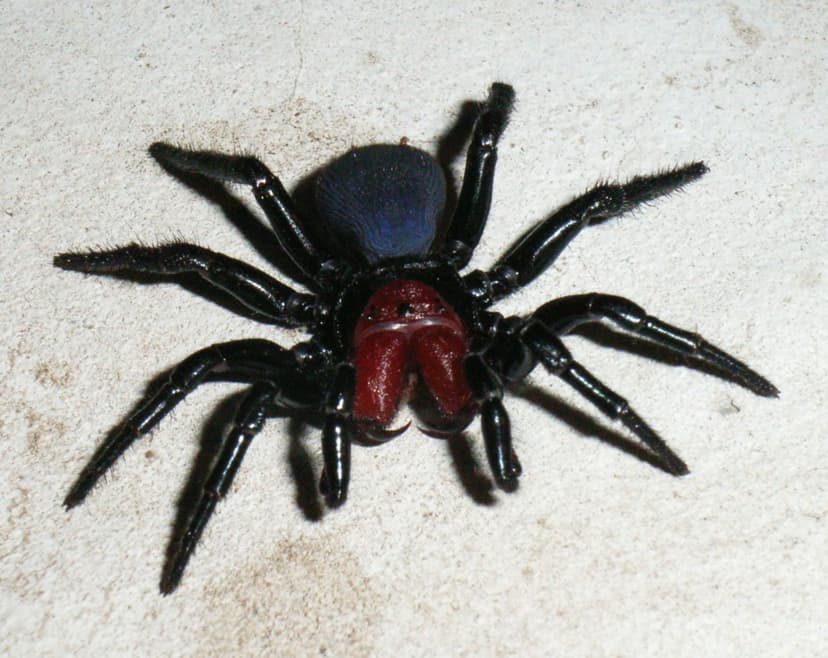
Actinopodidae is a family of mygalomorph spiders native to mainland Australia and South America, typically inhabiting open forests. This family includes the mouse spiders (Missulena species), which are notable for their medically significant and potentially dangerous bites.

Agelenidae
The Agelenidae, commonly known as funnel weavers, are a large family of spiders found globally. They are distinguished by their fast running speeds and the construction of flat sheet webs with a funnel-shaped retreat. While most species are solitary, some African species exhibit parasocial behavior, living in communal webs.
Amaurobiidae
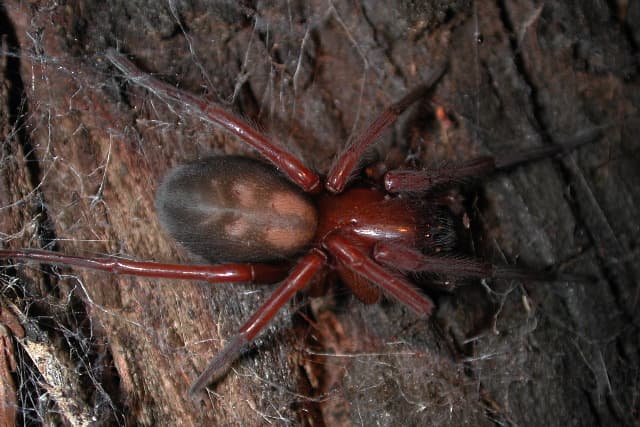
Amaurobiidae is a family of spiders characterized by their three-clawed feet and the presence of either a cribellum or its absence. These spiders are typically found in crevices, hollows, or under stones, where they construct retreats and are often captured in pitfall traps. While widespread, they can be challenging to distinguish from closely related spider families.