
Macrobunidae
Likely web-building or active hunting, typical of araneomorph spiders; specific strategies are not detailed.
Macrobunidae is a family of araneomorph spiders that was elevated from a subfamily of Amaurobiidae to its own family in 2023. This taxonomic change was based on molecular phylogenetic studies that demonstrated the group's distinct evolutionary lineage. Members of this family are generally small, brownish, and lack striking visual characteristics.
Key Facts
- ›Macrobunidae was established as a distinct family in 2023, previously considered a subfamily of Amaurobiidae.
- ›The family is part of the 'marronoid' group of spiders.
- ›Studies indicate Macrobunidae is a monophyletic group, separate from Amaurobiidae.
- ›Species within Macrobunidae can either possess a cribellum (often undivided) or a colulus.
- ›Male palps in Macrobunidae typically feature multiple apophyses.
- ›The family currently comprises 27 genera and 95 species.

- Male Palps Usually Have Multiple Apophyses, With the Retrolateral Tibial Apophysis Having A Branch That Engages With A Stridulatory Area On the Cymbium.
About Macrobunidae
Macrobunidae is a family of araneomorph spiders that was formally recognized as a distinct taxonomic rank in 2023. Previously, these spiders were classified as a subfamily, Macrobuninae, within the family Amaurobiidae. This elevation in status was a result of comprehensive molecular phylogenetic studies focused on the 'marronoid' group of spider families, which revealed that Macrobunidae represents a monophyletic group well separated from Amaurobiidae.
Taxonomy and Classification
The establishment of Macrobunidae as a family was a key outcome of a 2023 study that re-evaluated the relationships among several spider families. This research led to a revised circumscription of some families, including the creation of new or resurrected families. Macrobunidae emerged from this study as a distinct lineage, warranting its classification as a full family.
Genera and Species
As of October 2025, the Macrobunidae family is recognized to contain 27 genera and a total of 95 species. This indicates a diverse group of spiders within this family.
Physical Characteristics
Members of the Macrobunidae family generally share common traits: they are relatively small in size and exhibit brownish coloration. A notable characteristic within the family is the variation in the presence and structure of the cribellum. Some species possess a cribellum, which is usually undivided, while others have a cribellum divided into two parts. In contrast, ecribellate members of the family have a colulus in place of the cribellum. The male palps of Macrobunidae spiders are also often distinctive, typically featuring multiple apophyses. A specific feature mentioned is the retrolateral tibial apophysis, which usually has a branch designed to engage with a stridulatory area on the cymbium.
Source: Wikipedia ↗
Frequently Asked Questions
What is Macrobunidae?
Macrobunidae is a family of araneomorph spiders. It was officially recognized as a full family in 2023 after molecular phylogenetic studies showed it was a distinct evolutionary lineage.
How was the Macrobunidae family established?
The family Macrobunidae was established based on a 2023 molecular phylogenetic study of the 'marronoid' group of spiders. This study indicated that what was previously the subfamily Macrobuninae was a monophyletic group well-removed from the family Amaurobiidae, leading to its elevation in rank.
What are the general characteristics of Macrobunidae spiders?
Spiders belonging to the Macrobunidae family are generally described as relatively small and brownish. They typically do not possess striking morphological features.
Do all Macrobunidae spiders have a cribellum?
No, Macrobunidae species vary in this regard. Some have an undivided cribellum, while others have a cribellum divided into two parts. Ecribellate members of the family possess a colulus instead of a cribellum.
How many genera and species are in the Macrobunidae family?
As of October 2025, the Macrobunidae family includes 27 genera and a total of 95 species.
What is notable about the male palps of Macrobunidae spiders?
The tibiae of the male palp in Macrobunidae spiders usually have multiple apophyses. Specifically, the retrolateral tibial apophysis has a branch that interacts with a stridulatory area on the cymbium.
Related Spider species
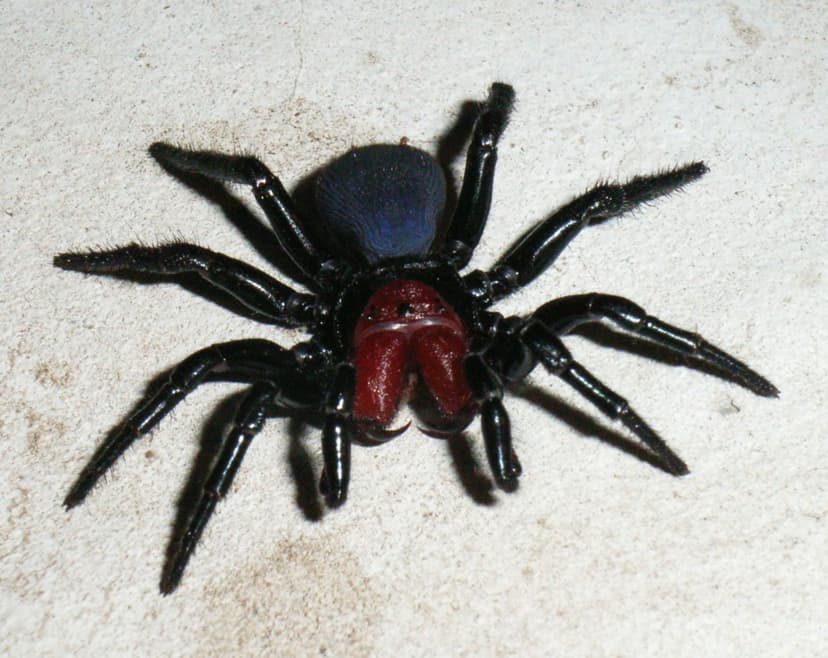
Actinopodidae
Actinopodidae is a family of mygalomorph spiders native to mainland Australia and South America, typically inhabiting open forests. This family includes the mouse spiders (Missulena species), which are notable for their medically significant and potentially dangerous bites.

Agelenidae
The Agelenidae, commonly known as funnel weavers, are a large family of spiders found globally. They are distinguished by their fast running speeds and the construction of flat sheet webs with a funnel-shaped retreat. While most species are solitary, some African species exhibit parasocial behavior, living in communal webs.
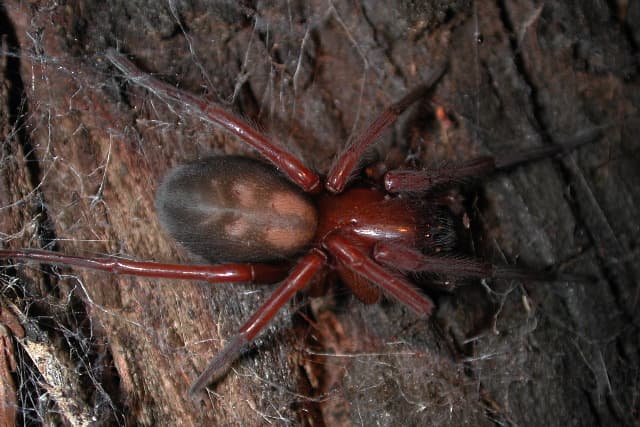
Amaurobiidae
Amaurobiidae is a family of spiders characterized by their three-clawed feet and the presence of either a cribellum or its absence. These spiders are typically found in crevices, hollows, or under stones, where they construct retreats and are often captured in pitfall traps. While widespread, they can be challenging to distinguish from closely related spider families.