
Migidae
Migidae spiders are trapdoor spiders, indicating a hunting strategy that likely involves ambushing prey from their concealed burrows.
Migidae, commonly known as tree trapdoor spiders, is a family of spiders characterized by their ability to construct burrows with a trapdoor. These spiders are found predominantly in the Southern Hemisphere, with a distribution spanning South America, Africa, Madagascar, Australia, New Zealand, and New Caledonia. Some species are distinctive for their habit of living within tree fern stems.
Key Facts
- ›Migidae are also referred to as tree trapdoor spiders.
- ›The family comprises approximately 100 species organized into eleven genera.
- ›They are characterized by building burrows equipped with a trapdoor.
- ›Migidae spiders are primarily found in the Southern Hemisphere.
- ›Some species inhabit tree fern stems.

Tree Trapdoor Spiders
South America, Africa, Madagascar, Australia, New Zealand, New Caledonia
Build Burrows With A Trapdoor, Some Species Live In Tree Fern Stems
Build Burrows, Construct Trapdoors
About Migidae
The Migidae family, commonly referred to as tree trapdoor spiders, is a group of arachnids recognized for their distinctive burrowing habits and the construction of a unique trapdoor. This family encompasses approximately 100 species, which are organized into eleven genera. These spiders are found predominantly in the Southern Hemisphere, reflecting a Gondwanan distribution that includes regions such as South America, Africa, Madagascar, Australia, New Zealand, and New Caledonia.
Physical Characteristics and Habitat
Migidae spiders vary in size from small to large. A notable characteristic of this family is their tendency to build burrows, which are often shielded by a meticulously constructed trapdoor. This adaptation serves as both a defensive mechanism and an effective hunting tool. Furthermore, some species within the Migidae family exhibit a specialized lifestyle, choosing to inhabit the stems of tree ferns, a behavior that contributes to their common name.
Distribution and Ecology
The geographic distribution of Migidae is largely confined to the Southern Hemisphere, making them a significant component of the arachnid fauna in these regions. Their presence across continents like South America, Africa, Australia, and islands such as Madagascar, New Zealand, and New Caledonia highlights their ancient evolutionary history. While the precise details of their diet and hunting strategies are not elaborated upon, their classification as trapdoor spiders implies an ambush predation style from their concealed burrows.
Source: Wikipedia ↗
Frequently Asked Questions
What are Migidae spiders commonly called?
Migidae spiders are commonly known as tree trapdoor spiders. This name reflects their characteristic behavior of building burrows with a trapdoor and their association with arboreal habitats.
Where are Migidae spiders found geographically?
Migidae spiders have a Gondwanan distribution, meaning they are found almost exclusively in the Southern Hemisphere. Their range includes South America, Africa, Madagascar, Australia, New Zealand, and New Caledonia.
What is distinctive about Migidae burrows?
Migidae spiders are known for constructing burrows that are equipped with a trapdoor. This specialized structure is a key characteristic of the family and aids in their hunting and defense.
Do all Migidae spiders build trapdoors?
Yes, the construction of burrows with a trapdoor is a defining feature of the Migidae family. This adaptation is central to their lifestyle and hunting strategy.
How many species are in the Migidae family?
As of recent records, the Migidae family includes approximately 100 species. These species are further categorized into eleven distinct genera.
Related Spider species
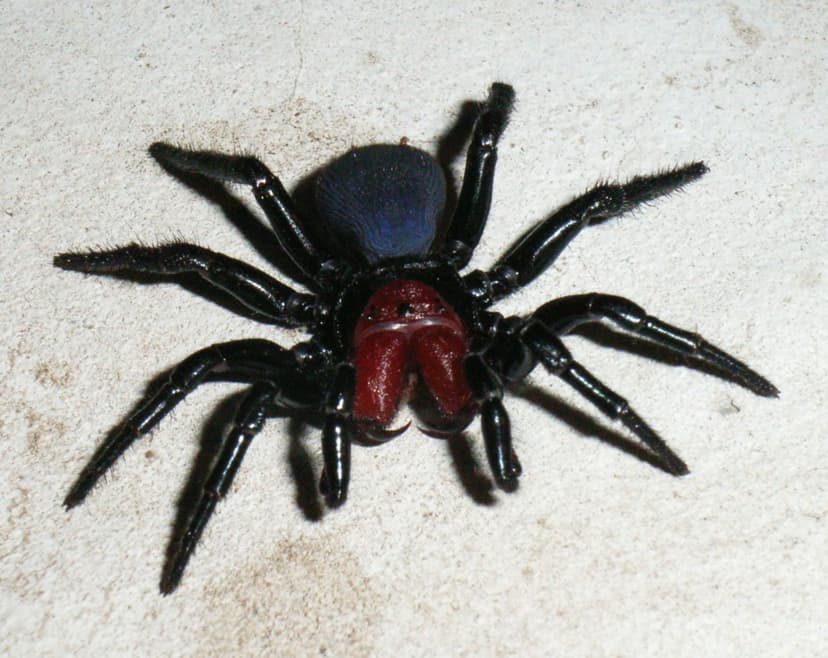
Actinopodidae
Actinopodidae is a family of mygalomorph spiders native to mainland Australia and South America, typically inhabiting open forests. This family includes the mouse spiders (Missulena species), which are notable for their medically significant and potentially dangerous bites.

Agelenidae
The Agelenidae, commonly known as funnel weavers, are a large family of spiders found globally. They are distinguished by their fast running speeds and the construction of flat sheet webs with a funnel-shaped retreat. While most species are solitary, some African species exhibit parasocial behavior, living in communal webs.
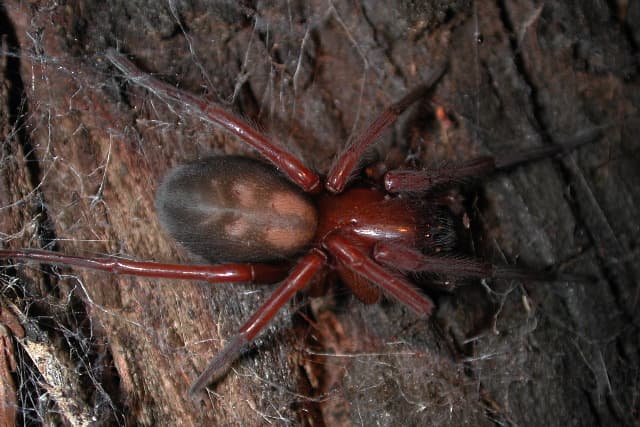
Amaurobiidae
Amaurobiidae is a family of spiders characterized by their three-clawed feet and the presence of either a cribellum or its absence. These spiders are typically found in crevices, hollows, or under stones, where they construct retreats and are often captured in pitfall traps. While widespread, they can be challenging to distinguish from closely related spider families.