
Periegopidae
Likely fast-moving, nocturnal hunters that do not build webs for prey capture.
Periegops is a genus of spiders characterized by having only six eyes, a distinctive trait among arachnids which typically possess eight. As the sole genus within the family Periegopidae, it comprises three recognized species found in Australia and New Zealand. These spiders inhabit forest environments with deep leaf litter and are believed to be fast-moving, nocturnal hunters.
Key Facts
- ›Possesses six eyes instead of the usual eight.
- ›The only genus in the family Periegopidae.
- ›Found in forest habitats with deep leaf litter.
- ›Likely fast-moving, nocturnal hunters.
- ›Uses silk for drag lines and retreats, not for prey capture webs.
- ›Females of some species may attract multiple males.

Australia, New Zealand
Six Eyes Instead of the Usual Eight, Eye Pattern In Three Clusters of Two Eyes
Fast-Moving Hunters, Nocturnal Activity, Use Silk For Drag Lines and Retreats, Females May Attract Multiple Males
About Periegopidae
Periegops Spiders: The Six-Eyed Forest Dwellers
Periegops is a genus of spiders distinguished by a unique characteristic: they possess only six eyes, a notable departure from the usual eight eyes found in most spider species. This genus represents the entirety of the family Periegopidae and currently includes three scientifically described species. Historically, Periegops was classified within other spider families, but in 1995, Raymond Forster established its distinct family status. The spiders are known for their forest habitat preferences, thriving in environments with deep leaf litter and well-drained soil.
Taxonomy and Discovery
The genus Periegops was first formally described in 1893 by Eugene Simon, based on a specimen identified as P. hirsutus, which is now considered a synonym for P. suterii. The classification of Periegops has evolved over time, with its elevation to its own family, Periegopidae, marking a significant taxonomic recognition.
Physical Characteristics
Spiders of the genus Periegops are identifiable by their unusual eye count of six, a feature that sets them apart. The typical arrangement of these eyes is in three distinct clusters, with each cluster containing two eyes. Body length varies between species and sexes, generally ranging from 5.9 mm to 10.9 mm. Their carapace is typically orange, often displaying a darker shade on the anterior side. The abdomen presents a brown or creamy brown coloration, frequently adorned with a chevron pattern.
Species and Distribution
As of early 2026, the World Spider Catalog recognizes three species within the Periegops genus:
- Periegops australia Forster, 1995: Found in Queensland, Australia.
- Periegops keani Vink, Dupérré & Malumbres-Olarte, 2013: Native to the North Island of New Zealand.
- Periegops suterii (Urquhart, 1892): Inhabits the South Island of New Zealand.
Habitat and Behavior
Periegops spiders are found in forest habitats, specifically favoring areas with deep leaf litter and well-drained soil. They are believed to be fast-moving, nocturnal hunters. Unlike many spider species, Periegops have not been observed constructing webs for capturing prey. Instead, they utilize silk primarily for creating drag lines and for building silk retreats. Observations of P. suterii have noted females accompanied by two to three males, which may suggest a unique method of attracting mates.
Source: Wikipedia ↗
Frequently Asked Questions
What makes Periegops spiders unique?
The most distinctive feature of Periegops spiders is their possession of six eyes, whereas most other spider species have eight. They are also the only genus within their family, Periegopidae.
Where are Periegops spiders found?
Periegops spiders are found in specific geographic regions. Periegops australia is located in Queensland, Australia, while Periegops keani inhabits New Zealand's North Island, and Periegops suterii is found on New Zealand's South Island.
What kind of habitat do Periegops spiders prefer?
These spiders are found in forest environments. They specifically favor areas with deep leaf litter layers and well-drained soil, which provides them with suitable conditions for living and hunting.
How do Periegops spiders hunt?
Periegops spiders are believed to be nocturnal hunters that move quickly. They do not construct webs to capture prey; instead, they utilize silk to create drag lines and build silk retreats for shelter.
What is the typical size of a Periegops spider?
The body length of Periegops spiders varies, generally ranging from 5.9 mm to 10.9 mm. This size can differ depending on the specific species and whether the individual is male or female.
What is the coloration of Periegops spiders?
The carapace of Periegops spiders is orange, often appearing darker on the front side. Their abdomen is typically brown or creamy brown, frequently displaying a chevron pattern.
Related Spider species
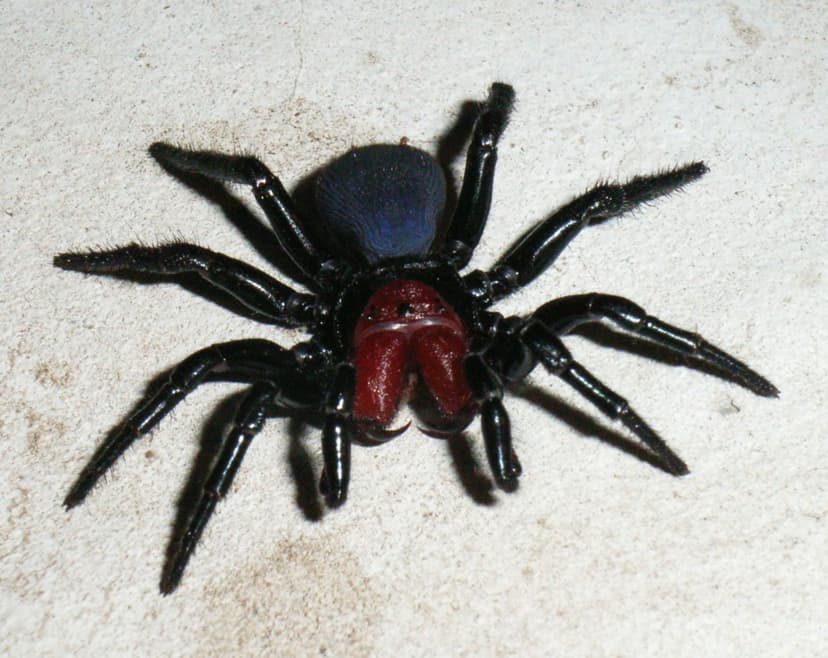
Actinopodidae
Actinopodidae is a family of mygalomorph spiders native to mainland Australia and South America, typically inhabiting open forests. This family includes the mouse spiders (Missulena species), which are notable for their medically significant and potentially dangerous bites.

Araneidae
The Araneidae, commonly known as orb-weaver spiders, are a widespread family of spiders renowned for constructing distinctive spiral wheel-shaped webs. Found globally, these spiders are characterized by their eight eyes, hairy or spiny legs, and the absence of stridulating organs. With nearly 5,000 described species, they represent one of the largest spider families, playing a significant role in controlling insect populations.

Cithaeronidae
Cithaeronidae is a small family of fast-moving araneomorph spiders known for actively hunting at night and resting in silken retreats during the day. Primarily found in hot, dry, stony environments, members of this family have a broad distribution that includes Africa, India, parts of Eurasia, and have been introduced to regions like Australia, Brazil, and the United States.