
Salticidae
Active hunters that stalk and pounce on prey, utilizing their exceptional vision and jumping ability. Some species may also employ web invasion or specialized attack techniques.
Jumping spiders, belonging to the family Salticidae, are the largest family of spiders, constituting about 13% of all known species. They are distinguished by their exceptional stereoptic color vision, which they utilize for hunting, courtship, and navigation. Most species are agile jumpers, capable of leaping significant distances to catch prey or escape threats, and are recognized by their distinctive eye pattern featuring large anterior median eyes.
Key Facts
- ›Salticidae is the largest spider family, with nearly 700 genera and around 7,000 described species.
- ›They possess some of the best vision among arthropods, including stereoptic color vision.
- ›Jumping spiders use their rear legs for jumping, propelled by a well-developed internal hydraulic system.
- ›Most species hunt during the day, utilizing their keen eyesight to stalk and capture prey.
- ›They construct silken 'pup tents' for shelter, molting, and protection from adverse weather.
- ›Complex visual courtship displays involving movements and body ornamentation are common, especially in males.

Jumping Spiders
- Distinctive Eye Pattern With Four Pairs of Eyes, the Anterior Median Pair Being Particularly Large and Prominent.
- Rectangular-Shaped Cephalothorax Perpendicular To Their Direction of Motion.
- Legs Are Not Covered With Very Prominent Spines, and the Front Four Legs Are Generally Larger Than the Hind Four.
- Capable of Agile and Accurate Jumps For Hunting, Navigation, and Escape.
- Use Silk Draglines For Safety During Jumps.
- Exhibit Complex Visual Courtship Displays.
- Some Species Are Territorial Or Can Negotiate Complex Detours To Reach Prey.
- Can Detect Airborne Acoustic Stimuli.
About Salticidae
Jumping Spiders (Salticidae)
Jumping spiders, collectively known as the family Salticidae, represent the largest and most diverse family of spiders, making up approximately 13% of all described spider species with nearly 700 genera and around 7,000 species. These arachnids are renowned for their exceptional visual acuity, possessing stereoptic color vision that rivals that of many vertebrates. This advanced sight is crucial for their survival, playing a vital role in courtship rituals, efficient hunting, and precise navigation.
Description and Distinguishing Features
Salticids are readily identifiable by their characteristic eye arrangement and cephalothorax shape. They possess eight eyes, with the anterior median pair being exceptionally large and prominent, providing detailed, three-dimensional vision essential for estimating distances. Their faces are typically rectangular and perpendicular to their direction of movement. While their front legs are often larger than their hind legs, it is the hind legs that are primarily used for their impressive jumping capabilities, which are facilitated by a well-developed internal hydraulic system rather than large musculature.
Habitat and Distribution
Jumping spiders are found in a wide array of habitats across the globe, thriving in environments ranging from the dense canopies of tropical forests to arid deserts, scrublands, and even high mountainous regions. The species Euophrys omnisuperstes holds the record for being collected at the highest elevation, found on the slopes of Mount Everest.
Behavior and Hunting Strategies
Most jumping spiders are diurnal hunters, a behavior consistent with their reliance on vision. They are known for their agile and accurate leaps, often covering distances many times their own body length. When hunting, they typically stalk their prey, using their keen eyesight to assess the target before launching an attack. They also employ a silk dragline for safety, especially when jumping across gaps or to descend from heights. Beyond hunting, they construct silken "pup tents" which serve as shelters from inclement weather, places for molting, storing egg cases, and overwintering.
Diet and Reproduction
The diet of jumping spiders is primarily carnivorous, consisting of insects and other small arthropods. However, some species have been observed to consume nectar, and one species, Bagheera kiplingi, has a diet that is predominantly herbivorous, feeding on specialized structures from acacia plants. Reproduction involves elaborate courtship displays, particularly by males, who utilize visual cues such as vibrant colors, iridescent hairs, and complex movements to attract females. The ability to perceive ultraviolet light plays a role in mate selection for some species. After mating, females construct egg sacs within their silken shelters, and in some cases, provide nourishment to their young.
Vision and Adaptations
The visual system of jumping spiders is remarkably advanced. They have three pairs of secondary eyes and a principal pair of anterior median eyes that are highly mobile, allowing them to scan their surroundings. The anterior median eyes provide high-resolution vision, with a retina capable of tetrachromatic color vision, extending into the ultraviolet range. Their ability to adjust focus and scan objects off-axis compensates for their narrow field of vision. This sophisticated visual system is central to their survival, enabling precise predation and complex social interactions.
Source: Wikipedia ↗
Frequently Asked Questions
What makes jumping spiders unique?
Jumping spiders are unique due to their exceptional vision, which allows for stereoptic color perception, and their remarkable jumping ability. They use their sight for hunting, mating, and navigating their environment, and can leap distances many times their body length.
How do jumping spiders hunt?
Jumping spiders are primarily diurnal hunters that use their excellent vision to stalk prey. They approach cautiously, often attaching a dragline for safety, before making an agile leap to capture their meal. Some species may also employ specialized techniques, such as invading the webs of other spiders.
What do jumping spiders eat?
While generally carnivorous and preying on insects and other small arthropods, many jumping spiders also supplement their diet with nectar from plants. One notable species, Bagheera kiplingi, feeds primarily on specialized structures found on acacia plants.
Where do jumping spiders live?
Jumping spiders are found in a wide variety of habitats across the globe, including tropical and temperate forests, scrublands, deserts, and mountainous regions. The species Euophrys omnisuperstes has been recorded at the highest elevation, on the slopes of Mount Everest.
How do jumping spiders jump?
Jumping spiders primarily use their hind legs to jump, extending them rapidly through an internal hydraulic system that increases hemolymph pressure. This allows them to make powerful and accurate leaps without needing overly muscular legs.
Do jumping spiders build webs to catch prey?
Most jumping spiders do not build webs for hunting; they are active hunters. However, some species, like certain Portia species, can spin functional, albeit unusual, capture webs, and Spartaeus species are known to capture moths in their webs.
What is the most distinctive feature of a jumping spider?
The most distinctive feature of jumping spiders is their eye pattern, characterized by eight eyes arranged in three rows. The large anterior median pair are particularly prominent and are responsible for their excellent, detailed vision.
Related Spider species

Orsolobidae
Orsolobidae is a family of six-eyed spiders comprising approximately 200 described species across thirty genera. First described by J. A. L. Cooke in 1965, it was elevated to family status from the "Dysderidae" classification in 1985. While most of its genera are endemic to New Zealand and Australia, some are also found in southern Africa and South America.
Oonopidae
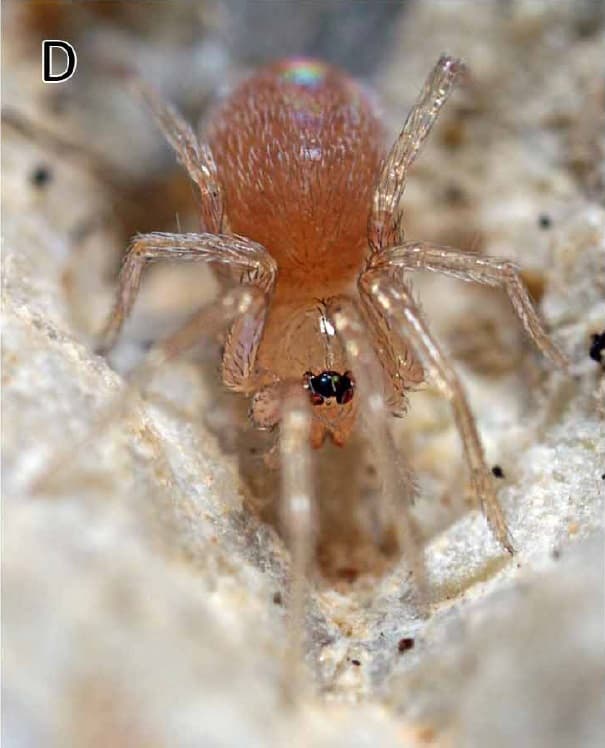
Oonopidae, commonly known as goblin spiders, are a widespread family of tiny spiders, typically measuring between 1 to 3 millimeters. They are characterized by their small size, often six eyes (though variations exist), and a remarkable array of unusual morphological traits, particularly in males. These spiders are frequently found in leaf litter, under rocks, and in tropical rainforest canopies, with some species even inhabiting termite nests.
Philodromidae
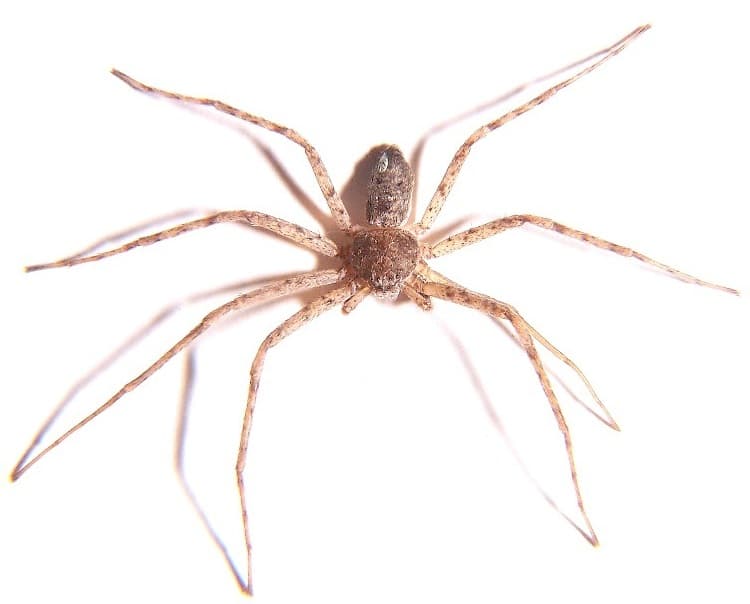
Philodromidae, commonly known as philodromid crab spiders or running crab spiders, is a diverse family of araneomorph spiders that includes over 500 species across approximately thirty genera. These spiders are characterized by their crab-like body shape and active hunting strategy, preying on insects and other small invertebrates by ambush rather than web-building. They are typically found on plants, from deciduous trees to conifers, and are widespread across various habitats.