
Segestriidae
Ambush predator utilizing silken tubes to detect prey vibrations.
Tube-dwelling spiders, scientifically known as Segestriidae, are a family of araneomorph spiders recognized by their distinctive leg arrangement and six eyes. They construct branching silken tubes, often found in bark fissures or under stones, which are believed to be an adaptation for their specialized leg structure.
Key Facts
- ›Possess six eyes arranged in a semicircle, unlike the typical eight eyes of many spiders.
- ›Their first three pairs of legs are oriented forward, an adaptation likely for life in silken tubes.
- ›Construct branching silken tubes, often found in tree bark fissures or beneath stones.
- ›The family includes five genera: Segestria, Ariadna, Citharoceps, Gippsicola, and Indoseges.
- ›Fossil evidence of the family dates back to the Eocene Baltic amber.

Tube-Dwelling Spiders
North America, South America, Eurasia, Africa, New Zealand, Australia
First Three Pairs of Legs Arranged Forward, Six Eyes Arranged In A Semicircle
Construct Branching Silken Tubes, Leg Structure Adapted For Tube Dwelling
About Segestriidae
Tube-Dwelling Spiders (Segestriidae)
Tube-dwelling spiders, scientifically classified as Segestriidae, form a distinct family within the araneomorph spiders. First described by Eugène Simon in 1893, this family is characterized by unique physical traits and specialized living habits. Their most recognizable features include having only six eyes, arranged in a semicircle, rather than the typical eight, and a distinctive leg arrangement where the first three pairs of legs point forward. This latter characteristic is believed to be a key adaptation for their tube-dwelling lifestyle.
Habitat and Distribution
The Segestriidae family comprises five genera, with Segestria and Ariadna being the most widespread. These genera are found across vast regions, including North America, South America, Eurasia, Africa, and New Zealand, with Ariadna also inhabiting Australia. Their habitat typically involves constructing elaborate, branching silken tubes. These structures are often found in protected locations such as fissures in tree bark or concealed beneath stones, providing a secure environment for the spiders.
Physical Characteristics and Evolution
The forward-facing leg structure of Segestriidae spiders is thought to be crucial for navigating and sensing vibrations within their silken tubes. Beyond their unique eye and leg arrangements, further details regarding their size and coloration are not extensively documented in readily available records. The family's evolutionary history includes fossil evidence dating back to the Eocene epoch, with specimens found in Baltic amber. Some Cretaceous taxa, initially identified as tube-dwelling spiders, are also considered potential early members of the Segestriidae lineage or related stem groups within the Dysderoidea superfamily.
Source: Wikipedia ↗
Frequently Asked Questions
What are tube-dwelling spiders?
Tube-dwelling spiders, belonging to the family Segestriidae, are a group of araneomorph spiders known for constructing silken tubes. These tubes serve as their habitat and are often found in natural crevices like tree bark or under rocks.
How are tube-dwelling spiders different from other spiders?
Segestriidae spiders are distinctive due to having only six eyes, arranged in a semicircle, rather than the usual eight. Additionally, their first three pairs of legs are positioned forward, which is thought to be an adaptation for their tube-dwelling lifestyle.
Where are tube-dwelling spiders found?
The genera Segestria and Ariadna are widely distributed across North America, South America, Eurasia, Africa, and New Zealand. Ariadna also extends its range to Australia. The smaller genera have more limited distributions.
What do the silken tubes of Segestriidae spiders look like?
Unlike the simple tubes of some spiders, the silken tubes created by Segestriidae can branch. They are frequently located in fissures within tree bark or concealed under stones, providing a protected environment for the spider.
Are there any fossil records of tube-dwelling spiders?
Yes, the oldest confirmed members of the Segestriidae family have been identified from Eocene Baltic amber. Some Cretaceous taxa that were originally described as tube-dwelling spiders may also belong to the ancestral lineage of Segestriidae.
Related Spider species

Agelenidae
The Agelenidae, commonly known as funnel weavers, are a large family of spiders found globally. They are distinguished by their fast running speeds and the construction of flat sheet webs with a funnel-shaped retreat. While most species are solitary, some African species exhibit parasocial behavior, living in communal webs.
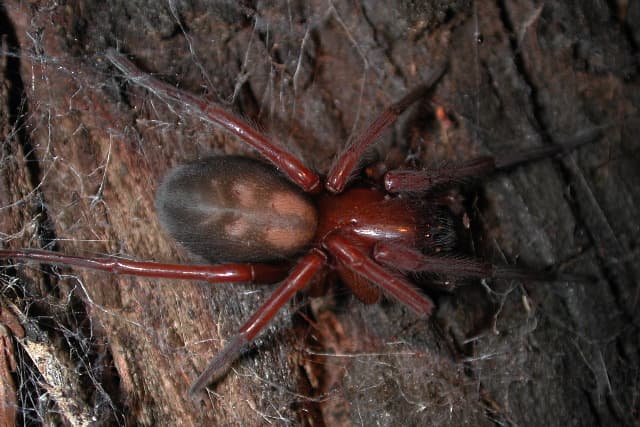
Amaurobiidae
Amaurobiidae is a family of spiders characterized by their three-clawed feet and the presence of either a cribellum or its absence. These spiders are typically found in crevices, hollows, or under stones, where they construct retreats and are often captured in pitfall traps. While widespread, they can be challenging to distinguish from closely related spider families.
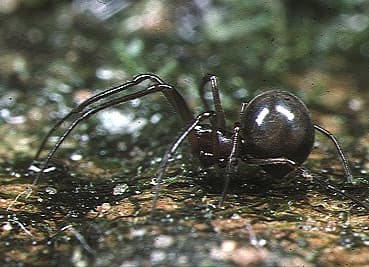
Anapidae
Anapidae is a diverse family of small spiders, with most species measuring less than two millimeters in length. These spiders are found worldwide, inhabiting leaf litter and moss in rainforest environments. A distinctive characteristic of many Anapidae species is their ability to build small orb webs, often less than three centimeters in diameter.