
Stenochilidae
As web builders that produce silk, they likely utilize webs to ensnare their prey. The specific design or placement of these webs is not detailed.
Stenochilidae is a family of spiders native to Southeast Asia, characterized by their production of ecribellate silk and distinctive diamond-shaped carapace. These small spiders are found across a broad range from India to Fiji, with unique morphological features that differentiate them from other spider families.
Key Facts
- ›They produce ecribellate silk, meaning their silk lacks the fine hairs found in cribellate silk.
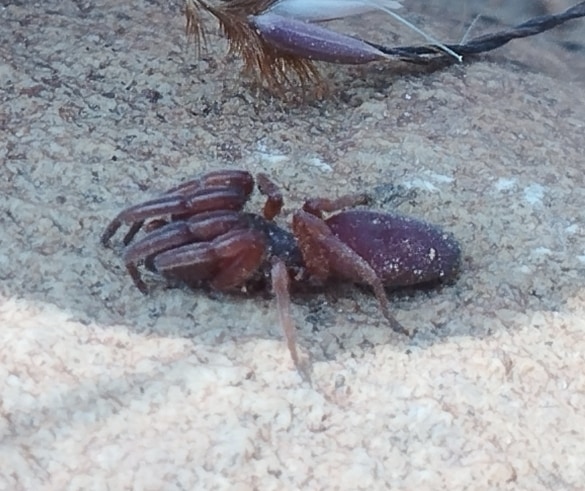
- ›Stenochilids possess a uniquely diamond-shaped carapace that is heavily tuberculate.
- ›Their eye arrangement forms single, continuous, gently curved rows.
- ›These spiders have only two large spinnerets, with remnants of four posterior spinnerets.
- ›The family is distributed across the Oriental realm, from India to Fiji.
- ›Males have complex genitalia, while females lack an external epigyne.
India, Sri Lanka, Myanmar, Cambodia, Thailand, Malaysia, Singapore, China, Philippines, Borneo, Bali, New Guinea, Fiji, Iraq
- Diamond-Shaped, Heavily Tuberculate Carapace
- Two Thoracic Grooves
- Single, Continuous, Gently Curved Eye Rows
- Two Large Spinnerets Plus Remnants of Four Posterior Spinnerets
- Elongate Labium Fused To the Sternum
About Stenochilidae
Stenochilidae is a distinct family of araneomorph spiders originating from Southeast Asia, notable for their production of ecribellate silk. First formally described by Tamerlan Thorell in 1873, the family currently encompasses thirteen recognized species distributed across two genera.
Distribution and Habitat
The geographical range of Stenochilidae is notably restricted, primarily within the Oriental realm. Their distribution extends from India in the west, through Southeast Asia, and reaches as far east as Fiji. Specific locations where they have been recorded include India, Sri Lanka, Myanmar, Cambodia, Thailand, Malaysia, Singapore, China, the Philippines, Borneo, Bali, New Guinea, and Fiji. An unusual westernmost record has been noted from Iraq.
Morphology and Characteristics
Stenochilidae spiders are generally small, measuring between 3.5 to 10 mm in total length. They are readily identifiable by their unique, diamond-shaped carapace, which is widest behind the second pair of coxae and exhibits extensive tuberculation. The carapace varies in outline, being simpler in the genus Colopea and more undulated in Stenochilus. Unlike most spiders, they possess two thoracic grooves: typically an anterior groove and a posterior pit. Their eye arrangement is also distinctive, with the eyes of each side forming a single, continuous, gently curved row. In many species, the posterior median eyes are notably elongated, twice the size of the other eyes. A key diagnostic feature is the presence of only two large spinnerets, accompanied by remnants of four posterior spinnerets. In males, these remnants are nonfunctional, but in females, they are larger, functional, and fused into a platelike structure resembling a cribellum. The leg formula follows the pattern 1243, with legs I and II being enlarged and bearing divided prolateral scopulae on the metatarsi. The opisthosoma is pale yellow, marked with two brown oblique dorsal muscle impressions, and covered in dark, spine-like setae.
Taxonomy and Evolution
The taxonomic history of Stenochilidae involves its initial description as a family by Thorell in 1873, followed by its reclassification as a subfamily of Palpimanidae by Simon in 1893. Platnick and Shadab's comprehensive revision in 1974 re-established Stenochilidae as a distinct family, citing numerous morphological differences from Palpimanidae, including features of the carapace, thoracic grooves, eye pattern, chelicerae, labium, abdominal scutum, spinnerets, leg segment lengths, and genitalia. The family's diversity was further explored by Pekka Lehtinen in 1982, who described new species and provided detailed morphological analyses.
Source: Wikipedia ↗
Frequently Asked Questions
What is the scientific name for this spider family?
The scientific name for this family of spiders is Stenochilidae. This name is derived from the Greek words for 'narrow' and 'lip,' referring to a characteristic feature of their labium.
Where are Stenochilidae spiders found?
Stenochilidae spiders have a restricted distribution within the Oriental realm. They are found from India in the west, across Southeast Asia, and as far east as Fiji.
What is distinctive about their appearance?
Stenochilidae spiders are instantly recognizable by their uniquely diamond-shaped carapace, which is heavily tuberculate. They also have two thoracic grooves instead of the more common one.
How many spinnerets do Stenochilidae spiders have?
A diagnostic feature of Stenochilidae is the presence of only two large spinnerets, along with remnants of four posterior spinnerets. In females, these remnants are fused into a platelike structure.
What is unusual about their eyes?
The eye arrangement in Stenochilidae spiders is distinctive, with the eyes of the right and left sides forming single, continuous, gently curved rows. In many species, the posterior median eyes are unusually elongate.
Do male and female Stenochilidae have different genitalia?
Yes, male and female Stenochilidae exhibit significant differences in their genitalia. Males have complex entelegyne palpi, while females of both genera lack an external epigyne and have haplogyne-type genitalia.
Related Spider species

Dipluridae
Dipluridae, commonly known as curtain-web spiders, are a family of mygalomorph spiders characterized by two pairs of booklungs and stabbing chelicerae. While historically encompassing genera now moved to other families, the current Dipluridae are primarily found in South America and the Caribbean, known for building messy funnel-webs or silk-lined burrows.

Deinopidae
Deinopidae, commonly known as net-casting spiders, are a family of circumtropical cribellate spiders recognized for their unique hunting strategy. These stick-like spiders catch prey by stretching a specialized web between their front legs and then propelling themselves forward, entangling their victims. Their exceptional night vision, facilitated by large posterior median eyes, allows them to hunt effectively in low-light conditions.

Hypochilidae
Hypochilidae, commonly known as lampshade spiders, represent one of the most primitive lineages within the araneomorph spiders. These long-legged arachnids are characterized by their distinctive "lampshade" style webs, typically constructed under overhangs and within caves. The family is distributed across North America and China, with most species found in mountainous regions.