
African grey woodpecker
The African grey woodpecker is a widespread bird species found throughout much of Sub-Saharan and equatorial Africa. It is characterized by its green upperparts, pale grey head and underparts, and a red rump and belly patch, with males distinguished by a red crown. This woodpecker primarily inhabits forests and woodlands, where it nests in tree holes and feeds on insects.
Key Facts
- ›Named 'Goërtan' by the Senegalese people, as noted by Comte de Buffon.
- ›Possesses a straight, pointed bill, stiff tail, and zygodactyl feet typical of woodpeckers.
- ›Adult males have a distinctive red crown, while females and young birds have plain grey heads.
- ›Its diet consists mainly of insects, which it captures with a long, darting tongue.
- ›Breeds in tree holes, often in oil palms, and typically lays two to four eggs.

African Grey Woodpecker
Sub-Saharan Africa, Equatorial Africa
Red Crown, Red Rump, Small Red Belly Patch, Unmarked Green Upperparts, Pale Grey Head and Underparts
Insects
Tapping, Drumming, Using long, darting tongue to capture insects
Tree Hole, Oil Palm
Loud and Fast Peet-Peet-Peet-Peet Call
About African grey woodpecker
The African grey woodpecker (Dendropicos goertae) is a common bird species found widely across Sub-Saharan and equatorial Africa. It is a member of the woodpecker family, Picidae, and is distinguished by its physical characteristics and its ecological role in forest and bush environments.
Description and Identification
This woodpecker measures approximately 20 cm (7.9 inches) in length. It exhibits a typical woodpecker morphology, featuring a straight, pointed bill, stiff tail feathers for support against tree trunks, and zygodactyl feet with two toes forward and two backward. Its plumage is characterized by unmarked green upperparts, a pale grey head and underparts, a distinctive red rump, and a small red patch on the belly. Adult males are readily identified by their red crown, while females possess a plain grey head. Young birds resemble females but have paler red markings and may show barring on their flanks.
Distribution and Habitat
The African grey woodpecker is a widespread resident breeder with a broad range covering tropical parts of western and central Africa. Its habitat preferences are diverse, including woodland, savannah areas with scattered trees, copses of larger trees, riverside forests, and pastures. This adaptability allows it to thrive in a variety of vegetated landscapes.
Behavior and Ecology
Like other woodpecker species, the African grey woodpecker is an insectivore. It regularly engages in tapping and drumming activities, likely for foraging and communication. Its vocalization is described as a loud and rapid "peet-peet-peet-peet" call. The species nests in tree holes, frequently choosing oil palms, and typically lays clutches of two to four eggs.
Conservation Status
The International Union for Conservation of Nature (IUCN) has classified the African grey woodpecker as 'Least Concern'. This designation reflects its common status, extensive geographic range, and seemingly stable population trend, indicating it is not currently facing significant threats to its survival.
Source: Wikipedia ↗
Frequently Asked Questions
What is the scientific name for the African grey woodpecker?
The scientific name for the African grey woodpecker is Dendropicos goertae. Previously, it was placed in the genus Picus before being moved to Dendropicos.
Where is the African grey woodpecker found?
This species is a resident breeder found in much of Sub-Saharan and equatorial Africa. Its range spans across many countries including Angola, Ethiopia, Nigeria, and Senegal.
What are the typical habitats of the African grey woodpecker?
The African grey woodpecker is associated with forest and bush environments. This includes woodland, savannah with scattered trees, larger tree copses, riverside forests, and pastures.
How can I distinguish between a male and female African grey woodpecker?
Adult males are identifiable by their red crown. Females, in contrast, have a plain grey head without the red coloration.
What does the African grey woodpecker eat?
As an insectivore, the African grey woodpecker feeds on insects. It uses its long tongue, which can dart forward, to capture its prey.
What is the conservation status of the African grey woodpecker?
The International Union for Conservation of Nature (IUCN) has rated the conservation status of the African grey woodpecker as 'least concern'. This indicates it is a common bird with a very wide range and stable populations.
Related Woodpecker species

Campo flicker
The campo flicker is a medium-sized woodpecker found across South America, inhabiting a variety of open and semi-open landscapes. It is known for its terrestrial foraging habits, primarily feeding on ants and termites, and exhibits a complex breeding system.

Eurasian wryneck
The Eurasian wryneck is a migratory woodpecker species found predominantly in temperate regions of Europe and Asia, wintering in tropical Africa and southern Asia. It is characterized by its thrush-like body shape, unique snake-like head-twisting ability used as a defense mechanism, and a diet primarily consisting of ants and other insects.
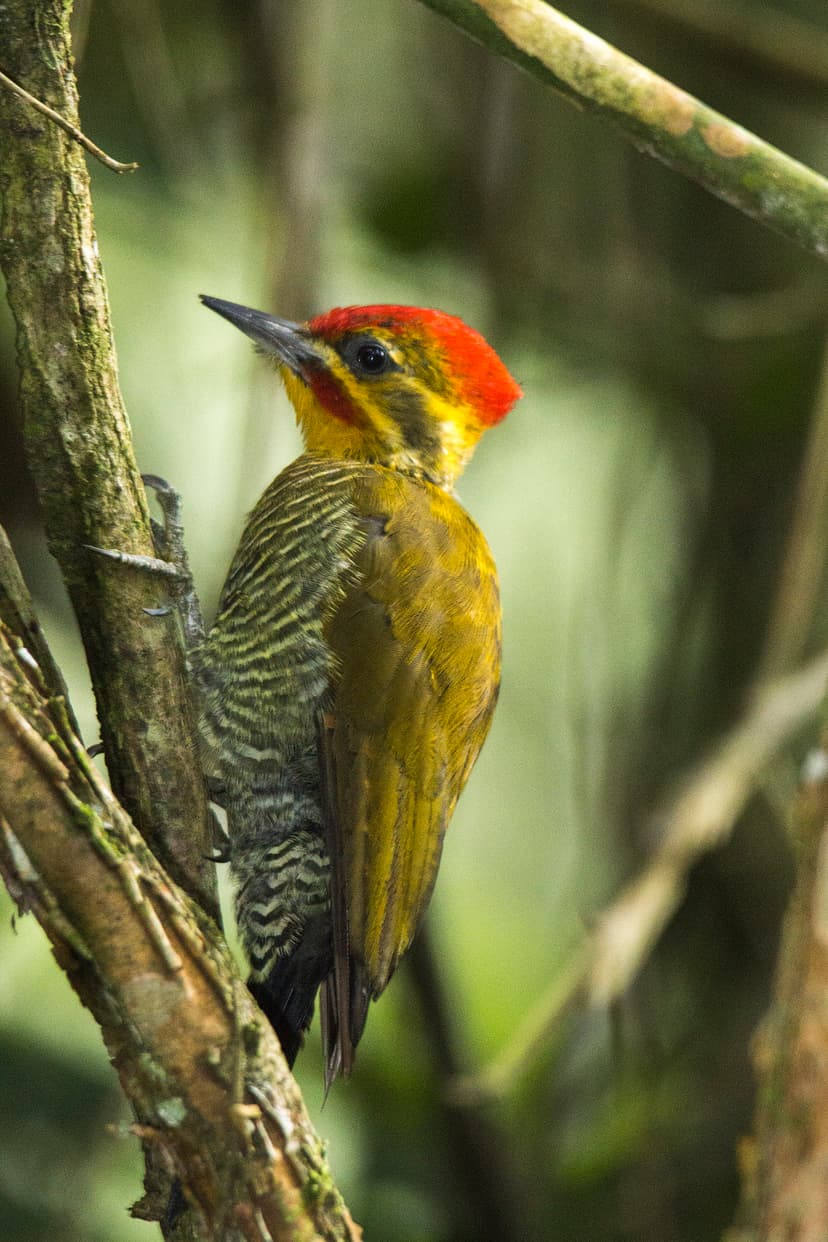
Yellow-browed woodpecker
The yellow-browed woodpecker, also known as the white-browed woodpecker, is a Near Threatened bird species found in Argentina, Brazil, Paraguay, and Uruguay. Measuring between 21 to 22 cm, it is characterized by its olive green upperparts and whitish underparts with dark olive bars, with males and females exhibiting distinct head plumage. This species primarily inhabits humid forests and woodlands, often foraging in the mid-levels for ants and their eggs.