
Campo flicker
The campo flicker is a medium-sized woodpecker found across South America, inhabiting a variety of open and semi-open landscapes. It is known for its terrestrial foraging habits, primarily feeding on ants and termites, and exhibits a complex breeding system.
Key Facts
- ›Found in Argentina, Bolivia, Brazil, Paraguay, Suriname, and Uruguay.
- ›Forages primarily on the ground, pecking and digging for ants and termites.
- ›Breeds in the dry season, typically August and September, excavating nest cavities.
- ›Both sexes have a black crown and yellow face with white around the eye; males have a red malar stripe, females a black one.
- ›Has a complex vocal repertoire including songs and sharp, nasal calls.
- ›Both subspecies are classified as Least Concern by the IUCN.

Campo Flicker, Field Flicker, Pampas Flicker
South America
Savanna, Pampas, Scrub, Gallery Forest, Forest Edges, Grasslands, Cerrado, Parks, Farmland, Pasture
Red Malar Stripe, Black Malar Stripe, Black Crown, Yellow Face, White Around the Eye
Ants, Termites
- Terrestrial foraging
- Pecking
- Digging
- Gleaning from ant and termite mounds, soil, stones, and dead wood
Termite Mounds, Earthen Banks, Trees, Fence Posts
- Song: Rapid 'wicwicwic---' repeated 10-12 times
- Calls: High, sharp, nasal 'tih', 'tir', or 'wur'
- Duets: High 'wicwicwic' answered by low 'wucwucwuc'
About Campo flicker
The campo flicker (Colaptes campestris) is a species of woodpecker native to South America, found in countries including Argentina, Bolivia, Brazil, Paraguay, Suriname, and Uruguay. This species, which can reach about 30 cm in length, is characterized by its black crown, yellow face with white eye-rings, and brown upperparts with dull white barring. Males are distinguished by a red malar stripe, while females possess a black one.
Habitat and Distribution
The campo flicker inhabits a diverse array of semi-open to open landscapes. Its range includes savannas, the Pampas, scrublands, gallery forests, forest edges, Pantanal grasslands, cerrado, and human-altered environments such as parks, farmland, and heavily grazed pastures. It can be found at elevations ranging from 80 to 1,700 meters.
Behavior and Diet
This species is almost entirely terrestrial in its foraging habits, often feeding in pairs or small social groups. They actively peck, dig, and glean for their primary food sources: ants and termites. Fruits constitute a very minor part of their diet. The campo flicker is generally considered a year-round resident in its range.
Breeding and Vocalization
The breeding season for the campo flicker typically peaks in the dry season, around August and September. Both sexes participate in excavating nest cavities in various substrates like termite mounds, earthen banks, trees, or fence posts. The species exhibits a complex social and reproductive system, and clutch sizes usually range from four to five eggs. Their vocalizations are varied, including a rapid song and sharp, nasal calls, with pairs often engaging in duets.
Conservation Status
The campo flicker is classified as Least Concern by the IUCN. It possesses large ranges and is considered common. While human land-use changes can offer increased open habitats, deforestation may pose a challenge by reducing available nesting sites. The overall population trend is believed to be increasing.
Source: Wikipedia ↗
Frequently Asked Questions
What is the scientific name of the campo flicker?
The scientific name of the campo flicker is Colaptes campestris. It belongs to the subfamily Picinae within the woodpecker family Picidae.
What are the main differences between the two subspecies of campo flicker?
The two subspecies, C. c. campestris and C. c. campestroides, differ primarily in the color of their throat; the nominate subspecies has a black throat, while campestroides has a white one. They also hybridize in their contact zones.
Where does the campo flicker typically live?
The campo flicker inhabits a wide variety of semi-open to open landscapes, including savannas, Pampas, scrub, gallery forests, forest edges, grasslands, cerrado, and altered areas like parks and farmland.
What does the campo flicker eat?
The campo flicker's diet consists almost entirely of ants and termites, including their adults, larvae, and pupae. Fruits form a very small portion of their diet.
How does the campo flicker build its nest?
Both male and female campo flickers excavate nest cavities. These nests can be found in termite mounds, earthen banks, trees, or fence posts.
What is the conservation status of the campo flicker?
Both subspecies of the campo flicker are considered to be of Least Concern by the IUCN. Their populations are believed to be increasing, and no immediate threats have been identified.
Related Woodpecker species
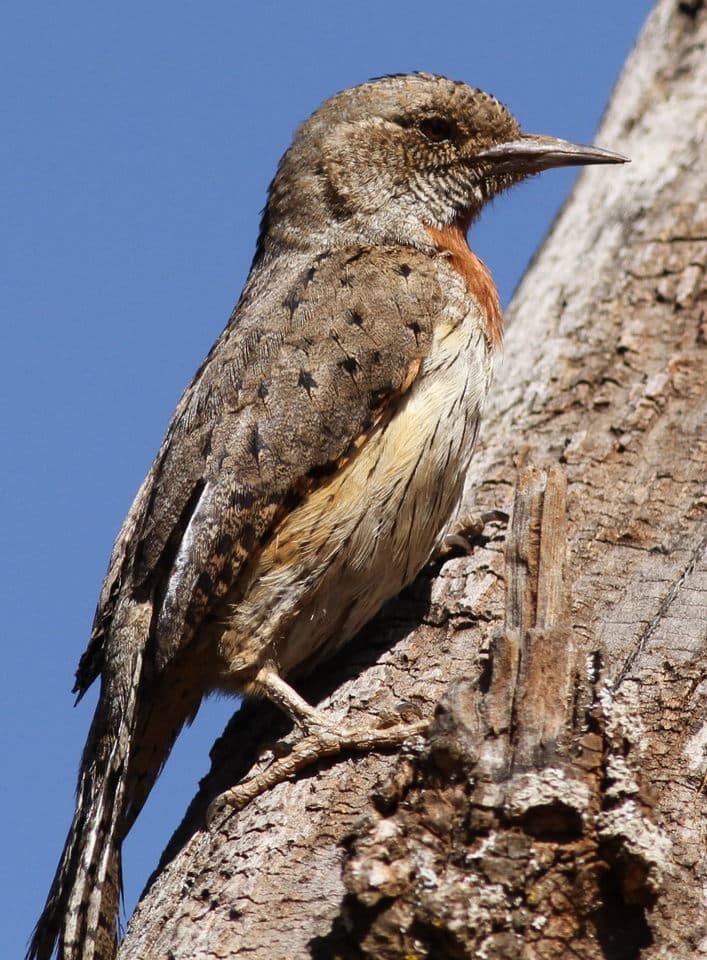
Red-throated wryneck
The red-throated wryneck is a slim, elongated bird found in sub-Saharan Africa, recognized by its cryptic plumage of greys and browns. It is a member of the woodpecker family, distinguished by its habit of twisting its neck when agitated. Primarily feeding on ants, it nests in pre-existing holes and is considered a species of least concern due to its large and increasing population.

African grey woodpecker
The African grey woodpecker is a widespread bird species found throughout much of Sub-Saharan and equatorial Africa. It is characterized by its green upperparts, pale grey head and underparts, and a red rump and belly patch, with males distinguished by a red crown. This woodpecker primarily inhabits forests and woodlands, where it nests in tree holes and feeds on insects.
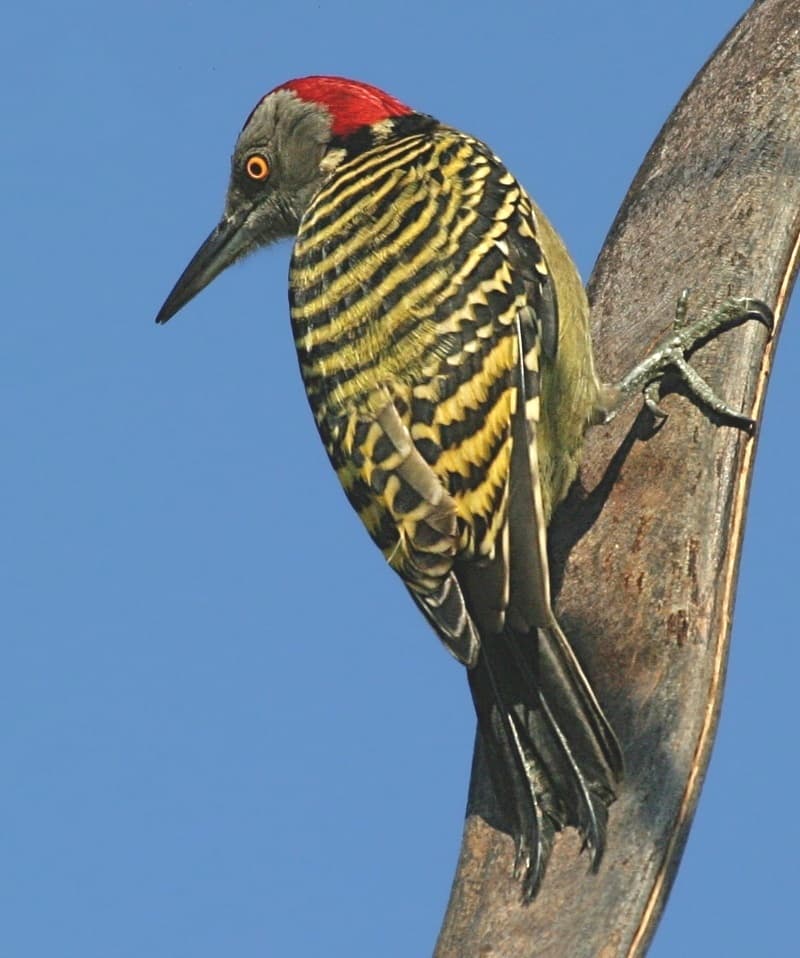
Hispaniolan woodpecker
The Hispaniolan woodpecker is a medium-sized, gold and black barred bird found exclusively on the island of Hispaniola. This species is known for its social behavior and distinctive vocalizations, inhabiting a variety of forest types, plantations, and even urban parks across both Haiti and the Dominican Republic.