
Bar-breasted piculet
The bar-breasted piculet is the smallest living species in the woodpecker family, characterized by its small size and distinctive barring on its underparts. It inhabits humid tropical forests primarily in the Amazon Basin, spanning parts of Bolivia, Brazil, Colombia, and Peru.
Key Facts
- ›It is the smallest extant species within the woodpecker family.
- ›Adults typically measure around 7.5 cm (3.0 in) in length and weigh between 8 to 10 g (0.28 to 0.35 oz).
- ›Its diet is believed to consist of insects and insect larvae, often foraged from the upper canopy.
- ›The breeding season is thought to occur between June and November.
- ›Its call is described as a high, thin "tsirrrit-tsit-tsit" or "see-see-suw."
- ›The species is classified as Least Concern by the IUCN, despite an unknown population size that is believed to be decreasing.

Bar-Breasted Piculet
Bolivia, Brazil, Colombia, Peru
- Humid Tropical Terra Firme Forest Edges and Clearings
- VáRzea Forest
- Secondary Forest
Barring On Underparts, Yellow Streaks On Forehead, White Spots On Crown
Insects, Insect Larvae
Prefers Upper Canopy
Tsirrrit-Tsit-Tsit, Extr. High, Very Thin 'See-See-Suw.'
About Bar-breasted piculet
The Bar-breasted Piculet
The bar-breasted piculet (Picumnus aurifrons) holds the distinction of being the smallest living species within the diverse woodpecker family (Picidae). This diminutive bird is found in the Amazon Basin, with its distribution encompassing parts of Bolivia, Brazil, Colombia, and Peru. Its scientific name, Picumnus aurifrons, reflects its characteristic features.
Description and Characteristics
Adult bar-breasted piculets typically measure around 7.5 cm (3.0 inches) in length and weigh between 8 to 10 grams. Males and females exhibit subtle differences in plumage. Adult males of the nominate subspecies, P. a. aurifrons, possess a black crown with yellow streaks on the forehead and white spots on the rest, complemented by gray-brown cheeks. Their upperparts are olive green, and their underparts are yellowish-white with brown barring on the breast and streaks on the flanks. Adult females are similar but feature white spots across their entire crown. Juveniles resemble adults but have a browner, streaked crown and lighter belly streaking.
There are seven recognized subspecies, each with slight variations in plumage, such as the intensity of barring on the breast or the coloration of forehead streaks, as seen in P. a. borbae and P. a. juruanus.
Distribution and Habitat
The bar-breasted piculet is primarily an inhabitant of the Amazon Basin. Its specific subspecies are distributed across various regions within Brazil, including Mato Grosso, and between major rivers like the Madeira, Tapajós, Tocantins, and Purus. It is also found in northeastern Peru, western Brazil along the Solimões River, eastern Peru, and northern Bolivia, extending to the upper Juruá River. The range of P. a. flavifrons has also been extended into southeastern Colombia. The species prefers the edges and clearings of humid tropical terra firme forests, but it can also be found in várzea forests and secondary forest regrowth. Its elevational range extends from near sea level up to 1,100 meters (3,600 feet).
Behavior and Ecology
This species is believed to be a year-round resident throughout its range, indicating it does not undertake significant seasonal migrations. Foraging behavior is not extensively documented, but it appears to favor the upper canopy. Its diet is presumed to consist of insects and insect larvae.
The breeding season for the bar-breasted piculet is thought to occur between June and November, though little else is known about its breeding biology. Vocalizations have been described as a high, thin "tsirrrit-tsit-tsit" or "see-see-suw."
Conservation Status
The International Union for Conservation of Nature (IUCN) has assessed the bar-breasted piculet as Least Concern. Despite possessing an extremely large geographic range, its population size is not precisely known and is believed to be decreasing. No immediate threats have been identified, and the species may be more common than currently observed, potentially being overlooked. It is known to occur in at least two protected areas in Peru.
Source: Wikipedia ↗
Frequently Asked Questions
What is the bar-breasted piculet's size?
The bar-breasted piculet is exceptionally small, making it the smallest recognized species in the entire woodpecker family. Adults typically measure about 7.5 cm (3.0 inches) in length.
What does the bar-breasted piculet eat?
While its diet has not been fully detailed, it is understood to consume insects. Insect larvae are also known to be part of its diet. It appears to prefer foraging in the upper canopy of its forest habitat.
Where does the bar-breasted piculet live?
This species is found within the Amazon Basin, with its range extending across Bolivia, Brazil, Colombia, and Peru. It primarily inhabits the edges and clearings of humid tropical terra firme forests, as well as várzea and secondary forests.
What is the conservation status of the bar-breasted piculet?
The bar-breasted piculet is currently listed as Least Concern by the International Union for Conservation of Nature (IUCN). Although its range is very large, its population size is not precisely known and is thought to be declining.
What sounds does the bar-breasted piculet make?
The vocalizations of the bar-breasted piculet have been described as sounding like "tsirrrit-tsit-tsit." Another description notes a very high, thin call of "see-see-suw."
Related Woodpecker species
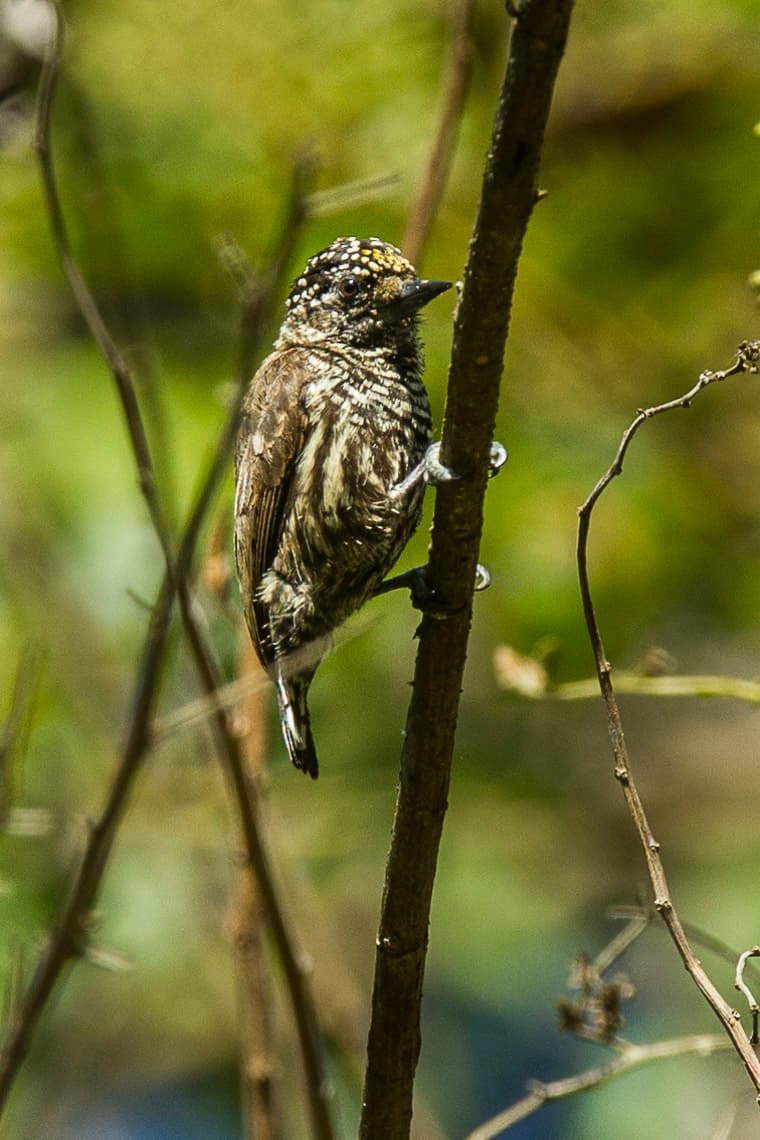
Ecuadorian piculet
The Ecuadorian piculet is a small bird found in the dry forests and scrublands of Ecuador and Peru. It is characterized by its gray-brown upperparts and whitish underparts with distinct barring, and males and females exhibit slight differences in their crown markings. This species is generally quiet but has a distinctive song and foraging habits.
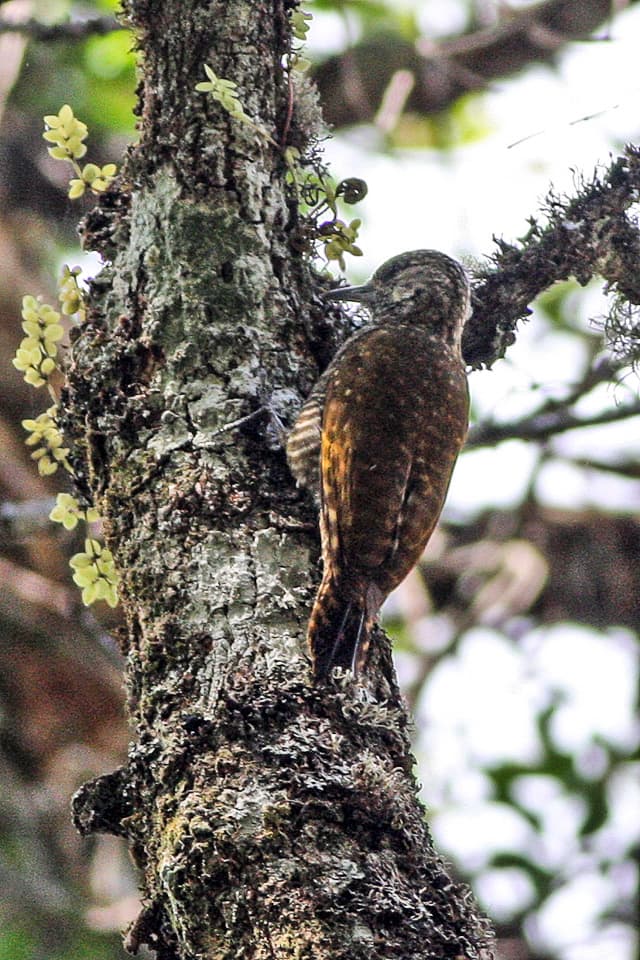
Dot-fronted woodpecker
The dot-fronted woodpecker (Veniliornis frontalis) is a species found in Argentina and Bolivia, inhabiting dry montane woodlands and humid forests. Measuring approximately 16 cm in length, it is characterized by its olive to gray-brown forehead with white spots, and males display red on their crown and nape.
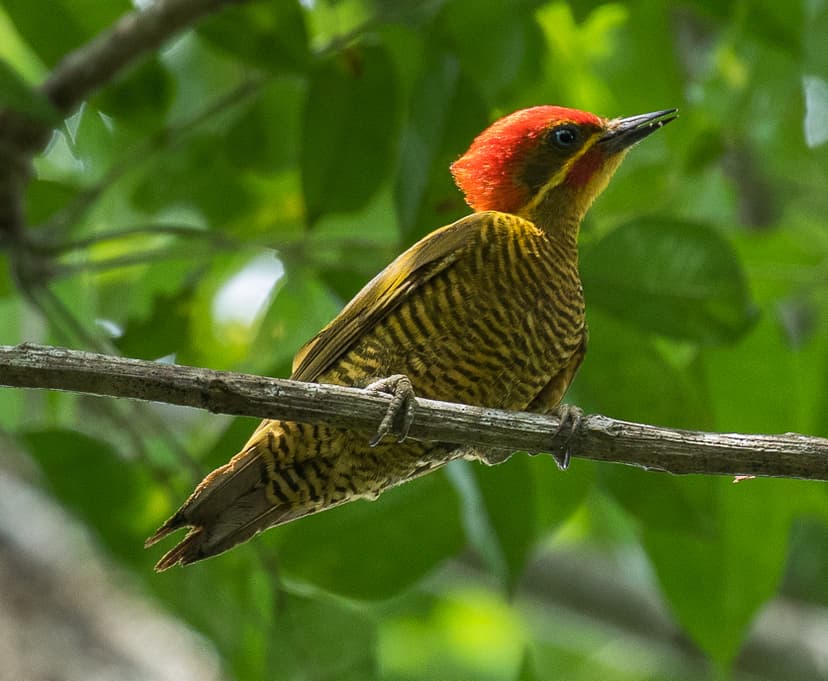
Golden-green woodpecker
The golden-green woodpecker is a South American bird found in a variety of wooded habitats across the continent. Characterized by its size and distinctive head markings that vary between sexes and subspecies, it primarily feeds on ants and termites. This species is generally considered to be of Least Concern, despite a suspected decreasing population trend.