
Golden-tailed woodpecker
The golden-tailed woodpecker is a species of bird found in woodlands and forests south of the equator, extending into parts of Africa. It is distinguished by its barred, greenish upper plumage, streaked underparts, and a characteristic strident call. This woodpecker primarily feeds on ants and termites, foraging by probing and gleaning, and excavates its nests in trees.
Key Facts
- ›Distinctive barred greenish upperparts and streaked underparts.
- ›Primarily feeds on arboreal ants and termites.
- ›Excavates nests in trees, usually on the underside of a branch.
- ›Found widely in woodlands and forests across sub-Saharan Africa.
- ›Males and females are distinguished by head markings and malar stripes.
- ›Has a characteristic strident call-note and soft drumming.
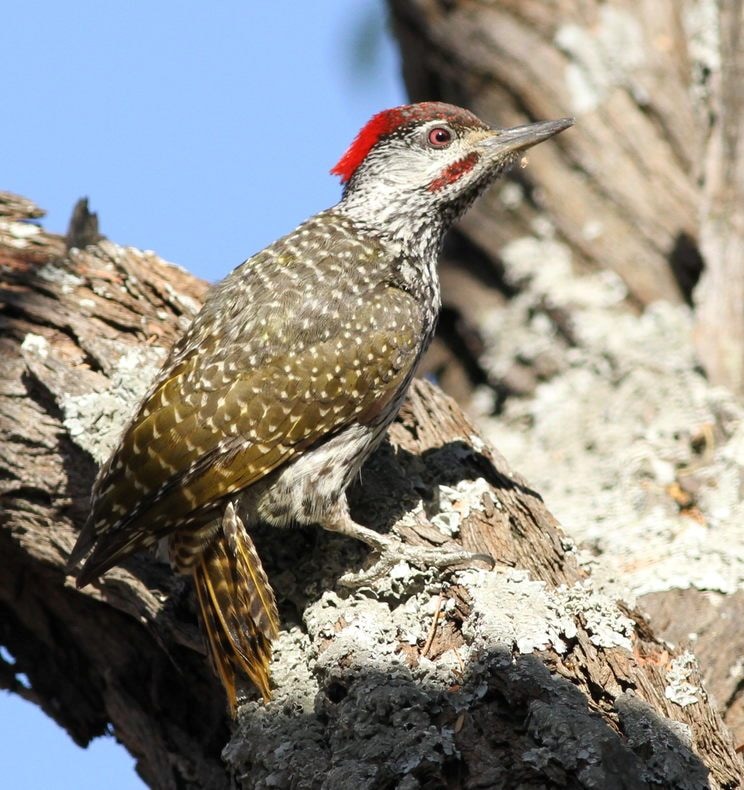
Abingdon's Woodpecker
Africa
Coastal Forest, Miombo Woodland, Mopane Woodland, Acacia Woodland, Riparian Woodland
Barred Upper Plumage, Streaked Underparts, Golden-Olive Tail, Red Fore-Crown, Black and Spotted White Fore-Crown, Red Malar Stripes, Mottled Black and White Malar Stripes
Ants, Termites, Millipedes, Wood-Boring Larvae, Leaf-Feeding Moth Larvae
Probing, Gleaning, Hammering Dead Or Infected Wood
Underside of a branch in a tree, Lower to middle level of a tree
Single Strident Call-Note, Long-Range Repeated Call, Soft Drumming
About Golden-tailed woodpecker
The golden-tailed woodpecker, scientifically known as Campethera abingoni, is a species of bird belonging to the family Picidae. It is distinguished by its barred, greenish upper plumage and streaked underparts, with golden-olive tails that are not markedly different from those of related species. Its specific name commemorates the 5th Earl of Abingdon, and it is part of a species complex that includes the Knysna and Mombasa woodpeckers.
Range and Habitat
This woodpecker is widespread in woodlands and forests, predominantly found south of the equator, with localized populations to the north. Its habitat includes coastal forests, miombo, mopane, and acacia woodlands. It shows a preference for riparian woodland, particularly in the drier regions of southern Africa. They establish territories of 10 to 15 hectares and can cover considerable distances between foraging sites.
Description and Behavior
Measuring 20 to 21 cm in length, the golden-tailed woodpecker exhibits sexual dimorphism in its head markings and malar stripes. Males have red fore-crowns and red malar stripes, while females have black and white spotted fore-crowns and mottled black and white malar stripes. Their iris is typically dark red but can vary, with slate-grey mandibles and greenish-olive legs and feet. Juveniles are heavily streaked and barred, with mottled malar stripes and a brown iris.
Diet and Nesting
The diet of the golden-tailed woodpecker primarily consists of arboreal ants and termites, supplemented by millipedes and various larvae. They obtain food by probing and gleaning, and also by hammering dead or infected wood, more frequently than other Campethera species. Nesting occurs during early summer, with both sexes excavating cavities, usually on the underside of a branch. They lay two to three glossy white eggs, incubated by both parents, with the male taking night shifts. Chicks are fed regurgitated food by both parents and fledge after 22 to 25 days. Their nests are known to be parasitized by various honeyguide species.
Vocalization
Beyond its characteristic single, strident call-note, often described as 'waaa' or 'weeea' usually by the male, the golden-tailed woodpecker also produces a long-range and repeated 'yaooaak-yaaaaaak'. It also drums softly. Several accepted races exist, with variations in plumage and size across their extensive African range.
Source: Wikipedia ↗
Frequently Asked Questions
What are the distinctive physical characteristics of the golden-tailed woodpecker?
The golden-tailed woodpecker is recognizable by its barred, greenish upper plumage and streaked underparts. While its golden-olive tail is not markedly different from related species, its single, strident call is characteristic. Males and females can be distinguished by their head markings and malar stripes.
What is the typical habitat of the golden-tailed woodpecker?
This species is found in coastal forests, miombo, mopane, and acacia woodlands. It shows a preference for riparian woodland, especially in the drier regions of southern Africa. They may forage intensively in the lower to middle strata of trees within their established territories.
What does the golden-tailed woodpecker eat?
The golden-tailed woodpecker's diet consists mainly of arboreal ants and termites. They also consume millipedes and various wood-boring and leaf-feeding moth larvae. They obtain most of their food by probing and gleaning, but also hammer dead or infected wood.
How does the golden-tailed woodpecker build its nest and raise its young?
Both sexes excavate nests, typically on the underside of a branch in trees. They lay two to three glossy white eggs, with both parents incubating and feeding the chicks regurgitated food. The incubation period is about 13 days, and the young leave the nest after 22 to 25 days.
Where is the golden-tailed woodpecker found?
The golden-tailed woodpecker is widespread in woodlands and forests south of the equator, with localized populations north of it. It inhabits numerous countries across sub-Saharan Africa, including Angola, Botswana, South Africa, and Tanzania.
Related Woodpecker species

Bearded woodpecker
The bearded woodpecker is a large African bird characterized by its striking black and white head with a distinct black moustache and eye-stripe, contrasting with a brownish, barred body. It inhabits a wide variety of wooded environments across tropical central Africa and is considered a fairly common species with a 'least concern' conservation status.

Acorn woodpecker
The Acorn Woodpecker is a medium-sized woodpecker recognized by its striking black and white plumage, with males sporting a red cap. These birds are highly social and exhibit cooperative breeding behaviors, living in family groups. They are predominantly found in oak-filled forests across Central America and into the western United States and Colombia, relying heavily on acorns for sustenance and storage.
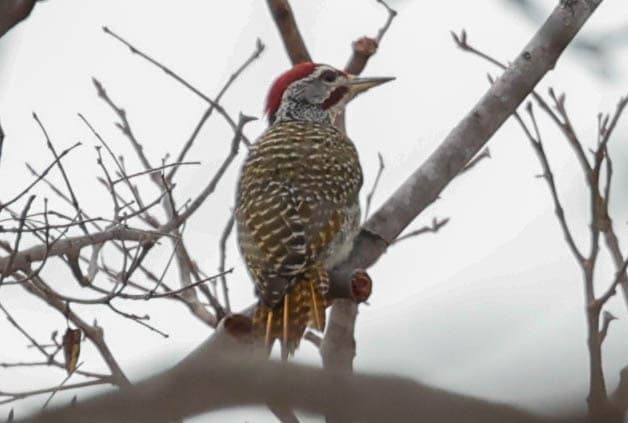
Speckle-throated woodpecker
The Speckle-throated woodpecker is an East African bird known for its greenish upperparts with yellowish barring and pale yellowish underparts marked with black speckles, particularly on the throat. It inhabits open woodlands across parts of Mozambique, Malawi, Tanzania, and formerly Kenya. This species is often considered a subspecies of Bennett's woodpecker.