
Black-cheeked woodpecker
The black-cheeked woodpecker is a medium-sized woodpecker found from Mexico south to Ecuador. It is characterized by its distinctive black "cheeks" extending from the eye down the neck, with males and females differing in head plumage. This species inhabits a variety of forest types and clearings, feeding on arthropods, fruits, and nectar.
Key Facts
- ›Found from southern Mexico south to Ecuador.
- ›Adults measure 17-19 cm in length and weigh 42-68 g.
- ›Males have a golden yellow forehead and red crown/nape; females have a white forehead and black crown with red hindcrown/nape.
- ›Diet includes arthropods, fruits, berries, seeds, catkins, and nectar.
- ›Nests are excavated in dead trunks or branches, typically 4-30 m above ground.
- ›Classified as Least Concern by the IUCN, though populations are believed to be decreasing due to deforestation.

Pucheran's Woodpecker
Mexico, Costa Rica, Panama, Colombia, Ecuador, Peru
Humid To Wet Evergreen Forest, Mature Secondary Forest, Abandoned Plantations, Clearings With Scattered Trees, Gardens
Black, White, Golden Yellow, Red, Olive-Buff, Gray, Buffish White, Yellow-Brown
- Black marking around the eye extending down the side of the neck
- White line behind the eye
- Black and white barred upper back
- White lower back and uppertail coverts with pale buff tinge
- Black flight feathers with narrow white tips and white bars
- Black tail with white bars on central feathers
- Red spot in the center of the belly
- Male: Golden yellow forehead, red crown and nape
- Female: White to buffy white forehead, black central crown, red hindcrown and nape
Arthropods, Fruits, Berries, Seeds, Catkins, Nectar
Probing, Pecking, Gleaning, Hawking, Clinging To the Underside of Branches, Joins Mixed-Species Foraging Flocks
Excavated nest hole in a dead trunk, Excavated nest hole in a dead branch
- Series of c. 4 short rattling trills on same pitch, 'churrr, churrr, churrr, churrr' or 'cherrr'
- Longer smoother rattle
- Loud full-toned 'krrrr'
- Higher-pitched piercing 'chirriree' or 'keereereek'
About Black-cheeked woodpecker
The black-cheeked woodpecker (Melanerpes pucherani) is a striking bird species belonging to the Picidae family. Its range extends from southern Mexico down to Ecuador, inhabiting a variety of forest environments.
Description and Identification
Adult black-cheeked woodpeckers typically measure between 17 and 19 cm in length and weigh between 42 and 68 grams. The sexes exhibit similar plumage except for their head patterns. Males are distinguished by a golden yellow forehead and a red crown and nape. Females, in contrast, possess a white to buffy white forehead, a black central crown, and a red hindcrown and nape. Both sexes share black markings around the eyes that extend down the neck, and a white line behind the eye. Their upper backs are barred black and white, while the lower back and uppertail coverts are whitish with a pale buff tinge. Flight feathers are black or brownish-black with narrow white tips and bars. The tail is black with white barring on the central feathers. The lores, cheeks, chin, and upper throat are whitish. The lower throat and breast are olive-buff with a gray tinge, and the rest of the underparts are buffish white with strong wavy bars and a distinctive red spot on the belly. Undertail coverts are yellow-brown. Juveniles are duller and browner with more diffuse barring and a smaller, paler belly spot.
Distribution and Habitat
This species is found from Veracruz and Chiapas in southern Mexico, continuing south along the Caribbean slope into Costa Rica. From there, it occupies both slopes in Panama, western Colombia, and western Ecuador, with a limited presence in Peru. The black-cheeked woodpecker prefers the interior and edges of humid to wet evergreen forests, mature secondary forests, and abandoned plantations. It can also be found in clearings with scattered trees and sometimes ventures into gardens, even those situated far from forest cover. Its altitudinal distribution is primarily between 700 and 900 meters, though it can occasionally be found up to 1,200 meters and, locally in Ecuador, as high as 1,500 meters.
Behavior and Ecology
The black-cheeked woodpecker is a year-round resident within its established range. Its diet is varied, consisting of a wide array of arthropods such as spiders, beetles, and ants, alongside aerial insects. It also consumes a considerable amount of plant matter, including fruits, berries, seeds, and catkins, and has been observed feeding on nectar from large tree flowers. Foraging typically occurs singly or in pairs, though groups may gather at fruiting trees, and the species sometimes joins mixed-species foraging flocks. They are active foragers, usually moving from the mid-level to the canopy of the forest, employing probing, pecking, gleaning, and hawking techniques. They are agile climbers, sometimes seen clinging to the undersides of branches.
Breeding and Vocalizations
The breeding season for the black-cheeked woodpecker spans from March to July. They excavate nest holes in dead tree trunks or branches, generally positioned between 4 and 30 meters above the ground. Both male and female birds participate in incubating the clutch, which typically consists of two to four eggs. The incubation period lasts for 14 days, and the young fledge approximately three weeks after hatching.
The most common vocalization of the black-cheeked woodpecker is a series of about four short, rattling trills, often described as 'churrr' or 'cherrr'. They also produce a longer, smoother rattle, a loud 'krrrr' call, and a higher-pitched piercing 'chirriree' or 'keereereek'. Both sexes engage in drumming, though not with great frequency.
Conservation Status
The IUCN has assessed the black-cheeked woodpecker as Least Concern. The species possesses a very large range and an estimated population of at least 50,000 mature individuals. However, this population is believed to be decreasing, largely due to extensive deforestation. No immediate threats have been identified, and the species occurs in several protected areas, but its numbers are negatively impacted by habitat loss.
Source: Wikipedia ↗
Frequently Asked Questions
What is the scientific name of the black-cheeked woodpecker?
The scientific name of the black-cheeked woodpecker is Melanerpes pucherani. This binomial nomenclature is used to classify the species within the woodpecker family Picidae.
What is the geographic range of the black-cheeked woodpecker?
The black-cheeked woodpecker is found from Veracruz and Chiapas in southern Mexico, extending south along the Caribbean slope into Costa Rica. It continues through Panama on both slopes, and into western Colombia and western Ecuador, with a slight extension into Peru.
What does the black-cheeked woodpecker eat?
Its diet is diverse, including a wide variety of arthropods such as spiders, beetles, and ants, as well as aerial insects. It also consumes significant amounts of plant material, including fruits, berries, seeds, and catkins, and has been observed taking nectar from tree flowers.
Where does the black-cheeked woodpecker build its nests?
The black-cheeked woodpecker excavates its nest holes in dead tree trunks or branches. These nests are typically located between 4 and 30 meters (approximately 15 to 100 feet) above the ground.
What is the conservation status of the black-cheeked woodpecker?
The black-cheeked woodpecker is listed as Least Concern by the International Union for Conservation of Nature (IUCN). Despite a large range and population, estimates suggest the population is decreasing, primarily due to extensive deforestation.
Related Woodpecker species

Jamaican woodpecker
The Jamaican woodpecker is a striking bird endemic to Jamaica, distinguishable by its black and white barred plumage and red accents. This species inhabits a wide array of wooded environments across the island, from sea level to high mountains. Its diet is a mix of insects and fruits, and it is a year-round resident known for its distinctive calls and drumming.

Golden-olive woodpecker
The golden-olive woodpecker is a widespread bird species found from Mexico through South America, excluding Chile, Paraguay, and Uruguay. It inhabits a diverse range of wooded environments, from dry thornscrubs to humid rainforests. This species is characterized by its green upperparts with a bronze tinge and buffy yellow underparts with blackish bars, with males and females differing in head plumage.
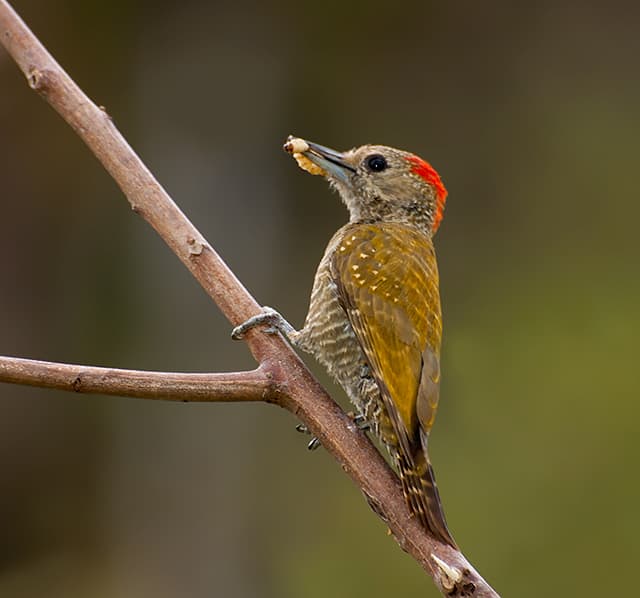
Little woodpecker
The little woodpecker (Veniliornis passerinus) is a small South American bird found in a wide variety of wooded habitats, generally avoiding dense forest interiors. Males and females share similar plumage, with males displaying red on their heads. This adaptable species is widespread across the continent and is currently listed as Least Concern.