
Golden-olive woodpecker
The golden-olive woodpecker is a widespread bird species found from Mexico through South America, excluding Chile, Paraguay, and Uruguay. It inhabits a diverse range of wooded environments, from dry thornscrubs to humid rainforests. This species is characterized by its green upperparts with a bronze tinge and buffy yellow underparts with blackish bars, with males and females differing in head plumage.
Key Facts
- ›Inhabits a wide range of wooded environments from dry thornscrubs to humid rainforests.
- ›Diet primarily consists of ants, termites, and wood-boring beetles and their larvae.
- ›Nests are excavated in living or dead trees or palms.
- ›Males and females have similar plumage, with differences primarily on the head.
- ›Assessed as Least Concern by the IUCN due to its large range, despite a decreasing population trend.

Rusty-Crowned Woodpecker, Bronze-Winged Woodpecker
North America, Central America, South America
Thornscrub, Rainforest, Cloudforest, Oak-Pine Woodland, Dry Deciduous Forest, Riparian Thickets, Mangroves, Forest Edges, Clearings With Scattered Trees, Shade-Grown Coffee Plantations
- Green upperparts with a bronze tinge
- Buffy yellow underparts with blackish bars
- Males have a red malar stripe and red on crown/nape
- Females have red only on the nape and streaked malar area
Ants, Termites, Wood-Boring Beetles, Larvae, Fruits, Berries, MüLlerian Bodies
- Explores trunks, limbs, branches, and vines of trees
- Hunts alone, in pairs, or in mixed-species flocks
- Pecks, hammers, probes, pries, and gleans for prey
Living Trees, Dead Trees, Palms
- Protracted Rising Rattling Trill
- Repeated Loud, Clear Dree
- Single Sharp Deeeeh
- Sharp Kyown
- Churr, Choo-úR
- Liquid Woick-Woick-Woick
- Utzia-Deek
- Short, Sometimes Repeated Drumming Rolls Or Separated Strikes
About Golden-olive woodpecker
The golden-olive woodpecker (Colaptes rubiginosus), also known by names such as the rusty-crowned woodpecker or bronze-winged woodpecker, is a widely distributed bird species belonging to the woodpecker family, Picidae. Its extensive range spans from Mexico southward through Panama and across most of mainland South America, notably absent only from Chile, Paraguay, and Uruguay. This adaptable species thrives in a diverse array of wooded environments, encompassing everything from arid tropical thornscrubs and dry deciduous forests to humid rainforests, cloudforests, and even managed landscapes like shade-grown coffee plantations.
Physical Description and Identification
Adult golden-olive woodpeckers typically measure between 18 and 23 centimeters in length. Both sexes share a plumage characterized by green upperparts with a distinct bronze tinge and buffy yellow underparts marked with blackish bars. The primary distinctions between males and females are found on their heads: adult males of the nominate subspecies possess a slate gray forehead and crown bordered with red, along with a prominent red malar stripe. Adult females, in contrast, display red coloration solely on their nape, and their malar area is streaked rather than uniformly red.
Behavior and Ecology
The golden-olive woodpecker is a year-round resident throughout its range. Its diet predominantly consists of insects, including ants, termites, and the larvae of wood-boring beetles, supplemented occasionally by fruits and berries. They have also been observed consuming Müllerian bodies, specialized growths produced by Cecropia plants for ant symbionts. Foraging occurs from the mid-level to the canopy of forests, where they explore tree trunks, branches, and vines using a variety of techniques such as pecking, hammering, probing, prying, and gleaning.
Nesting and Reproduction
This species excavates its nest cavities in living or dead trees or palms, at heights ranging from 1.2 to 18 meters above the ground. The breeding season varies regionally, occurring between January and May in parts of Mexico and Colombia, and extending from December or January to June or July in Ecuador and Peru. Both sexes share incubation duties for clutches of two to four eggs. Nestlings are provisioned by both parents through regurgitation for approximately 24 days until fledging.
Conservation Status
The International Union for Conservation of Nature (IUCN) has classified the golden-olive woodpecker as Least Concern. Despite an unspecified but believed-to-be-decreasing population, its extremely large geographic range and adaptability to various wooded habitats contribute to its secure status. No immediate threats have been identified, and the species is considered fairly common to common across much of its territory, often found within protected areas.
Source: Wikipedia ↗
Frequently Asked Questions
Where is the golden-olive woodpecker found?
The golden-olive woodpecker is found from Mexico south and east through Panama, and in every mainland South American country except for Chile, Paraguay, and Uruguay. It inhabits a very wide variety of landscapes, including dry tropical thornscrubs, humid rainforests, cloudforests, oak-pine woodland, and riparian thickets.
What does the golden-olive woodpecker eat?
The primary diet of the golden-olive woodpecker consists of ants, termites, and wood-boring beetles and their larvae. They will also consume fruits and berries, though less frequently. Interestingly, they have also been noted to eat Müllerian bodies, which are growths produced by Cecropia plants to feed ants.
How does the golden-olive woodpecker build its nest?
This species excavates its nest cavity in a living or dead tree or palm. These nests can be located anywhere between 1.2 and 18 meters above the ground. Both male and female golden-olive woodpeckers participate in excavating the nest site.
What are the main physical characteristics of the golden-olive woodpecker?
The golden-olive woodpecker is typically 18 to 23 cm long. Both sexes have green upperparts with a bronze tinge and buffy yellow underparts with blackish bars. Adult males have a slate gray forehead and crown with a red border and nape, while females have red only on their nape and streaked malar areas.
What is the conservation status of the golden-olive woodpecker?
The golden-olive woodpecker is listed as Least Concern by the IUCN. While its population size is not precisely known and is believed to be decreasing, its extremely large range and ability to inhabit diverse wooded habitats suggest a secure future. No immediate threats have been identified.
Related Woodpecker species
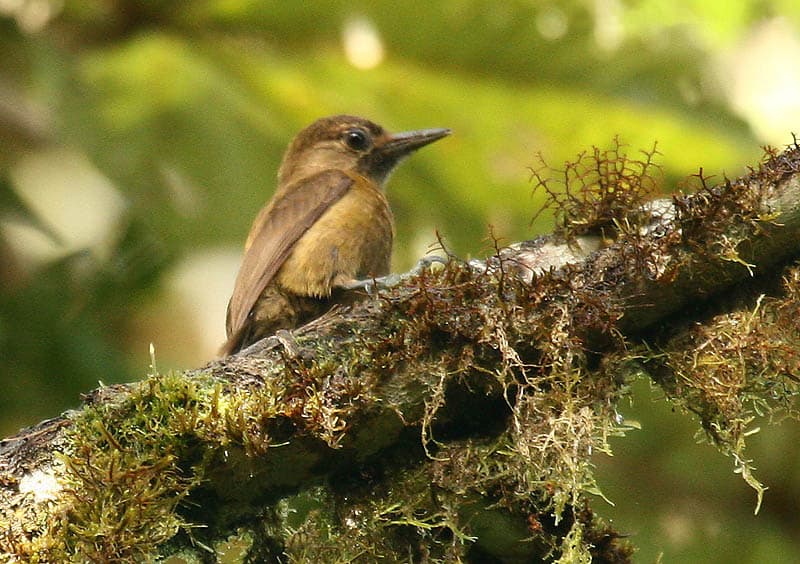
Smoky-brown woodpecker
The Smoky-brown woodpecker (Leuconotopicus fumigatus) is a widespread bird species found across Central and South America. This medium-sized woodpecker is characterized by its predominantly olive-brown plumage, with males displaying a red crown and females a dark brown one. It inhabits various wooded environments, from humid forests to dry woodlands and plantations, and primarily feeds on wood-boring beetles.

Black-cheeked woodpecker
The black-cheeked woodpecker is a medium-sized woodpecker found from Mexico south to Ecuador. It is characterized by its distinctive black "cheeks" extending from the eye down the neck, with males and females differing in head plumage. This species inhabits a variety of forest types and clearings, feeding on arthropods, fruits, and nectar.
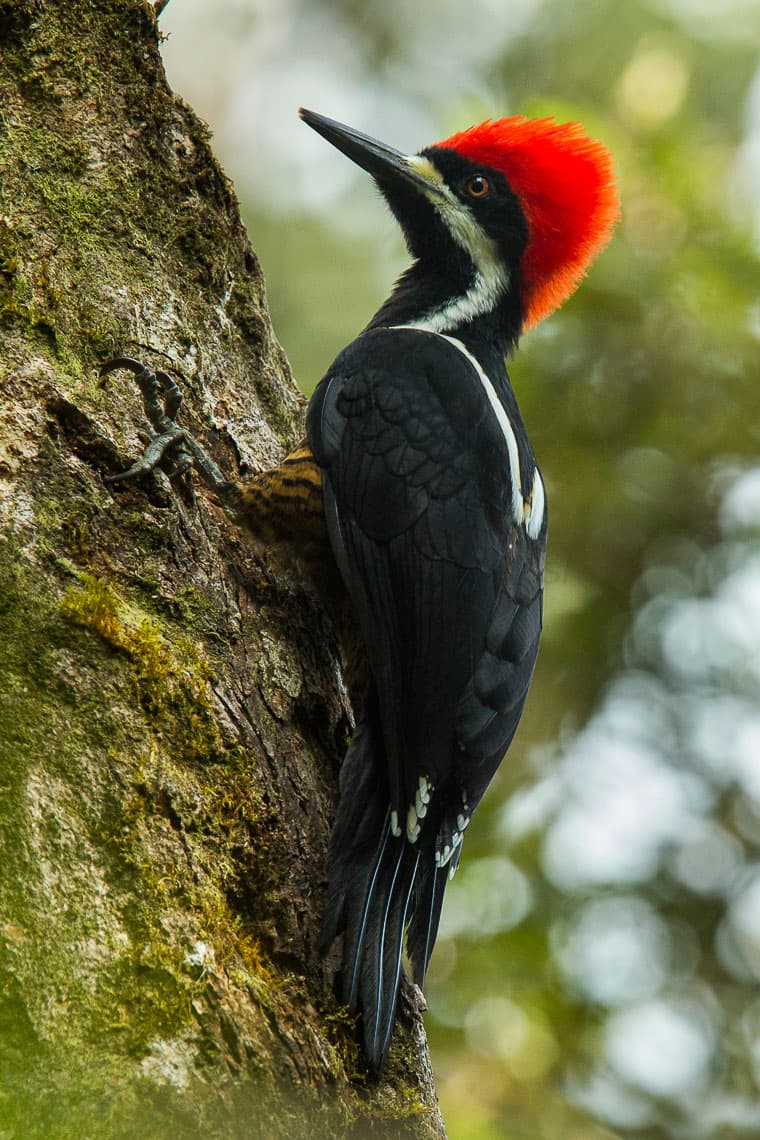
Powerful woodpecker
The powerful woodpecker is a large bird found in the montane forests of Colombia, Ecuador, Peru, and Venezuela. It is characterized by its striking black and white facial markings and the male's red head and crest, while females have black heads. This species is a year-round resident that forages at all forest levels.