
Himalayan flameback
The Himalayan flameback is a woodpecker species found across the Indian subcontinent, primarily inhabiting Himalayan sal forests and other tropical and subtropical woodlands. It is characterized by its black hind neck, distinctive throat markings, and coppery-brown to red wings. While not currently threatened, deforestation poses a potential risk to its populations.
Key Facts
- ›Inhabits lower-to-middle altitudes of Himalayan sal forests and other deciduous/semi-evergreen forests.
- ›Found year-round in Bangladesh, Bhutan, India, Myanmar, and Nepal, with a disjunct population in the southeastern Ghats.
- ›Males have a yellowish-red forehead and crest, while females have an entirely black crest streaked with white.
- ›Its call is a series of rapidly repeated 'klak-klak-klak-klak-klak' sounds, slower and softer than that of the Greater Goldenback.
- ›Breeds from March to may, nesting in excavated holes in trees and laying 2-3 eggs.
- ›Similar in appearance to the Greater Goldenback but smaller with a smaller bill.
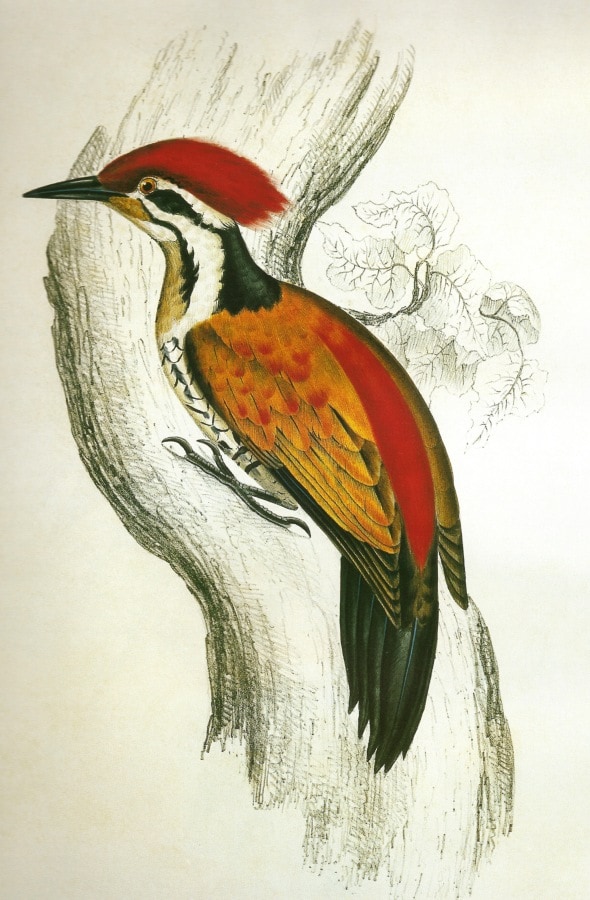
Himalayan Goldenback
Indian Subcontinent, Bangladesh, Bhutan, India, Myanmar, Nepal
Tropical/Subtropical Deciduous Forests, Semi-Evergreen Forests, Lowland Ficus Forests, Lowland Bombax Forests
Black hind neck, Brownish throat markings, Irregularly streaked black breast, Moustachial stripe, Three toes, Yellowish-red forehead and crest in males, Black crest streaked with white in females, White and black bands bordering the crest
Insects
Flocks and feeds with other bird species
Excavated Holes In Trees
- Series of Rapidly Repeated Klak-Klak-Klak-Klak-Klak
About Himalayan flameback
The Himalayan flameback, scientifically known as Dinopium shorii and also referred to as the Himalayan goldenback, is a species of woodpecker found across the Indian subcontinent. While currently not considered threatened, there is concern that deforestation could significantly impact its populations.
Description and Identification
This species is similar in appearance to the Greater Goldenback but is distinguished by its smaller size and bill. Key identifying features include a striking black hind neck and a brownish center on the throat, which can extend down the breast and is bordered by irregular black spotting. They possess an indistinct, divided moustachial stripe, with the center being brownish and sometimes reddish in males. The Himalayan flameback has either reddish or brown eyes and notably has three toes. The breast is irregularly streaked with black, though sometimes it appears completely white. Their wings are a coppery brown to red hue. A notable sexual dimorphism exists in the crest: males have a yellowish-red forehead that deepens to red on the crest, while the female's crest is entirely black and streaked with white. In both sexes, the crest is bordered by white and black bands on either side of the head.
Distribution and Habitat
Himalayan flamebacks are year-round residents primarily found in the lower-to-middle altitudes of the Himalayan sal forest region. Their range encompasses Bangladesh, Bhutan, India, Myanmar, and Nepal. A separate, disjunct population also exists in the southeastern Ghats. Their preferred habitats are mature tropical and subtropical deciduous forests, as well as semi-evergreen forests, with a particular affinity for lowland Ficus and Bombax forests.
Behavior and Reproduction
Very little is known about the detailed behavior and breeding habits of the Himalayan flameback. Their call is described as a series of rapidly repeated 'klak-klak-klak-klak-klak' sounds, which is slower and softer than that of the Greater Goldenback. Their diet is also poorly documented, but it is assumed to be primarily insects, as is common for many woodpecker species. They often forage in mixed-species flocks, frequently associating with birds like the Greater Goldenback. Breeding occurs between March and May, with nests excavated in tree cavities. The typical clutch size is between 2 to 3 eggs.
Source: Wikipedia ↗
Frequently Asked Questions
What are the distinguishing features of the Himalayan flameback?
The Himalayan flameback can be identified by its black hind neck, brownish throat markings that may extend to the breast with black spotting, and an indistinct moustachial stripe. Males also sport a yellowish-red forehead and crest, while females have a black crest streaked with white.
Where is the Himalayan flameback found?
This species is commonly found in the Indian subcontinent, primarily in the lower-to-middle altitudes of the Himalayan sal forest region. Its range includes Bangladesh, Bhutan, India, Myanmar, and Nepal, where it is a year-round resident.
What does the Himalayan flameback eat?
The diet of the Himalayan flameback is not well-documented. It is assumed that their primary food source consists of insects, similar to many other woodpecker species, and they are often observed foraging with other birds like the Greater Goldenback.
When does the Himalayan flameback breed?
The breeding season for the Himalayan flameback occurs from March to May. They nest in excavated holes in trees, and a typical clutch size consists of 2 to 3 eggs.
What is the conservation status of the Himalayan flameback?
The Himalayan flameback is not currently considered threatened. However, it is suspected that deforestation could have a severe impact on its population in the future.
What sounds does the Himalayan flameback make?
The characteristic call of the Himalayan flameback is a series of rapidly repeated 'klak-klak-klak-klak-klak' sounds. This call is noted to be slower and softer compared to the vocalizations of the Greater Goldenback.
Related Woodpecker species

Rufous woodpecker
The rufous woodpecker is a medium-sized brown woodpecker native to South and Southeast Asia, characterized by its short bill and dark, barred plumage. It is known for its unique nesting behavior, often constructing its nest within the carton nests of arboreal ants. This species primarily forages for small insects, particularly ants and termites, in various forest types.
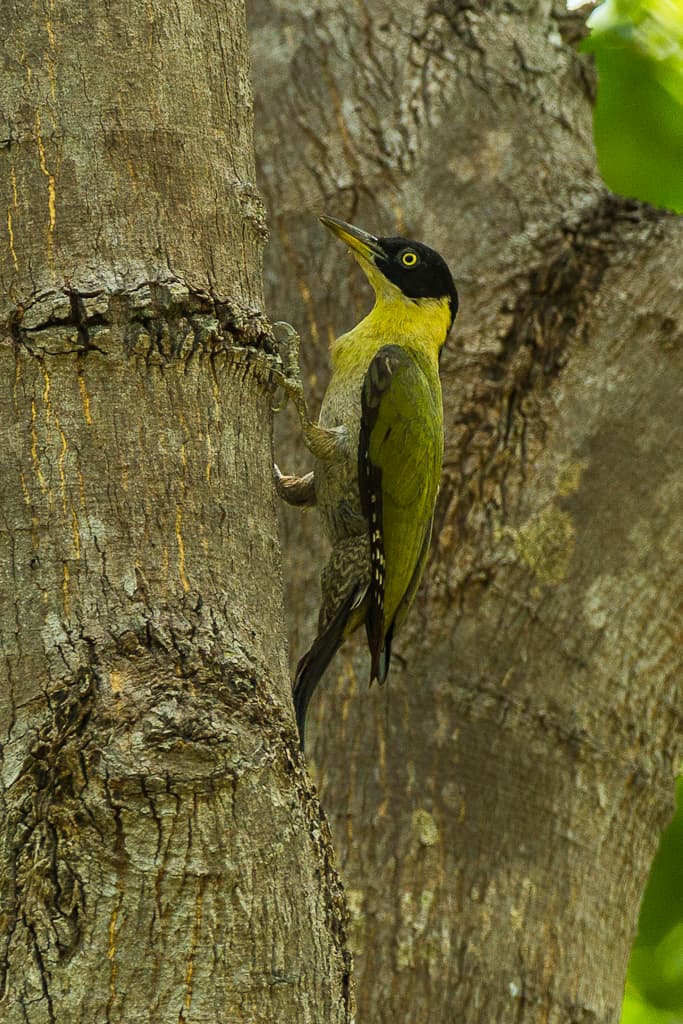
Black-headed woodpecker
The black-headed woodpecker is a medium-sized bird found in Cambodia, Laos, Myanmar, Thailand, and Vietnam, inhabiting deciduous and coniferous forests. It is characterized by its distinct plumage, including a black face, yellow throat, green wings, and a red lower back, with males possessing a red crown and females a black one. This species is insectivorous, primarily feeding on termites and ants, and is known for its loud, yelping vocalizations.

Bearded woodpecker
The bearded woodpecker is a large African bird characterized by its striking black and white head with a distinct black moustache and eye-stripe, contrasting with a brownish, barred body. It inhabits a wide variety of wooded environments across tropical central Africa and is considered a fairly common species with a 'least concern' conservation status.