
Blood-colored woodpecker
The blood-colored woodpecker is a small bird found in Guyana and Suriname, inhabiting coastal lowlands like mangroves and swamp forests. It is characterized by its crimson-red upperparts and distinctive head plumage, with males having a crimson crown and females a brown crown with white tips. This species is a year-round resident, known for its varied diet and unique nesting habits.
Key Facts
- ›Measures approximately 13 cm (5.1 inches) in length and weighs between 23 to 30 g (0.81 to 1.1 oz).
- ›Males and females differ in head plumage: males are crimson-red from crown to nape, while females have a brown crown with white feather tips.
- ›Inhabits coastal lowlands, including mangroves and swamp forests, and is sometimes found in coffee plantations.
- ›Its diet consists primarily of ants, beetles, and caterpillars.
- ›Nests are excavated by both sexes, often low to the ground in stumps or branches, with clutches typically containing one to three eggs.
- ›Assessed by the IUCN as Least Concern, with a believed stable population despite a limited range.
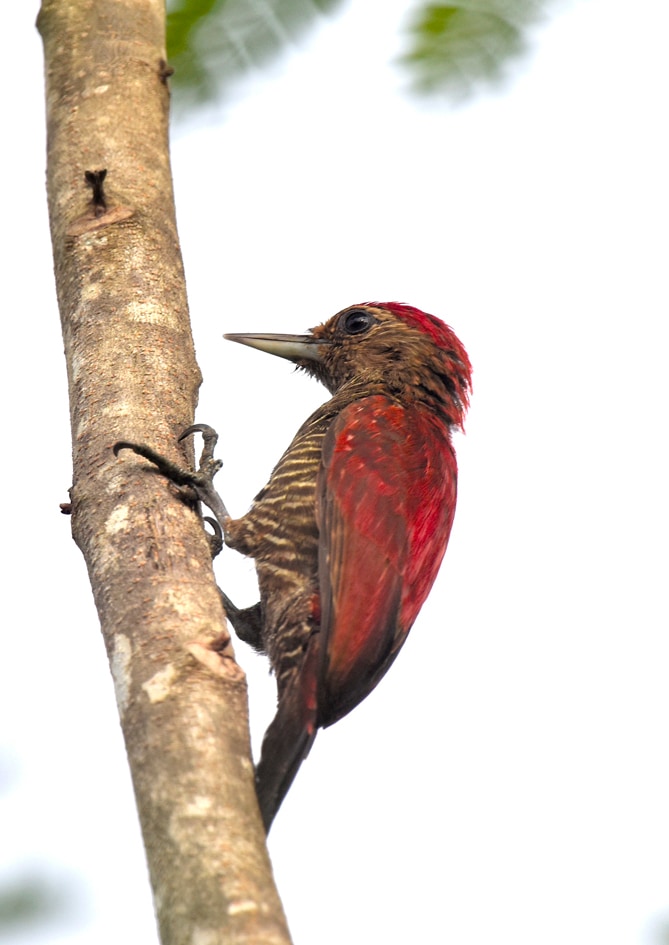
Blood-Coloured Woodpecker
Guyana, Suriname
Mangroves, Swamp Forest, Coastal Lowlands, Coffee Plantations
- Crimson-red upperparts
- Males with crimson crown to nape
- Females with brown crown and white feather tips
Ants, Beetles, Caterpillars
Forages In Trees and Shrubs, Typically Forages Singly Or In Pairs
Stumps, Branches, Low To the Ground
Single 'Keek' Notes, Fast Series of C. 16 'Wih' Notes
About Blood-colored woodpecker
The blood-colored woodpecker (Veniliornis sanguineus) is a species of bird belonging to the woodpecker family, Picidae. It is primarily found in the coastal lowland regions of Guyana and Suriname. This species is a year-round resident, inhabiting diverse environments such as mangroves, swamp forests, and occasionally coffee plantations.
Description and Identification
Adult blood-colored woodpeckers measure approximately 13 cm (5.1 inches) in length and weigh between 23 to 30 grams. The sexes exhibit sexual dimorphism, particularly in their head plumage. Both adults possess a largely brown face. Males are distinguished by a striking crimson-red coloration extending from their crown to the nape, with visible brown feather bases. Females, in contrast, have a brown crown featuring fine white feather tips. The upperparts of both sexes are a dark crimson-red with greenish-brown feather bases. Their flight feathers are dark brown, with the primaries edged in greenish-brown and the secondaries and tertials displaying wide crimson edges. The tail is dark brown, and their underparts are dark brownish, marked with off-white bars. The iris is dark red-brown, the beak is dark gray with a lighter tip, and the legs are blackish. Juveniles tend to be duller and browner than adults.
Behavior and Ecology
Blood-colored woodpeckers forage for food in trees and shrubs, typically observed alone or in pairs. Their diet consists mainly of insects, including ants, beetles, and caterpillars. The breeding behavior of this species has been documented in Suriname, with breeding activity recorded in February, March, and between May and November. Both sexes participate in excavating nest holes, which are usually situated low to the ground in stumps or branches and can take up to two months to complete. Clutch sizes usually range from one to three eggs. Both parents share the responsibilities of incubating the eggs and caring for the nestlings and fledglings. The exact incubation period and time to fledging are not precisely known.
Vocalizations
Characteristic vocalizations of the blood-colored woodpecker include single 'keek' notes, which are its most common call. It also produces a rapid series of approximately 16 'wih' notes. Both males and females engage in drumming.
Conservation Status
The International Union for Conservation of Nature (IUCN) has assessed the blood-colored woodpecker as Least Concern. While its range is limited and its exact population size is not determined, the population is believed to be stable. No significant immediate threats have been identified. The species is described as fairly widespread within its range but restricted to the lowlands of the Guianas. However, potential habitat loss has been noted as a threat that could emerge in the future.
Source: Wikipedia ↗
Frequently Asked Questions
Where can the blood-colored woodpecker be found?
The blood-colored woodpecker is primarily found in Guyana and Suriname, specifically in the coastal lowlands. It inhabits areas such as mangroves and swamp forests.
What do blood-colored woodpeckers eat?
Their diet includes a variety of insects, with ants, beetles, and caterpillars being common food sources. They forage in trees and shrubs for these prey.
How do blood-colored woodpeckers build their nests?
Both male and female blood-colored woodpeckers excavate nest holes, which can take up to two months to complete. These nests are typically located low to the ground in stumps or branches.
What is the conservation status of the blood-colored woodpecker?
The blood-colored woodpecker is listed as Least Concern by the IUCN. Its population is believed to be stable, and no immediate threats have been identified, although habitat loss could become a concern.
How do male and female blood-colored woodpeckers differ in appearance?
While their upperparts are similar, males and females have distinct head plumage. Males display a crimson-red crown and nape, whereas females have a brown crown adorned with thin white feather tips.
Related Woodpecker species

Cream-colored woodpecker
The cream-colored woodpecker is a South American bird species known for its predominantly yellowish plumage, long crest, and black tail. It inhabits various humid forest environments across much of mainland South America, excluding the southern cone. Primarily feeding on ants and termites, it plays a role in its ecosystem by breaking into arboreal nests for food.
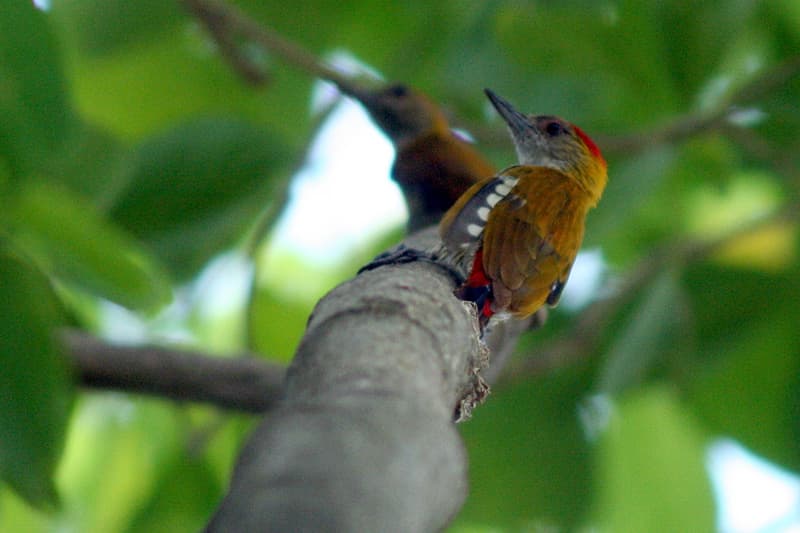
Red-rumped woodpecker
The red-rumped woodpecker is a bird species found in Central and South America, ranging from Costa Rica to Peru and Brazil. It is characterized by its olive-brown plumage with a crimson-red rump and uppertail coverts. This species inhabits a variety of forest types and savannas, and its diet primarily consists of insects.
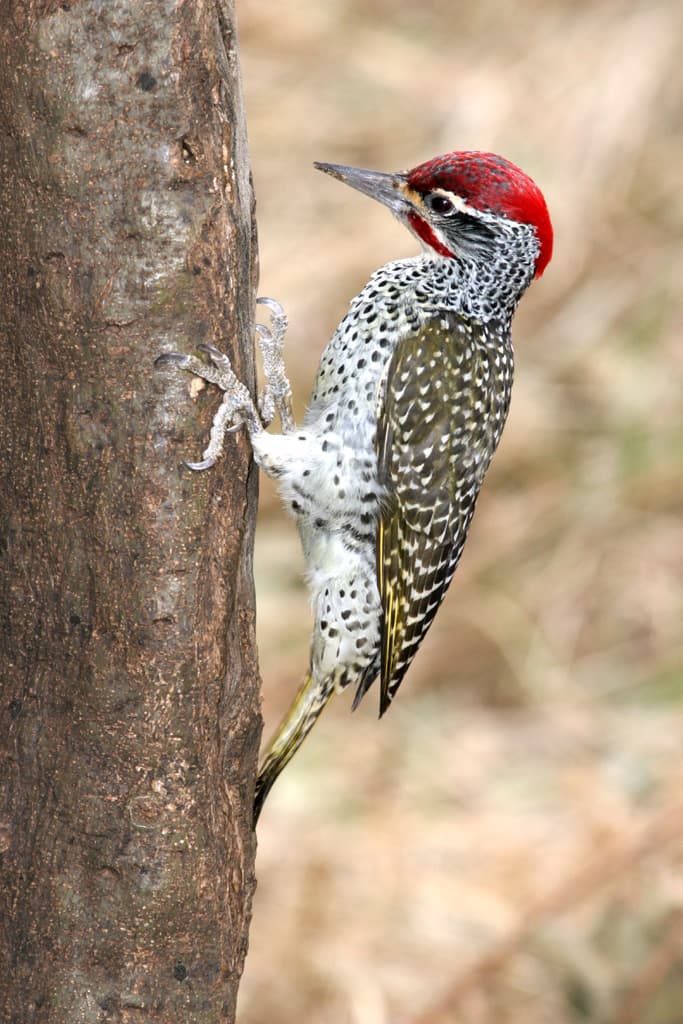
Nubian woodpecker
The Nubian woodpecker is a medium-sized bird found across Central and Eastern Africa, inhabiting open savannah woodlands and bushy areas. It is distinguished by its plumage, with males having a red crown and nape, while females have a black crown speckled with white. This species is common and its population is considered stable.