
Nubian woodpecker
The Nubian woodpecker is a medium-sized bird found across Central and Eastern Africa, inhabiting open savannah woodlands and bushy areas. It is distinguished by its plumage, with males having a red crown and nape, while females have a black crown speckled with white. This species is common and its population is considered stable.
Key Facts
- ›Found widely in Central and Eastern Africa, from Chad to Somalia and Tanzania.
- ›Measures approximately 21 cm in length.
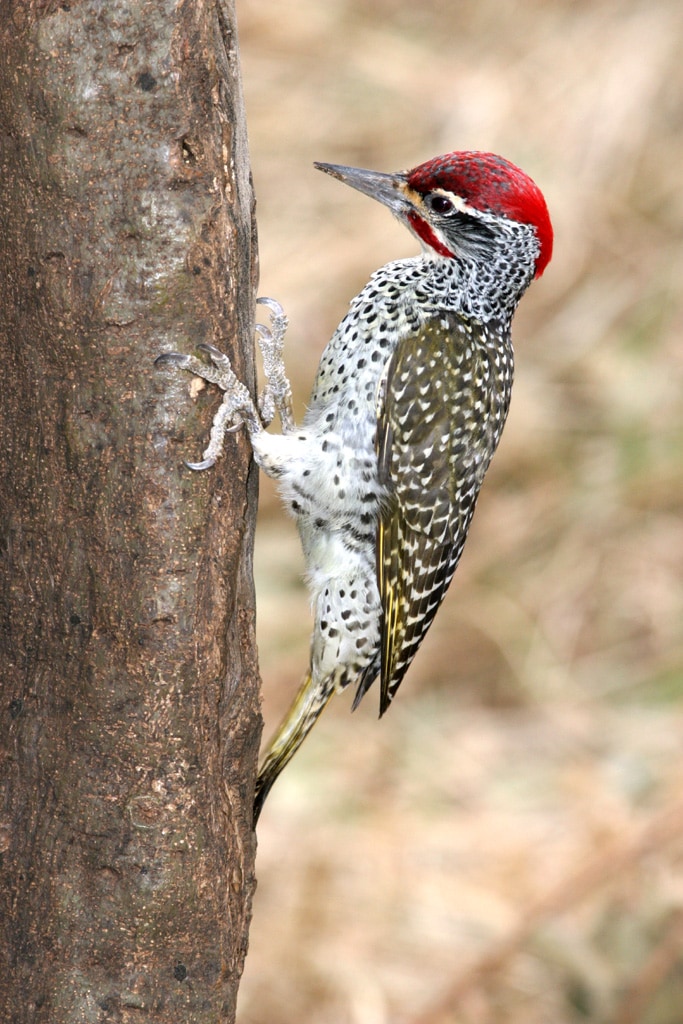
- ›Males have a red crown and nape, while females have a black crown with white speckling and a red nape.
- ›Inhabits open savannah woodland, bushy areas, and scrub.
- ›Feeds primarily on ants and termites, supplemented by spiders and beetles.
- ›Its conservation status is rated as 'least concern' by the IUCN.
Picus Nubicus
Central Africa, Eastern Africa
Open Savannah Woodland, Bushy Areas, Scrub
- Male: Red crown and nape, reddish cheek streak
- Female: Black crown speckled with white, red nape, dark cheek stripe with white speckling
- Upperparts olive-brown with cream speckling and barring
- Wings greenish-brown barred with white
- Tail greenish-yellow barred with brown
- Throat cream
- Head, neck, breast, and belly white, spotted and barred with black
Ants, Termites
Forages Mostly In Trees, Forages On the Ground
Shrill Ringing Or Piping Notes Repeated, Often Musical But Sometimes Metallic, Often Sung In Duet
About Nubian woodpecker
The Nubian woodpecker (Campethera nubica) is a medium-sized bird species belonging to the family Picidae. It is widely distributed throughout Central and Eastern Africa, with its range extending from Chad and Sudan in the west to Somalia and Kenya in the east, and south to Tanzania. This species is known for its distinctive plumage, which varies between the sexes.
Description and Identification
Adult Nubian woodpeckers typically measure around 21 cm (8.3 inches) in length. The male is characterized by a red crown and nape, along with a reddish streak on its cheek. In contrast, the female possesses a black crown speckled with white, a red nape, and a dark cheek stripe that is also speckled with white. The upper parts of both sexes are generally olive-brown, adorned with significant cream speckling and barring. Their wings are greenish-brown with white barring, and the tail is greenish-yellow barred with brown, featuring gold feather shafts. The throat is cream, while the head, neck, breast, and belly are white, marked with black spots and bars. The beak is grey with a dark tip, the eyes are red or pink, the orbital ring is grey, and the feet are olive or grey.
Distribution and Habitat
The Nubian woodpecker is endemic to eastern Africa, with its range encompassing countries such as Chad, Democratic Republic of the Congo, Djibouti, Eritrea, Ethiopia, Kenya, Somalia, South Sudan, Sudan, Tanzania, and Uganda. Its preferred habitat consists of open savannah woodlands, particularly those featuring Acacia and Euphorbia trees, as well as bushy areas and scrubland. The species is found at altitudes up to 2,000 meters (6,600 feet).
Behavior and Ecology
This species is non-migratory. Nubian woodpeckers often forage alone, communicating with their mates vocally. Their foraging activities take place primarily in trees, but they also descend to the ground to search for food. Their diet consists mainly of ants and termites, and they also consume spiders and beetles.
Vocalizations
The Nubian woodpecker produces a variety of vocalizations, including shrill ringing or piping notes that are often repeated. These calls can be musical but are sometimes described as metallic. It is also noted that they often sing in duet.
Source: Wikipedia ↗
Frequently Asked Questions
What is the scientific name of the Nubian woodpecker?
The scientific name of the Nubian woodpecker is Campethera nubica. It was first described by Pieter Boddaert in 1783.
Where is the Nubian woodpecker found?
The Nubian woodpecker is distributed widely across Central and Eastern Africa, with its range extending from Chad in the west to Somalia in the east and Tanzania in the south. It is also found in countries like Sudan, Ethiopia, Kenya, and the Democratic Republic of the Congo.
What does the Nubian woodpecker eat?
The Nubian woodpecker primarily forages for ants and termites. Its diet is also supplemented by other invertebrates such as spiders and beetles.
How can I identify a Nubian woodpecker?
Adult Nubian woodpeckers are about 21 cm long. Males are identifiable by their red crown and nape, and a reddish streak on the cheek. Females have a black crown speckled with white, a red nape, and a dark cheek stripe with white speckling. Both sexes have olive-brown upperparts with cream speckling and barring.
What is the conservation status of the Nubian woodpecker?
The Nubian woodpecker is rated as 'least concern' by the International Union for Conservation of Nature (IUCN). It is considered a fairly common species with a wide range and a stable population.
Related Woodpecker species

Melancholy woodpecker
The melancholy woodpecker is a species of woodpecker found in West Africa, inhabiting forests, woodlands, and clearings. This bird, measuring 17-18 cm in length, is characterized by its bronzy-green upperparts and greenish-yellow underparts with brown streaks. It is known for its insectivorous diet, foraging in family groups within the forest canopy.
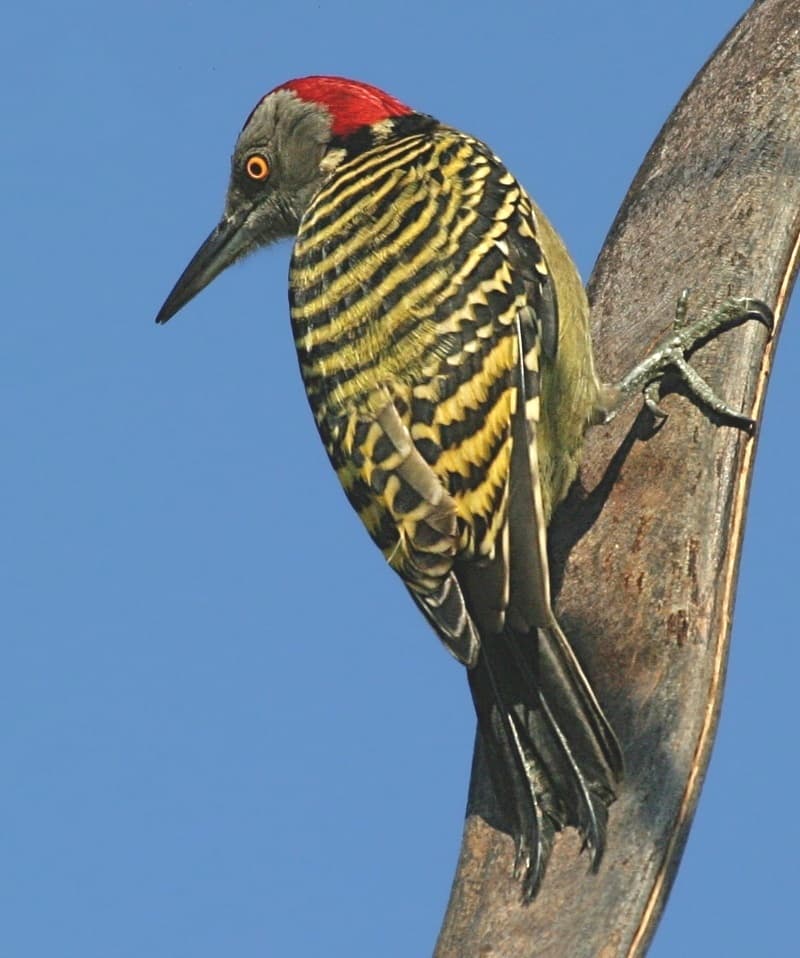
Hispaniolan woodpecker
The Hispaniolan woodpecker is a medium-sized, gold and black barred bird found exclusively on the island of Hispaniola. This species is known for its social behavior and distinctive vocalizations, inhabiting a variety of forest types, plantations, and even urban parks across both Haiti and the Dominican Republic.

Rusty-necked piculet
The rusty-necked piculet is a small woodpecker species, approximately 10 cm in length, inhabiting the seasonally flooded várzea forests along the Brazilian-Bolivian border, specifically the Rio Guaporé region. It is distinguished by the male's unique black crown with reddish-orange tips and the female's solid black crown, with both sexes exhibiting rusty buff to buff-brown on the sides and back of their neck and a pale stripe behind the eye.