
Cream-colored woodpecker
The cream-colored woodpecker is a South American bird species known for its predominantly yellowish plumage, long crest, and black tail. It inhabits various humid forest environments across much of mainland South America, excluding the southern cone. Primarily feeding on ants and termites, it plays a role in its ecosystem by breaking into arboreal nests for food.
Key Facts
- ›Found in most mainland South American countries, excluding Argentina, Chile, Paraguay, and Uruguay.
- ›Characterized by predominantly yellowish plumage, a long crest, and a black tail.
- ›Adult males possess a bright red malar stripe, absent in females.
- ›Feeds primarily on ants and termites, supplemented by fruits and seeds.
- ›Inhabits humid forest landscapes, including rainforests, Várzea, and swamp forests.
- ›Assessed as 'Least Concern' by the IUCN, despite a believed decreasing population trend.

Cream-Colored Woodpecker
South America
Rainforest, VáRzea, Swamp Forest, Gallery Forest, Mangroves, Deciduous and Open Woodland, Secondary Forest, Cacao Plantations
Yellowish, Creamy Yellow, Sulfur-Yellow, Cinnamon-White, Red, Brown, Rufous-Chestnut, Black
Long Crest, Black Tail, Bright Red Malar Stripe, Yellowish Bill, Red Or Red-Brown Iris
Ants, Termites, Fruits, Seeds
- Breaks into arboreal nests of ants and termites
- Forages at lower to middle forest levels
- Also forages in the canopy and on the ground
- Feeds alone, in pairs, or in small groups
Tree Cavities
High-Pitched Laugh, 'Wutchuk Kee-Hoo-Hoo-Hoo', 'Pueer, Pueer, Purr, Paw', 'Kiu-Kiu-Kiu-Kiu', 'WhéEjah'
About Cream-colored woodpecker
The cream-colored woodpecker (Celeus flavus) is a distinctive bird species found across much of South America. Its plumage is predominantly yellowish, with variations ranging from pale creamy yellow to sulfur-yellow, and it is characterized by a prominent long crest and a black tail. Adult males are further identifiable by a bright red malar stripe, a feature absent in females.
Distribution and Habitat
This species inhabits a variety of humid forest environments, often in proximity to water. Its preferred habitats include the interior and edges of rainforests, várzea (seasonally flooded forests), and swamp forests. While less common in gallery forests, mangroves, deciduous and open woodlands, and secondary forests, it can also be found in human-altered landscapes such as cacao plantations. Its elevational range is typically below 400 meters, though it can extend up to 700 meters.
Diet and Behavior
The cream-colored woodpecker's diet primarily consists of ants and termites, with fruits and seeds also forming a significant part of its food intake. It forages at various levels of the forest, from the lower to middle strata, and sometimes in the canopy or on the ground. A notable foraging technique involves breaking into the arboreal nests of its insect prey. These woodpeckers are generally year-round residents and do not migrate. Their vocalizations include a high-pitched laugh described as 'wutchuk kee-hoo-hoo-hoo', and other calls such as 'pueer, pueer, purr, paw' and 'kiu-kiu-kiu-kiu'.
Reproduction and Conservation
Information regarding the breeding biology of the cream-colored woodpecker is limited, with the breeding season appearing to vary geographically. Known nesting periods include April to June in Colombia and potentially earlier in Venezuela, with Suriname's season extending into February. The species nests in tree cavities. The cream-colored woodpecker is listed as 'Least Concern' by the IUCN. Despite possessing a very large range, its population is believed to be decreasing, although no immediate threats have been identified. It is considered rather uncommon in general, though it is notably common in Venezuela and occurs within several protected areas.
Source: Wikipedia ↗
Frequently Asked Questions
What is the scientific name for the cream-colored woodpecker?
The scientific name for the cream-colored woodpecker is *Celeus flavus*. This binomial nomenclature is used to classify the species within the scientific community.
Where can the cream-colored woodpecker be found?
This woodpecker species is distributed across most mainland South American countries. Its range includes countries like Colombia, Venezuela, Ecuador, Peru, Bolivia, and Brazil, but it is absent from Argentina, Chile, Paraguay, and Uruguay.
What does the cream-colored woodpecker eat?
The primary diet of the cream-colored woodpecker consists of ants and termites. It also consumes fruits and seeds to a lesser but still significant extent.
What are the distinguishing physical characteristics of the cream-colored woodpecker?
The cream-colored woodpecker is recognized by its mostly yellowish plumage, which can range from pale creamy yellow to sulfur-yellow. It also features a long crest and a black tail. Adult males are further distinguished by a bright red malar stripe.
What is the conservation status of the cream-colored woodpecker?
The cream-colored woodpecker is currently listed as 'Least Concern' by the International Union for Conservation of Nature (IUCN). While its range is extensive, its population is believed to be decreasing.
Does the cream-colored woodpecker migrate?
No, the cream-colored woodpecker is a year-round resident throughout its geographical range. It does not undertake seasonal migrations.
Related Woodpecker species
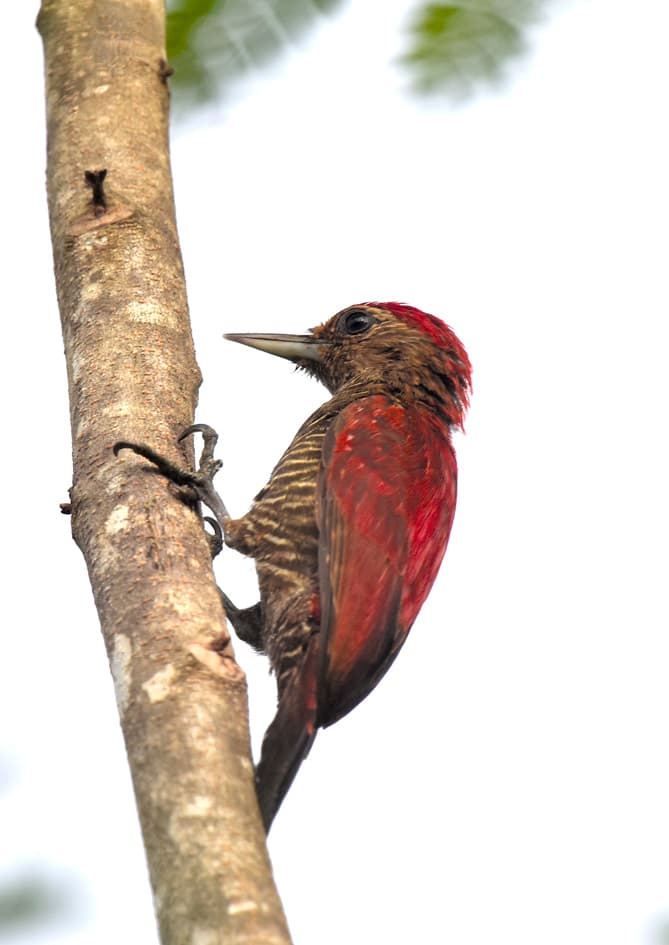
Blood-colored woodpecker
The blood-colored woodpecker is a small bird found in Guyana and Suriname, inhabiting coastal lowlands like mangroves and swamp forests. It is characterized by its crimson-red upperparts and distinctive head plumage, with males having a crimson crown and females a brown crown with white tips. This species is a year-round resident, known for its varied diet and unique nesting habits.
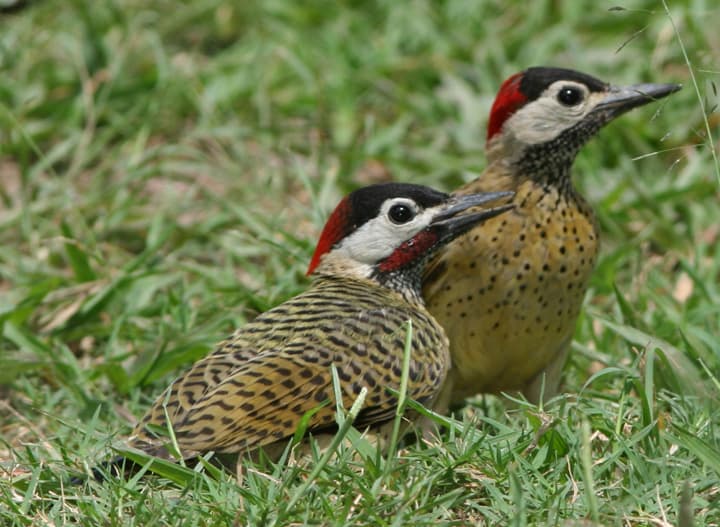
Spot-breasted woodpecker
The spot-breasted woodpecker (Colaptes punctigula) is a bird species found across much of mainland South America and Panama. It is characterized by its distinctive black and white spotted throat and is known for its varied vocalizations and adaptable habitat preferences, inhabiting humid lowland landscapes including forests, savannas, and plantations.
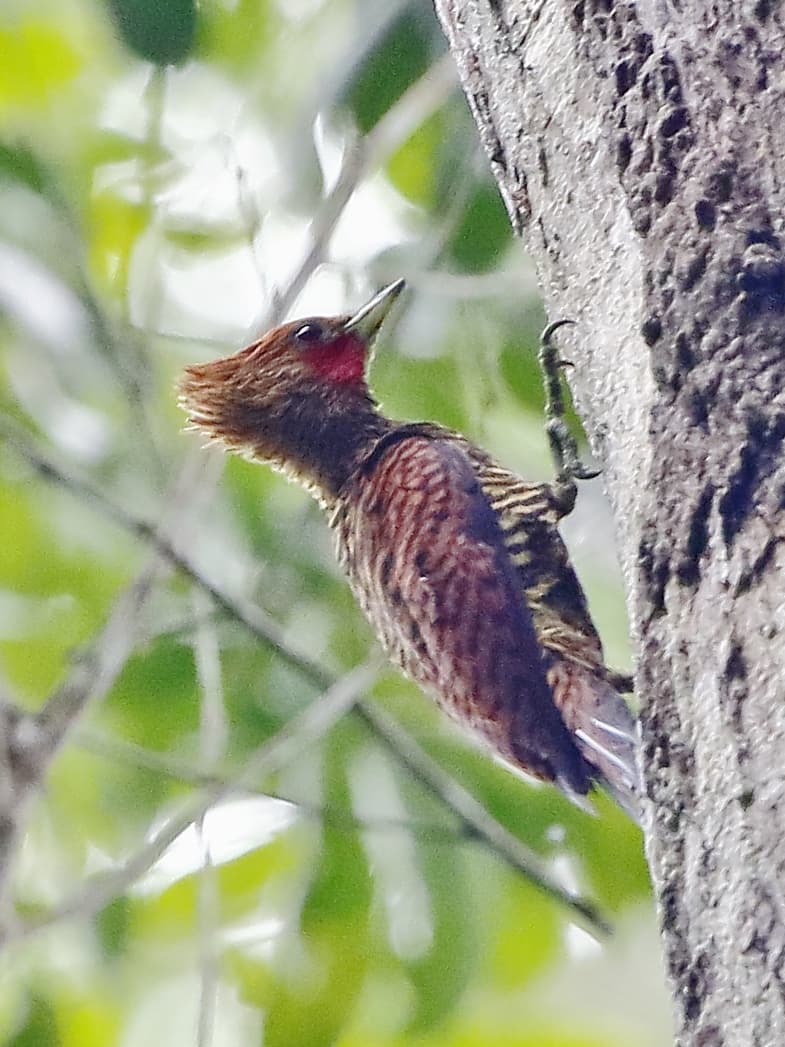
Waved woodpecker
The Waved Woodpecker (Celeus undatus) is a species found across much of northern South America, inhabiting various wooded landscapes from rainforest edges to savannas. It is characterized by its rufous-chestnut plumage, often marked with wavy black bars, and a distinctive crest. Primarily feeding on ants and termites, this species excavates its nest cavities in trees.