
Yucatan woodpecker
The Yucatan woodpecker is a small bird found in the dry forests and shrublands of the Yucatán Peninsula and surrounding areas in Belize and Mexico. It is characterized by its light gray underparts, black and white barred back, and a distinctive red cap on males. This species is known for its unique vocalizations and its ability to forage in degraded habitats.
Key Facts
- ›Found in Belize and Mexico, primarily on the Yucatán Peninsula and its offshore islands.
- ›Measures about 17 cm (6.7 in) in length.
- ›Adults have light gray faces and underparts with black and white barring on their back, wings, and tail.
- ›Males have a red cap extending from the eye to the nape, while females have red only on the occipital area.
- ›Inhabits subtropical or tropical dry forests, shrublands, and degraded former forests.
- ›Its conservation status is assessed as 'least concern' with a believed stable population.

Red-Vented Woodpecker
Belize, Mexico, Guatemala, Honduras
- Red cap on males
- Red patch on occipital area in females
- Yellow feathers around the base of the bill
- Black and white barred pattern on back, wings, and tail
- Silvery appearance of back barring from a distance
- Distinctive Vocalizations Different From Golden-Fronted Woodpecker
About Yucatan woodpecker
The Yucatan woodpecker, scientifically known as Melanerpes pygmaeus, is a species of bird belonging to the family Picidae. It is also sometimes referred to as the red-vented woodpecker. This species is a resident of Central America, with its primary range encompassing the Yucatán Peninsula, Belize, northeastern Guatemala, and extending to offshore islands such as Cozumel and Guanaja off the coast of Honduras.
Description and Identification
Adult Yucatan woodpeckers typically measure around 17 cm (6.7 inches) in length. Their plumage is characterized by light gray on the face and underparts, contrasted with black and white barring on the back, wings, and tail. Adult males possess a distinctive red cap that extends from the eye to the nape, while females have a smaller red patch confined to the occipital area. Yellow feathers are often visible around the base of the bill, and there may be a yellowish tinge to the belly or a red wash on the vent area.
The Yucatan woodpecker shares a strong visual resemblance with the Golden-fronted woodpecker (Melanerpes aurifrons), which also inhabits the Yucatán Peninsula, making field identification challenging. Key differences include the Golden-fronted woodpecker's larger size, longer beak, and reddish feathers at the bill base, contrasting with the Yucatan woodpecker's yellow bill-base feathers. From a distance, the barring pattern on the back of the Golden-fronted woodpecker appears blackish, whereas it has a silvery appearance in the Yucatan woodpecker. Vocalizations also serve as a distinguishing factor.
Distribution and Habitat
The Yucatan woodpecker is endemic to Central America and is primarily found in subtropical or tropical dry forests, dry shrublands, and significantly degraded former forest areas. They are commonly observed in clearings, near the edges of dry woodlands, and in coastal scrub, though they may also inhabit damper woodland environments.
Conservation Status
The International Union for Conservation of Nature (IUCN) assesses the Yucatan woodpecker's conservation status as 'least concern'. This designation reflects the species' believed stable population and extensive geographic range, indicating it is not currently facing significant threats to its survival.
Source: Wikipedia ↗
Frequently Asked Questions
What is the scientific name of the Yucatan woodpecker?
The scientific name of the Yucatan woodpecker is Melanerpes pygmaeus. This binomial nomenclature is used to classify the species within the scientific community.
Where can the Yucatan woodpecker be found?
The Yucatan woodpecker is endemic to Central America, with its range including the Yucatán Peninsula, Belize, northeastern Guatemala, and offshore islands like Cozumel and Guanaja.
What are the natural habitats of the Yucatan woodpecker?
This species prefers subtropical or tropical dry forests, dry shrublands, and areas that have been heavily degraded from their original forest state. They are often found in clearings and along the edges of dry woodlands.
How can I distinguish a Yucatan woodpecker from a Golden-fronted woodpecker?
Distinguishing them can be difficult. The Golden-fronted woodpecker is larger with a longer beak, has reddish feathers at the bill base (vs. yellow on Yucatan), and its back barring appears blackish from a distance (vs. silvery on Yucatan). Vocalizations also differ.
What is the conservation status of the Yucatan woodpecker?
The Yucatan woodpecker is listed as 'least concern' by the IUCN. This assessment is based on its believed stable population and extensive range.
What colors are present in the Yucatan woodpecker's plumage?
Adult Yucatan woodpeckers are mainly light gray on the face and underparts. They feature black and white barring on their back, wings, and tail. Males have a red cap, and both sexes may show yellow feathers around the bill base and a yellowish tinge on the belly or a red wash on the vent.
Related Woodpecker species
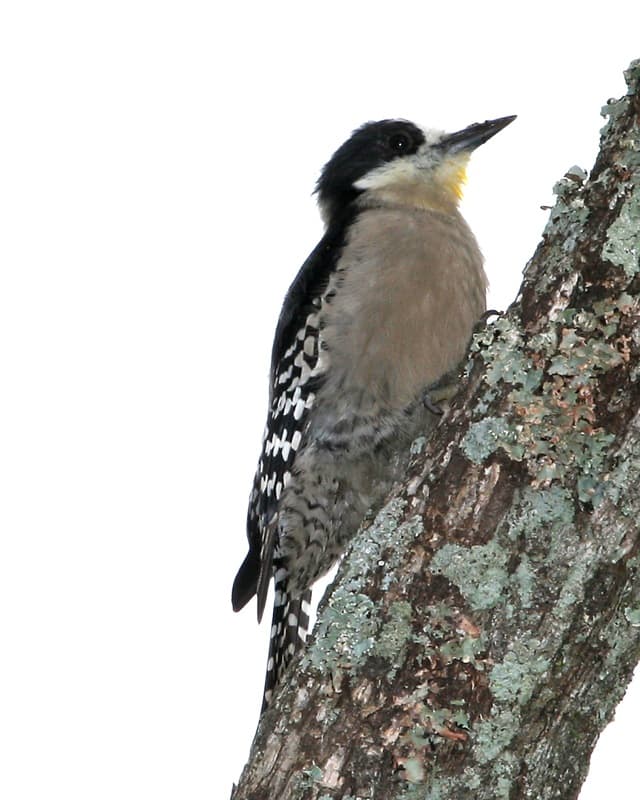
White-fronted woodpecker
The white-fronted woodpecker (Melanerpes cactorum) is a South American bird found in dry forests, shrublands, and savannahs. This species is characterized by its glossy black upperparts with a distinctive white line down the back, and white cheeks and throat, typically measuring around 17 cm in length.

Banded woodpecker
The banded woodpecker, also known as the banded red woodpecker, is a bird species found in tropical southeastern Asia. It is characterized by its predominantly rufous-brown upper parts, yellowish nape, and heavily barred belly. This species primarily inhabits lowland forests and mangroves, feeding on ants and other invertebrates.

Chestnut-colored woodpecker
The Chestnut-colored woodpecker is a medium-sized bird found in the humid forests of Middle America, from Mexico to Panama. It is characterized by its rufous-chestnut upperparts, black-marked underparts, and a distinctive pointed crest. Primarily feeding on ants and termites, this species plays a role in forest ecosystems despite facing threats from habitat loss.