
Cream-backed woodpecker
The cream-backed woodpecker is a striking bird found in the open landscapes of South America, including Argentina, Bolivia, Brazil, Paraguay, and Uruguay. Characterized by its mostly black body and a distinctive creamy band across its face, it primarily feeds on beetle larvae. This species is also known for its unique vocalizations and its habit of excavating nest holes in trees and palms.
Key Facts
- ›Found in Argentina, Bolivia, Brazil, Paraguay, and Uruguay.
- ›Measures 28-30 cm in length and weighs 203-281 g.
- ›Adults are mostly black with a creamy facial band and a whitish upper back.
- ›Primary diet consists of beetle larvae, often foraged from tall trees.
- ›Breeding season is concentrated in October and November, with nests excavated in trees or palms.
- ›Assessed as Least Concern by the IUCN with a stable population trend.
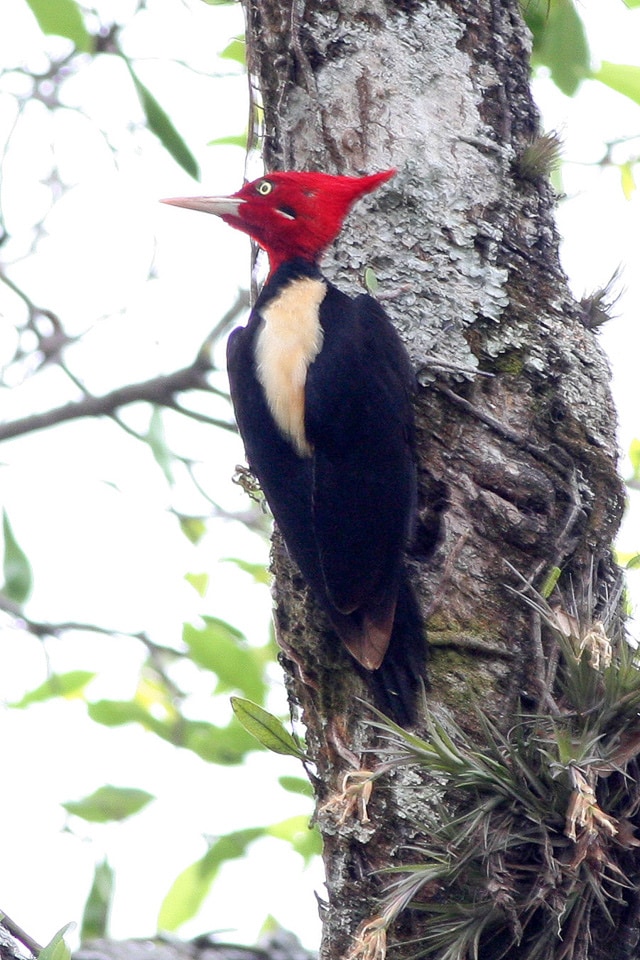
Cream-Backed Woodpecker
South America
Savanna, Woodlands, Transitional Forest, Pastures With Copses of Trees, Palm Groves
Black, Cream, White, Cinnamon-Buff, Red
- Creamy facial band
- Whitish upper back with pale cinnamon-buff feather tips
- Male crest
- Female crest
- Black and white ear covert spot
Beetle Larvae
Hammering, Pecking, Probing, Forages In Tall Trees, Forages On Fallen Logs
Tree Cavities, Palm Cavities
"Pi-Ow" Or "Kwee-Yaw" Call, "Whirring Notes", Quiet "Ahem", Soft and Squeaky Chattering Calls, Double Tap Drum
About Cream-backed woodpecker
The cream-backed woodpecker (Campephilus leucopogon) is a species of bird belonging to the woodpecker family, Picidae. It inhabits the generally open landscapes of the dry Gran Chaco region, with its distribution spanning across north-central Bolivia, western and central Paraguay, north-central Argentina, northern Uruguay, and southeastern Brazil. Its preferred habitats include savannas, woodlands, transitional forests, pastures dotted with trees, and palm groves, and it can be found at elevations up to 2,500 meters.
Description and Identification
This medium-sized woodpecker measures between 28 to 30 cm in length and weighs between 203 to 281 grams. Adult males and females share a predominantly black body below the neck. A distinguishing feature is a creamy band extending from the bill to the ear coverts, bordered by black above and below, which encircles the eye. The upper back is whitish, often with pale cinnamon-buff feather tips, and their flight feathers display significant pale cinnamon on the inner webs. Their bills are described as long and ivory-colored, resembling a chisel, with pale yellow irises and gray legs. Adult males possess a red crest, head, and neck, marked by a small black and white spot on the ear coverts. Adult females have a longer crest than males and lack this covert spot; their head and neck coloration differs, with red on the head and black on the neck. Juveniles resemble adults but exhibit less red plumage, which is more orange in tone.
Behavior and Ecology
The cream-backed woodpecker is a resident species, remaining throughout its range year-round. Its diet primarily consists of beetle larvae, which it extracts by hammering, and less frequently by pecking and probing, often in tall, isolated trees or fallen logs. Foraging is typically solitary, except during the breeding season.
Breeding and Vocalizations
The breeding season for the cream-backed woodpecker begins in September, with peak activity in October and November. They excavate nest holes in trees or palms, with known nests situated 6 to 8 meters above the ground. Both parents participate in feeding the nestlings, though specific details regarding clutch size, incubation period, and fledging time are not extensively documented.
Their vocalizations include a distinctive "pi-ow" or "kwee-yaw" call, sometimes repeated, and partners may exchange "whirring notes." They also communicate with a quiet "ahem" and various soft, squeaky chattering calls. Their drumming pattern is a double tap.
Conservation Status
The International Union for Conservation of Nature (IUCN) has assessed the cream-backed woodpecker as Least Concern. The species benefits from a large geographic range, and its population is believed to be stable. No immediate threats have been identified, although the species is considered poorly known and likely not common.
Source: Wikipedia ↗
Frequently Asked Questions
What is the scientific name of the cream-backed woodpecker?
The scientific name of the cream-backed woodpecker is Campephilus leucopogon. It was formerly placed in the genera Scapaneus and Phloeoceastes before being classified under the current genus Campephilus.
Where can the cream-backed woodpecker be found?
This woodpecker species is distributed across north-central Bolivia, western and central Paraguay, north-central Argentina, northern Uruguay, and southeastern Brazil. It inhabits the open, dry landscapes characteristic of the Gran Chaco region.
What does the cream-backed woodpecker eat?
The primary food source for the cream-backed woodpecker is beetle larvae. It typically forages for these by hammering into tall trees, though it may also feed on fallen logs.
How does the cream-backed woodpecker build its nest?
The cream-backed woodpecker excavates its nest hole in a tree or palm. Known nests have been found at heights of 6 to 8 meters above the ground.
What are the distinctive features of the cream-backed woodpecker?
Adult males and females differ slightly in their crests and facial markings. Both sexes are largely black below the neck, with a notable creamy band from the bill to the ear coverts and a whitish upper back with pale cinnamon-buff tips.
What is the conservation status of the cream-backed woodpecker?
The cream-backed woodpecker is listed as Least Concern by the IUCN. Its large range and believed stable population trend indicate no immediate threats, though its exact population size is not known.
Related Woodpecker species

Ochre-backed woodpecker
The ochre-backed woodpecker is a species found exclusively in Brazil, inhabiting humid forests, savannas, and orchards. Adults are characterized by their buffy to ochre heads and crests, with variable black markings on cinnamon-buff upperparts, and sooty underparts. They are known for their arboreal ant diet and distinctive calls.
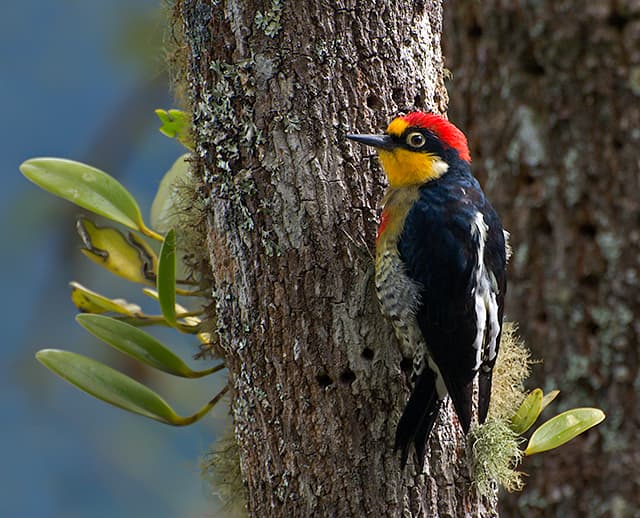
Yellow-fronted woodpecker
The yellow-fronted woodpecker is a colorful bird found in eastern South America, specifically in Brazil, Paraguay, and northeastern Argentina. It inhabits subtropical and tropical lowland forests, as well as degraded former forest areas. This species is characterized by its distinctive yellow fore-crown and throat, with males having a red crown and nape.
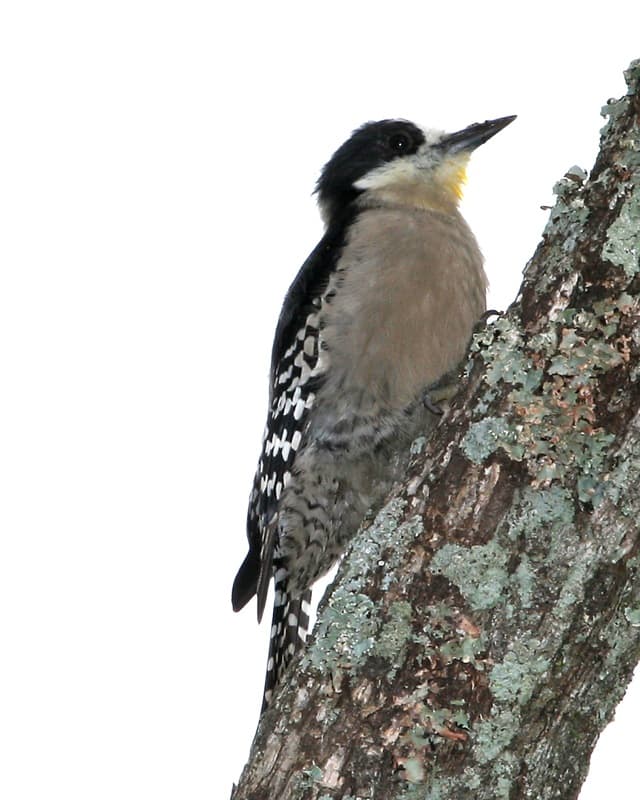
White-fronted woodpecker
The white-fronted woodpecker (Melanerpes cactorum) is a South American bird found in dry forests, shrublands, and savannahs. This species is characterized by its glossy black upperparts with a distinctive white line down the back, and white cheeks and throat, typically measuring around 17 cm in length.