
White-fronted woodpecker
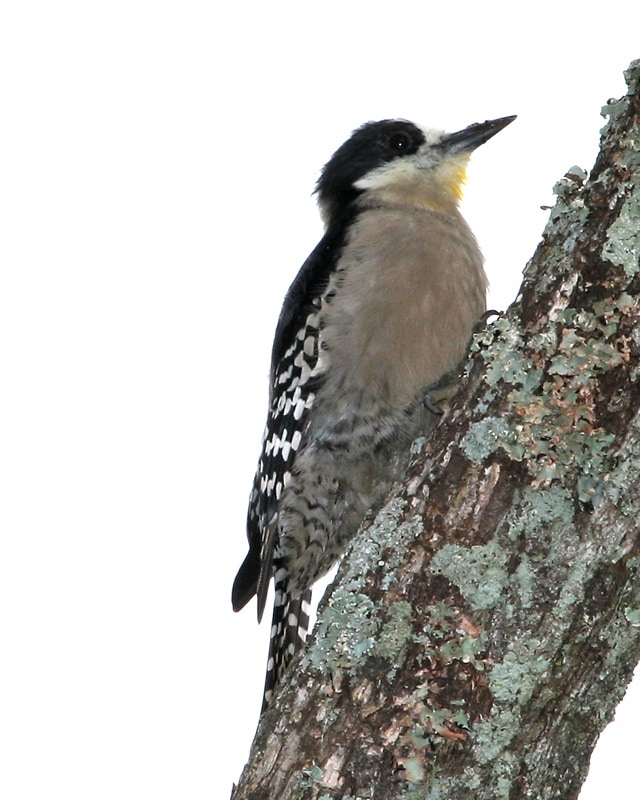
The white-fronted woodpecker (Melanerpes cactorum) is a South American bird found in dry forests, shrublands, and savannahs. This species is characterized by its glossy black upperparts with a distinctive white line down the back, and white cheeks and throat, typically measuring around 17 cm in length.
Key Facts
- ›Native to central South America, including Bolivia, Paraguay, and Argentina.
- ›Inhabits dry forests, shrublands, savannahs, and agricultural land with scattered trees.
- ›Adults measure approximately 17 cm in length.
- ›Plumage is predominantly glossy black with white markings, a white nape patch, and grey underparts.
- ›Males may have a small, not always visible, red patch on the crown.
- ›Assessed by the IUCN as 'least concern' due to its extensive range and stable population.
South America
- Subtropical Or Tropical Dry Forest
- Subtropical Or Tropical Dry Shrubland
- Subtropical Or Tropical High-Altitude Shrubland
- Chaco
- Savannah
- Semi-Desert With Scattered Trees
- Palm Groves
- Gallery Forest
- Agricultural Land With Scattered Trees
Thin white line down the center of the back, White nape patch, Black mask around the eye, Small red patch on the crown in males, Bold white barring on wings
About White-fronted woodpecker
The white-fronted woodpecker (Melanerpes cactorum) is a species of bird belonging to the family Picidae, native to central South America. This species is characterized by its striking plumage and its adaptation to arid and semi-arid environments.
Description and Identification
Adult white-fronted woodpeckers typically measure around 17 cm (7 inches) in length. The sexes are generally similar, though males may possess a small, sometimes inconspicuous, red patch on the crown. The upperparts are a glossy black, distinguished by a thin white line running down the center of the back, originating from a white nape patch. A prominent black mask encircles the eye and extends onto the mantle. The wings are bluish-black on the upper side, marked with bold white barring, while the underside is browner. The tail also exhibits white markings on its upper side. The fore-crown and cheeks are white, complemented by a white, yellow, or buff chin and throat. The breast and belly are typically grey, with subtle barring on the flanks and lower belly. The iris is reddish-brown, the beak is greyish-black, and the legs are grey. Juveniles share similarities with adults but tend to have duller black plumage, more heavily barred underparts, and both sexes may show traces of red or orange on the mid-crown.
Distribution and Habitat
The white-fronted woodpecker's range spans across central South America, including southeastern Peru, Bolivia, Uruguay, northern Argentina, Paraguay, and southeastern Brazil. Its preferred habitats are subtropical or tropical dry forests, dry shrublands, and high-altitude shrublands. It is also commonly found in chaco, savannah, and semi-desert regions characterized by scattered trees, shrubs, and cacti. Additionally, the species utilizes palm groves, gallery forests, and agricultural landscapes that feature scattered trees. They inhabit areas at altitudes of up to 2,500 meters (8,000 feet).
Status and Conservation
This woodpecker is considered a common species with a very extensive range. Its population appears to be stable, and no significant threats have been identified to its survival. Consequently, the International Union for Conservation of Nature (IUCN) has assessed its conservation status as 'least concern'.
Source: Wikipedia ↗
Frequently Asked Questions
What is the scientific name of the white-fronted woodpecker?
The scientific name of the white-fronted woodpecker is Melanerpes cactorum. This binomial nomenclature is used to classify this specific bird species within the scientific community.
What are the primary habitats of the white-fronted woodpecker?
The white-fronted woodpecker primarily inhabits subtropical or tropical dry forests, dry shrubland, and high-altitude shrubland. It also frequently occurs in chaco, savannah, and semi-desert regions with scattered trees, as well as palm groves and gallery forests.
How large is the white-fronted woodpecker?
The adult white-fronted woodpecker is approximately 17 cm (7 inches) in length. This measurement reflects its typical size within the species.
What are the distinctive physical characteristics of the white-fronted woodpecker?
Key features include glossy black upperparts with a thin white line down the center of the back, and a white nape patch. It also has white fore-crown and cheeks, a white chin and throat, and grey underparts. A black mask surrounds the eye, extending to the mantle.
Is the white-fronted woodpecker migratory?
No, the white-fronted woodpecker is a non-migratory, sedentary species. This means it remains in its established territory throughout the year and does not undertake seasonal journeys.
What is the conservation status of the white-fronted woodpecker?
The white-fronted woodpecker is listed as 'least concern' by the International Union for Conservation of Nature (IUCN). This assessment is based on its very extensive range, a seemingly stable population, and the absence of recognized major threats.
Related Woodpecker species

Yucatan woodpecker
The Yucatan woodpecker is a small bird found in the dry forests and shrublands of the Yucatán Peninsula and surrounding areas in Belize and Mexico. It is characterized by its light gray underparts, black and white barred back, and a distinctive red cap on males. This species is known for its unique vocalizations and its ability to forage in degraded habitats.
Grey-breasted woodpecker
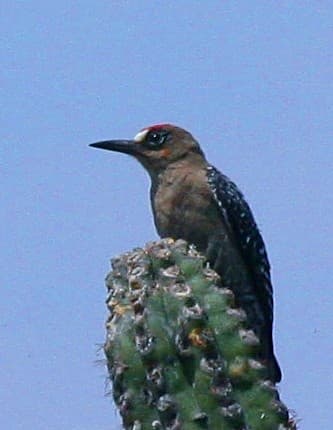
The grey-breasted woodpecker is a species endemic to the interior of southwestern Mexico. It inhabits subtropical or tropical lowland forests and high-altitude shrublands, often roosting communally on cacti. This bird is characterized by its greyish plumage, a pale red cheek patch, and a short black line over the eye.

Yellow-tufted woodpecker
The Yellow-tufted woodpecker is a South American bird known for its distinctive plumage, featuring bluish-black upper parts, a red breast and belly, and yellow markings on its crown. It inhabits humid lowland forests and degraded areas across several northern South American countries. This social and gregarious species primarily feeds on insects and fruits.