
Yellow-fronted woodpecker
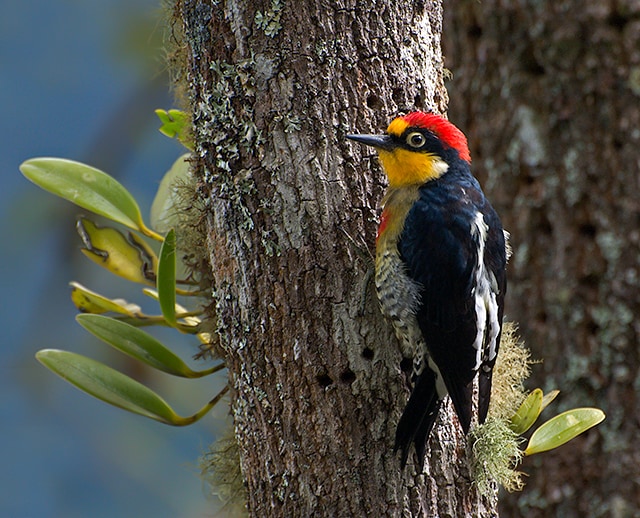
The yellow-fronted woodpecker is a colorful bird found in eastern South America, specifically in Brazil, Paraguay, and northeastern Argentina. It inhabits subtropical and tropical lowland forests, as well as degraded former forest areas. This species is characterized by its distinctive yellow fore-crown and throat, with males having a red crown and nape.
Key Facts
- ›About 18 cm (7 in) in length.
- ›Males have a red crown and nape; females have bluish-black in this region.
- ›Diet includes berries, fruits, seeds, and insects.
- ›Breeds between January and may in most of its range.
- ›Classified as 'least concern' by the IUCN due to its wide range and fairly common status.
South America
Subtropical Or Tropical Moist Lowland Forests, Heavily Degraded Former Forest, Sparsely Forested Areas, Gallery Forests, Secondary Forests, Palm Groves, Orchards, Gardens, Parkland
- Yellow fore-crown
- Yellow cheeks, chin, and throat
- Broad black band from beak base across eye to nape
- Red crown and nape
- Bluish-black crown and nape
Berries, Fruits, Seeds, Insects, Insect Larvae
Caching of food for later use.
Tree Cavities
About Yellow-fronted woodpecker
The yellow-fronted woodpecker, scientifically known as Melanerpes flavifrons, is a striking bird species native to eastern South America. Its distribution spans eastern and southeastern Brazil, eastern Paraguay, and northeastern Argentina. This species is commonly found in a variety of forested habitats, including subtropical and tropical moist lowland forests, as well as heavily degraded areas that were once forested. They also inhabit gallery forests, secondary forests, palm groves, orchards, gardens, and parklands, often favoring locations with scattered standing trees.
Description and Characteristics
Measuring approximately 18 cm (7 inches) in length, the yellow-fronted woodpecker is a colorful species. The sexes exhibit subtle differences: males possess a distinctive red crown and nape, whereas this region is bluish-black in females. Both sexes share a prominent yellow fore-crown, cheeks, chin, and throat. A broad black band extends from the base of the beak, across the eye, to the nape. The upper parts of the mantle and wings are predominantly black, contrasted by a white back and rump. The tail is black with some white barring on the outer feathers. The breast is typically grey or olive, the belly is red, and the flanks are barred with black and white or black and buff. Their irises are blue-black, encircled by a distinct yellowish or orange orbital ring. The beak is black, and the legs and feet are olive brown. Juvenile birds resemble adults but are less glossy, browner, and have less extensive red on the belly and crown.
Ecology and Behavior
The yellow-fronted woodpecker is a resident, nonmigratory species. Its diet is varied, consisting mainly of berries and fruits, supplemented by seeds and insects, including their larvae. A notable behavior observed is the caching of food, such as fruits and insects, for later consumption. This species is also a cooperative breeder. Multiple birds may nest in close proximity, with some individuals acting as nonbreeding helpers in the breeding process. Breeding typically occurs between January and May across most of its range.
Conservation Status
Due to its very wide geographic range and a status as a fairly common species, the yellow-fronted woodpecker is classified as 'Least Concern' by the International Union for Conservation of Nature (IUCN). While specific population trends are not precisely known, the species has a large overall population, and any decline is considered slow. This classification reflects a healthy and widespread presence in its natural environment.
Source: Wikipedia ↗
Frequently Asked Questions
What is the scientific name of the yellow-fronted woodpecker?
The scientific name of the yellow-fronted woodpecker is Melanerpes flavifrons. This binomial name is used to classify it within the scientific community and distinguish it from other woodpecker species.
Where is the yellow-fronted woodpecker found?
The yellow-fronted woodpecker is native to eastern South America. Its range includes eastern and southeastern Brazil, eastern Paraguay, and northeastern Argentina.
What does the yellow-fronted woodpecker eat?
The yellow-fronted woodpecker has a mixed diet. Its primary food sources are berries and fruits, but it also consumes seeds and insects, including their larvae.
What is the conservation status of the yellow-fronted woodpecker?
The International Union for Conservation of Nature (IUCN) has classified the yellow-fronted woodpecker's conservation status as 'least concern'. This is due to its very wide range, large total population, and slow population decrease.
Are male and female yellow-fronted woodpeckers different?
Yes, the sexes are similar but distinguishable. The male has a red crown and nape, while the female has a bluish-black region in the same area. Both share yellow on their fore-crown, cheeks, chin, and throat.
Related Woodpecker species

Eurasian wryneck
The Eurasian wryneck is a migratory woodpecker species found predominantly in temperate regions of Europe and Asia, wintering in tropical Africa and southern Asia. It is characterized by its thrush-like body shape, unique snake-like head-twisting ability used as a defense mechanism, and a diet primarily consisting of ants and other insects.

Golden-naped woodpecker
The golden-naped woodpecker is a bird species found in Costa Rica and western Panama, inhabiting subtropical or tropical moist lowland forests and degraded former forest areas. It is closely related to the beautiful woodpecker and is characterized by its yellow nape and distinctive markings on its crown, with males and females exhibiting slight differences. This species is currently listed as "least concern" by the IUCN.

White woodpecker
The White woodpecker is a striking South American bird recognized by its bright white plumage, black wings, and a small, distinct yellow eye patch. It inhabits wooded grasslands and various open woodland environments across a wide range of South America, from Suriname and French Guiana down to Argentina. This species is noted for its varied diet and adaptability to different habitats, including urban areas.