
Crimson-bellied woodpecker
The crimson-bellied woodpecker is a large woodpecker species found on the eastern slopes of the Andes in South America. It is characterized by its striking red underparts, black and white wings, and a distinctive red crest in both sexes. This species primarily inhabits humid and wet forests, foraging near the ground for beetles.
Key Facts
- ›Found in Bolivia, Colombia, Ecuador, and Peru.
- ›Measures 33-34 cm in length and weighs 225-250 g.
- ›Possesses a red forehead, crown, nape, hindneck, and entirely red underparts.
- ›Diet consists mainly of adult and larval beetles.
- ›Forages by hammering and probing on tree trunks near the ground.
- ›Its conservation status is Least Concern, though its population is believed to be decreasing.

Crimson-Bellied Woodpecker
South America
- Red forehead, crown, nape, and hindneck
- Thin black line above the eye
- Thin buff supercilium behind the eye
- Black band from nares through the eye to nape
- Black chin and throat
- Buff band on male's face
- Scapulars and upper back black to brownish black
- Lower back and rump deep red
- Uppertail coverts and tail black
- Black wings with white spots
- Red underparts from bottom of throat
Beetles
Hammering, Probing On Tree Trunks, Forages Near the Ground
- Song: Repetition of Harsh, Nasal, Squeaky But Loud Eer Notes
- Call: Loud Stk! St-Kr-R-R-R-R-R-R
- Drumming: Fast Drumroll of 3–4 Loud Raps
About Crimson-bellied woodpecker
The crimson-bellied woodpecker (Campephilus haematogaster) is a striking bird species found in the humid and wet forests along the eastern slopes of the Andes in South America. Its range includes Bolivia, Colombia, Ecuador, and Peru, where it inhabits montane forests and várzea, typically foraging at lower elevations between 500 and 2,200 meters.
Description and Identification
Measuring between 33 to 34 cm in length and weighing 225 to 250 grams, the crimson-bellied woodpecker is distinguished by its vibrant plumage. Both sexes share a prominent red forehead, crown, nape, and hindneck. They also have a thin black line above the eye, a buff supercilium behind the eye, and a black band extending from the nostrils through the eye to the nape, complemented by a black chin and throat. Males exhibit a buff band between the black eye band and chin, while females have the rear of this band extending down the side of the neck to the upper breast. Their scapulars and upper back are black to brownish-black, contrasting with a deep red lower back and rump. The uppertail coverts and tail are black, and their wings are black with distinctive white spots on the flight feathers, featuring pale bars on the underside. A defining characteristic is their entirely red underparts, extending from below the throat.
Behavior and Ecology
The crimson-bellied woodpecker is a year-round resident within its geographical distribution. Its diet primarily consists of adult and larval stages of large beetles, supplemented by other insects. Foraging behavior involves hammering and probing on the trunks of large trees, usually near the ground, and they are often observed foraging alone or in pairs.
Breeding and Vocalizations
The breeding season for this species appears to span from September to April in Colombia and Ecuador, though detailed information about their breeding biology remains scarce. Vocalizations include a song described as a repetition of harsh, nasal, squeaky yet loud 'eer' notes, and a call identified as a loud 'stk! st-kr-r-r-r-r-r-r'. Their drumming pattern consists of a fast drumroll of 3 to 4 loud raps.
Conservation Status
The crimson-bellied woodpecker is classified as Least Concern by the IUCN. While its range is extensive, its population size is not precisely known and is believed to be in decline. No immediate threats have been identified, but ongoing monitoring is important for this species.
Source: Wikipedia ↗
Frequently Asked Questions
What is the scientific name of the crimson-bellied woodpecker?
The scientific name of the crimson-bellied woodpecker is Campephilus haematogaster. It was formerly placed in its own genus, Cniparchus, which was later merged into Phloeoceastes before finally being placed in the current genus Campephilus.
Where is the crimson-bellied woodpecker found?
The crimson-bellied woodpecker is distributed along the east slope of the Andes mountains, extending from Colombia southward through Ecuador and Peru, with a small presence extending into Bolivia.
What kind of habitat does the crimson-bellied woodpecker prefer?
This species primarily inhabits the interior of humid and wet forests, including montane forests and várzea. It can also be found along the edges of these forests and at elevations ranging from 500 to 2,200 meters, depending on the specific region.
What does the crimson-bellied woodpecker eat?
The diet of the crimson-bellied woodpecker is predominantly composed of adult and larval stages of large beetles. They also consume other insects found in their environment.
How does the crimson-bellied woodpecker forage for food?
Crimson-bellied woodpeckers typically forage close to the ground on the trunks of large trees. They are often observed alone or in pairs, using their hammering and probing techniques to extract insects from the wood.
What are the sounds made by the crimson-bellied woodpecker?
The song of the crimson-bellied woodpecker is described as a repetition of harsh, nasal, squeaky yet loud 'eer' notes. Their call is a loud 'stk! st-kr-r-r-r-r-r-r', and they drum with a fast series of 3–4 loud raps.
What is the conservation status of the crimson-bellied woodpecker?
The International Union for Conservation of Nature (IUCN) has assessed the crimson-bellied woodpecker as Least Concern. Despite its large range, its population is believed to be decreasing, though no immediate threats have been identified.
Related Woodpecker species
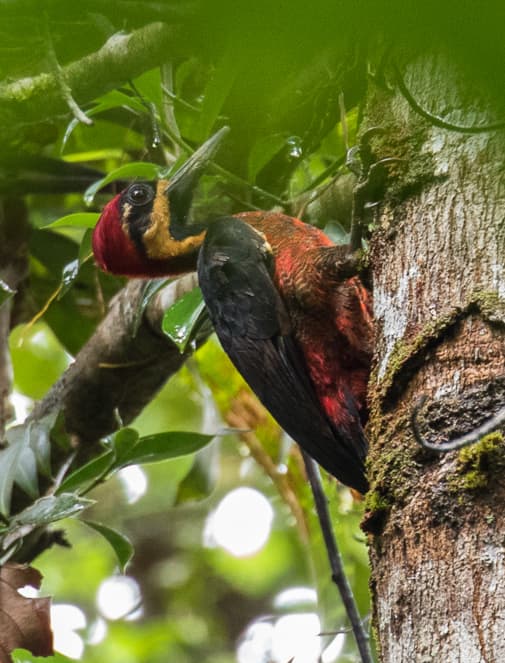
Splendid woodpecker
The splendid woodpecker is a striking bird found in Colombia, Ecuador, and Panama, recognized for its predominantly red plumage, black markings, and distinctive white spots on its wings. This species inhabits humid and montane forests, typically foraging near the ground on large tree trunks for beetle larvae and adults. While its exact population size is unknown, it is assessed as Near Threatened due to habitat loss from logging and cultivation.

Cinnamon woodpecker
The cinnamon woodpecker is a medium-sized bird found in Central and South America, inhabiting humid to wet forests. It is characterized by its rufous head with a bushy crest and distinctive black streaks, and its diet primarily consists of ants and termites, supplemented with fruit. This species is a year-round resident and is known for its varied vocalizations and slow, short drumming.
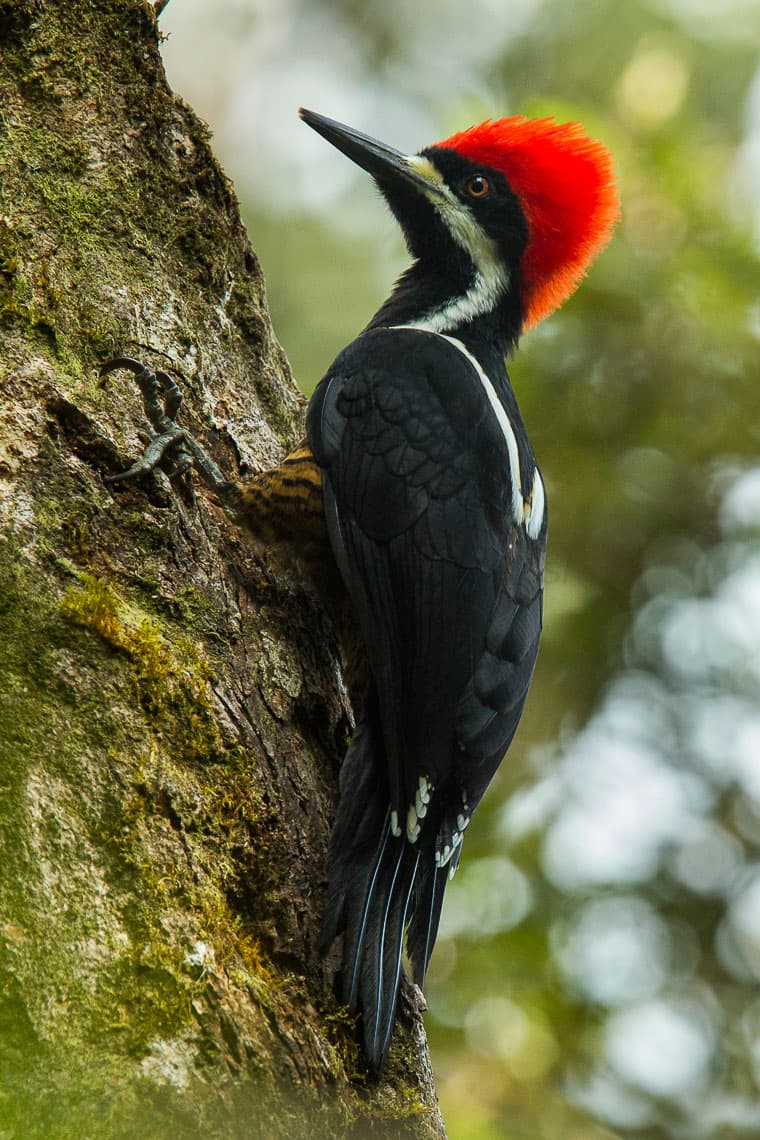
Powerful woodpecker
The powerful woodpecker is a large bird found in the montane forests of Colombia, Ecuador, Peru, and Venezuela. It is characterized by its striking black and white facial markings and the male's red head and crest, while females have black heads. This species is a year-round resident that forages at all forest levels.