
Powerful woodpecker
The powerful woodpecker is a large bird found in the montane forests of Colombia, Ecuador, Peru, and Venezuela. It is characterized by its striking black and white facial markings and the male's red head and crest, while females have black heads. This species is a year-round resident that forages at all forest levels.
Key Facts
- ›The powerful woodpecker measures approximately 32 cm (13 in) in length.
- ›Males have red heads and crests, while females have black heads.
- ›It inhabits mature montane forests, humid and wet forests, and cloud forests.
- ›The species is a year-round resident and forages in pairs at all forest levels.
- ›Nests are typically found in dead tree trunks, with clutches usually containing one or two eggs.
- ›Its IUCN conservation status is Least Concern, though its population is believed to be decreasing.
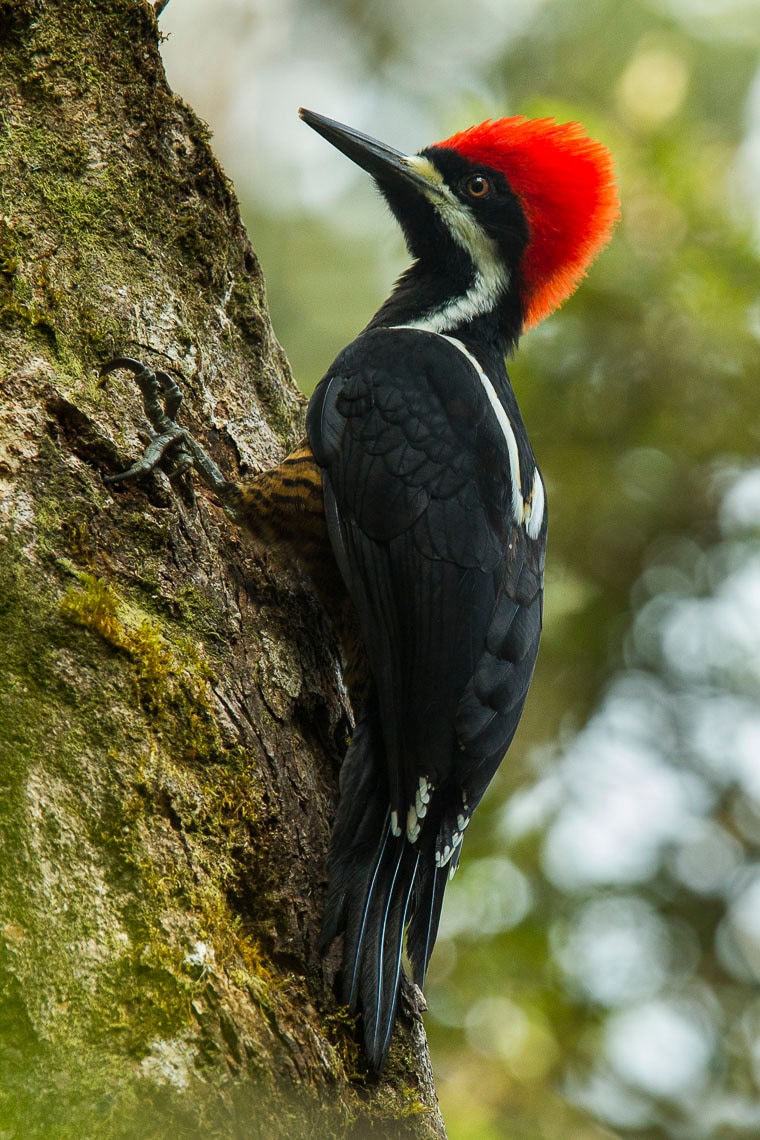
Colombia, Ecuador, Peru, Venezuela
- Male's red forehead to crest
- Female's black forehead to crest
- Black and white face and throat band
- Black hindneck, mantle, and upper back with white stripes
- White lower back and rump
- Long black chisel bill
Insects, Larvae
Forages At All Forest Levels, Often Forages In Pairs
Dead Tree Trunks
- Nasal 'Kyaaah' Or 'PeeyáW', Often Repeated
- Fast 'Kikikikikawh' In Flight
- Descending 'Kikikiki-Keh-Keh-Kah-Kah' When Excited
- Brief Double Tap Drum
About Powerful woodpecker
The powerful woodpecker (Campephilus pollens) is a striking bird species inhabiting the montane forests of South America, specifically found in Colombia, Ecuador, Peru, and Venezuela. It is recognized for its considerable size, reaching about 32 cm (13 inches) in length.
Description and Identification
A key distinguishing feature is the sexual dimorphism in plumage, particularly on the head. Adult males display vibrant red coloration from their forehead extending to their crest, while females exhibit black heads. Both sexes share distinctive black and white facial patterns, including a prominent white band running from the lores to below the ear coverts and down the side of the neck. Their upperparts are generally black with narrow white stripes, contrasted by a white lower back and rump. The wings are black with white tips on the primaries and white markings on the secondaries. Underparts are cinnamon-buff with black barring. They possess a long, black, chisel-shaped bill, white or pinkish-white irises, and dark gray legs.
Distribution and Habitat
The powerful woodpecker primarily resides in the interior and edges of mature montane forests, including humid, wet, and cloud forests. It can also be found in secondary and more open forest types. Its elevational range spans from 900 to 3,750 meters (3,000 to 12,300 feet), with the highest concentrations observed between 1,700 and 2,600 meters (5,600 to 8,500 feet).
Behavior and Ecology
Movement and Foraging
This species is a year-round resident throughout its geographical range. Powerful woodpeckers are known to forage at all levels within the forest, often in pairs. While specific dietary details are not extensively documented, their foraging behavior suggests a diet likely consisting of insects and their larvae extracted from wood and bark.
Breeding
The breeding season for the powerful woodpecker is estimated to occur between April and August. Nests are exclusively constructed within dead tree trunks. Observations of nests indicate small clutches, with one recorded instance of two eggs and another of a single nestling. Incubation periods are estimated to be at least 16 days, with fledging occurring between 34 and 37 days after hatching. Both parents appear to participate in incubation.
Vocalizations
The powerful woodpecker produces a range of sounds. Its most common call is a repeated, nasal 'kyaaah' or 'peeyáw'. During flight, it emits a rapid 'kikikikikawh', and when excited, a descending vocalization described as 'kikikiki-keh-keh-kah-kah'. Its drumming pattern is characterized by a brief double tap.
Conservation Status
The International Union for Conservation of Nature (IUCN) has assessed the powerful woodpecker as Least Concern. Despite possessing a large geographic range, its population size is not precisely known and is believed to be in decline. No immediate threats have been identified, and the species is considered rare to locally distributed across its range. It does occur within some protected areas.
Source: Wikipedia ↗
Frequently Asked Questions
What is the scientific name of the powerful woodpecker?
The scientific name of the powerful woodpecker is Campephilus pollens. It has historically been placed in genera such as Scapaneus and Phloeoceastes before its current classification within Campephilus.
Where is the powerful woodpecker found?
The powerful woodpecker is found in the Andean regions of Colombia, Ecuador, Peru, and Venezuela. The nominate subspecies inhabits the Andes from north-central Colombia and southwestern Venezuela southward, while another subspecies is found on the eastern slopes of the Peruvian Andes.
What does the powerful woodpecker eat?
While the powerful woodpecker's diet is not detailed, it is known to forage at all levels of the forest interior. Like other woodpeckers, it likely consumes insects and larvae found in wood and bark.
How do the male and female powerful woodpeckers differ?
The primary difference between adult males and females lies in their heads. Males are red from their forehead to their crest, whereas females have black heads in this region. Both sexes share similar black and white facial markings and underparts.
What are the nesting habits of the powerful woodpecker?
The breeding season for the powerful woodpecker is believed to occur between April and August. Nests have been observed exclusively in dead tree trunks. Clutch sizes are small, with documented nests containing either one or two eggs.
What sounds does the powerful woodpecker make?
The powerful woodpecker produces a common call described as a nasal 'kyaaah' or 'peeyáw', often repeated. In flight, it emits a fast 'kikikikikawh', and when excited, a descending 'kikikiki-keh-keh-kah-kah'. Its drumming pattern consists of a brief double tap.
Related Woodpecker species
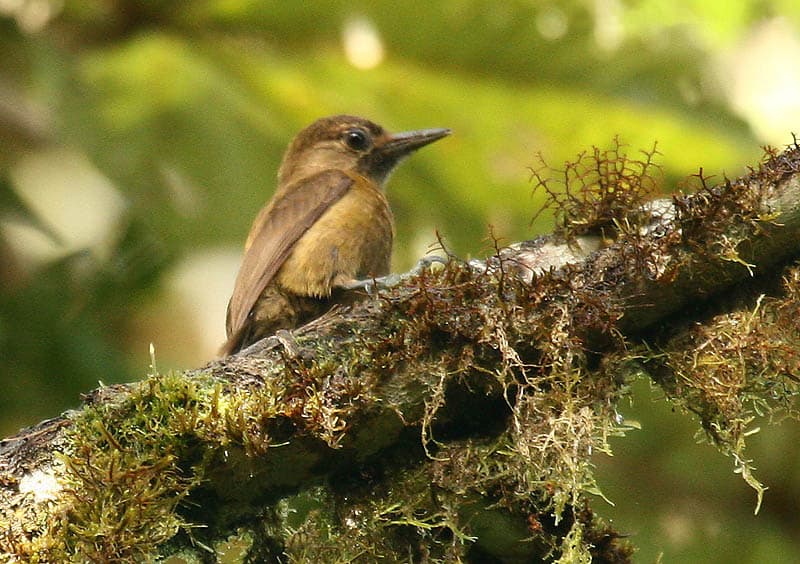
Smoky-brown woodpecker
The Smoky-brown woodpecker (Leuconotopicus fumigatus) is a widespread bird species found across Central and South America. This medium-sized woodpecker is characterized by its predominantly olive-brown plumage, with males displaying a red crown and females a dark brown one. It inhabits various wooded environments, from humid forests to dry woodlands and plantations, and primarily feeds on wood-boring beetles.

Crimson-bellied woodpecker
The crimson-bellied woodpecker is a large woodpecker species found on the eastern slopes of the Andes in South America. It is characterized by its striking red underparts, black and white wings, and a distinctive red crest in both sexes. This species primarily inhabits humid and wet forests, foraging near the ground for beetles.
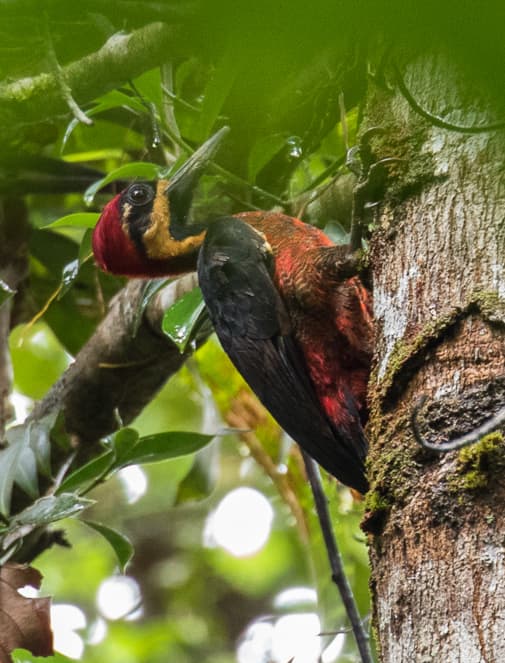
Splendid woodpecker
The splendid woodpecker is a striking bird found in Colombia, Ecuador, and Panama, recognized for its predominantly red plumage, black markings, and distinctive white spots on its wings. This species inhabits humid and montane forests, typically foraging near the ground on large tree trunks for beetle larvae and adults. While its exact population size is unknown, it is assessed as Near Threatened due to habitat loss from logging and cultivation.