
Ocellated piculet
The ocellated piculet is a small bird species found in the montane forests of Bolivia and Peru, with a possible extension into Argentina. Measuring between 9 to 10 cm, it is characterized by its predominantly brownish plumage, with males displaying red tips on their forehead feathers and males and females having spotted caps. They forage in pairs or singly, often as part of mixed-species flocks, and their diet is known to include insects.
Key Facts
- ›Small woodpecker species measuring 9-10 cm in length.
- ›Inhabits humid montane and mature secondary forests.
- ›Found in Bolivia, Peru, and possibly Argentina.
- ›Forages along thin branches and vines, often in mixed-species flocks.
- ›Diet is known to include insects.
- ›Assessed as Least Concern by the IUCN.
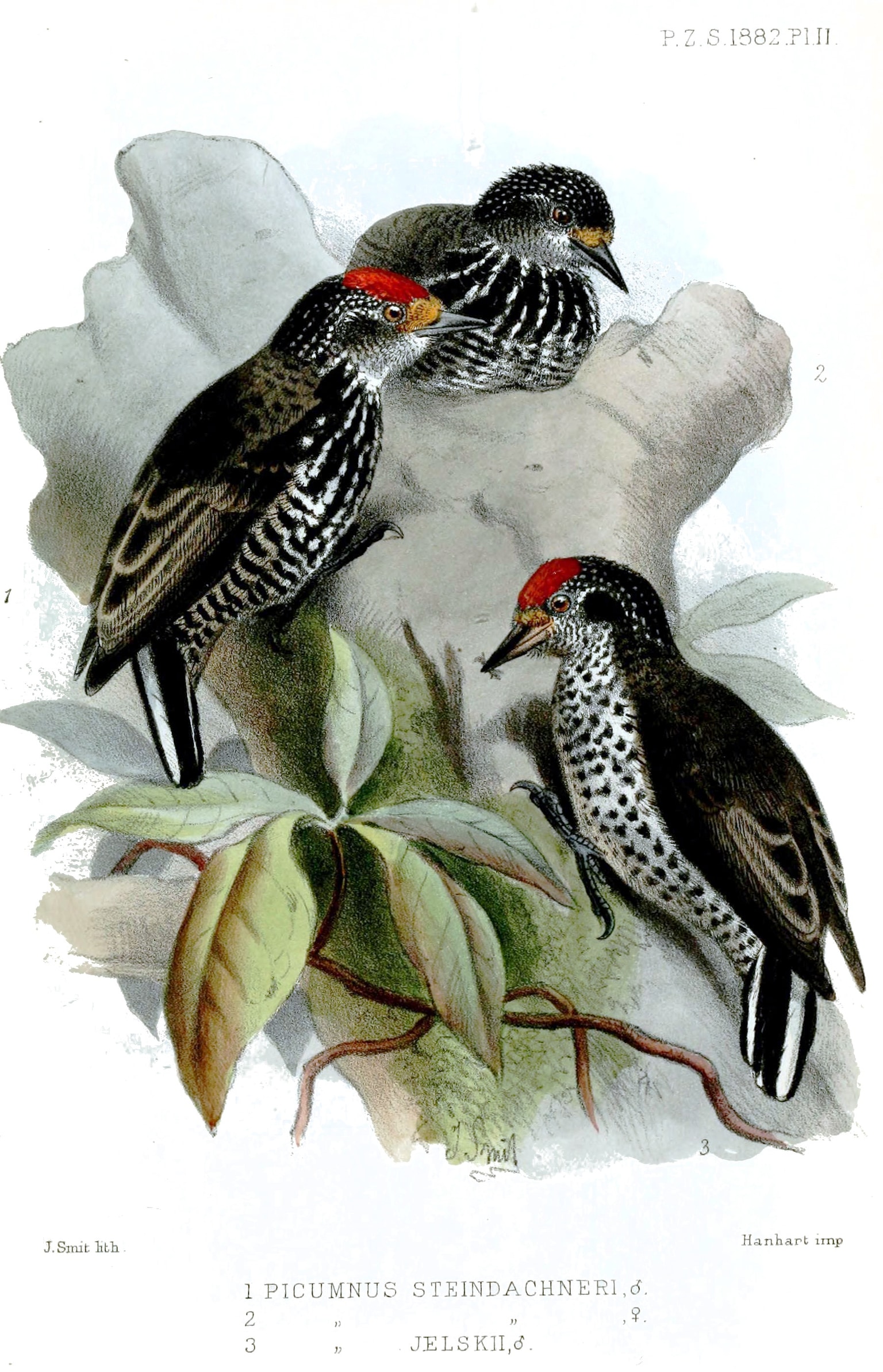
Ocellated Piculet
Bolivia, Peru, Argentina
- Humid montane forest
- Mature secondary forest
- Bushy undergrowth with vines, creepers, and epiphytes
Black cap with red tips on forehead feathers, Small white spots on cap, Buff-brown face with faint blackish bars, White stripe behind the eye
Insects
Forages Along Thin Branches and Vines, Moves Singly Or In Pairs, Often Part of A Mixed-Species Foraging Flock
Holes
- High-Pitched, Rapid, Falling Trill: Tree'E'E'E'E'E'E
About Ocellated piculet
Ocellated Picullet
The ocellated piculet (Picumnus dorbignyanus) is a small bird belonging to the woodpecker family, Picidae. This species is primarily found in the humid montane forests and mature secondary forests of Bolivia and Peru, with a potential, though not universally recognized, presence in northwestern Argentina. It favors habitats with dense, bushy undergrowth, often rich with vines, creepers, and epiphytes.
Description and Identification
Measuring between 9 and 10 centimeters in length and weighing 7 to 11 grams, the ocellated piculet is one of the smaller woodpecker species. Adult males are distinguished by a black cap featuring red tips on the forehead feathers and small white spots. Their faces are typically buff-brown with subtle blackish bars and a noticeable white stripe behind the eye. The upperparts are a dull brownish hue, and their flight feathers are dark brown edged with buffish white. The tail feathers also display white markings. Adult females are similar but lack the red coloration on their forehead. Juveniles are generally duller and darker than adults, with a sooty crown and diffused barring on their upper and underparts.
Distribution and Habitat
The nominate subspecies, P. d. dorbignyi, is found in western Bolivia and possibly extending into Argentina. The subspecies P. d. jelskii inhabits central Peru, specifically between the departments of Huánuco and Cuzco. The species' altitudinal range is considerable, occurring between 800 and 2,400 meters in Peru and 900 to 3,300 meters in Bolivia.
Behavior and Ecology
Ocellated piculets are generally sedentary birds, though they may descend to lower elevations during winter months. They are often observed foraging along thin branches and vines, typically in pairs or as part of mixed-species foraging flocks. While their diet has not been extensively studied, insects are known to be a component. Their nesting behavior is limited to excavating holes, with further details on their breeding biology remaining largely undocumented.
Vocalization
The characteristic vocalization of the ocellated piculet is described as a high-pitched, rapid, falling trill, often transcribed as "tree'e'e'e'e'e'e".
Conservation Status
The International Union for Conservation of Nature (IUCN) has classified the ocellated piculet as Least Concern. The species possesses a relatively large geographic range, and its population is believed to be stable, with no immediate significant threats identified. While generally considered uncommon, it can be locally abundant. Human activities, particularly habitat destruction, have localized impacts on the species.
Source: Wikipedia ↗
Frequently Asked Questions
What is the scientific name of the ocellated piculet?
The scientific name of the ocellated piculet is *Picumnus dorbignyanus*. It was first described by Frédéric de Lafresnaye in 1845.
Where can the ocellated piculet be found?
The ocellated piculet is found in Bolivia and Peru. Its range may also extend into extreme northwestern Argentina, though this is not universally recognized.
What does the ocellated piculet eat?
While its diet has not been extensively studied, the ocellated piculet is known to consume insects. They forage along thin branches and vines for food.
What is the conservation status of the ocellated piculet?
The ocellated piculet is listed as Least Concern by the IUCN. Its population is believed to be stable, and no immediate threats have been identified.
What are the distinguishing physical features of the ocellated piculet?
Adult males have a black cap with red tips on the forehead feathers and small white spots. Females lack the red on the forehead. Both sexes have buff-brown faces with faint blackish bars and a white stripe behind the eye. Their upperparts are dull brownish.
Related Woodpecker species
Yellow-vented woodpecker
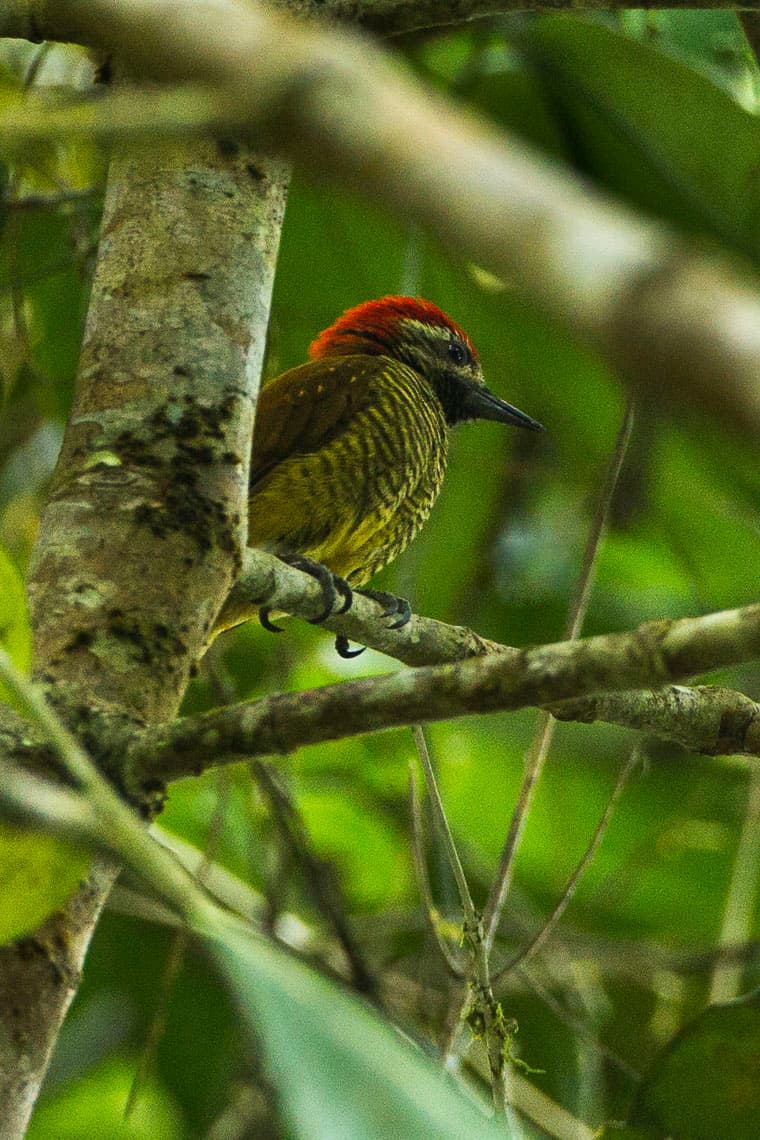
The yellow-vented woodpecker is a species found in the montane forests of Colombia, Ecuador, Peru, and Venezuela. It is characterized by its yellow flanks and belly, and males have a red crown while females have a black crown. This species primarily inhabits humid cloud forests and is known for its relatively quiet nature.
Crimson-mantled woodpecker
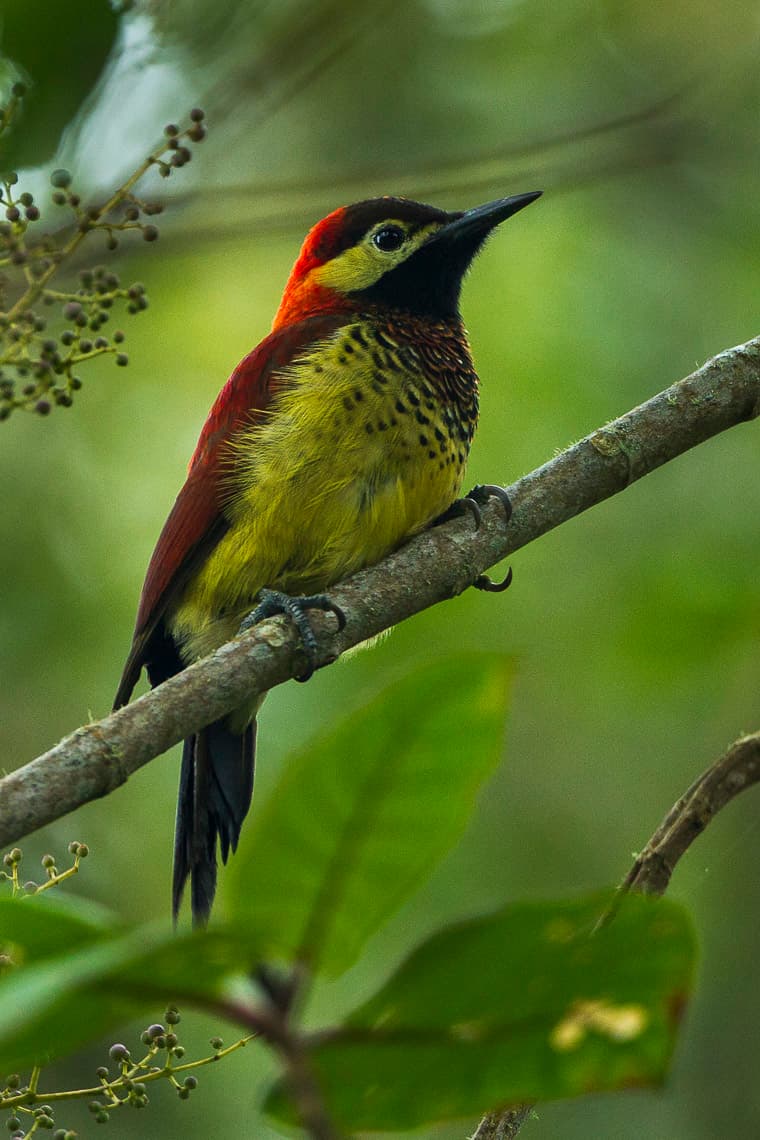
The crimson-mantled woodpecker is a species of bird found in the montane forests and páramo zones of Bolivia, Colombia, Ecuador, Peru, and Venezuela. It is characterized by its distinctive crimson red nape and mantle, with males and females differing primarily in the color of their crowns. This woodpecker primarily feeds on small arthropods, especially ants, and also consumes fruit.

Black-cheeked woodpecker
The black-cheeked woodpecker is a medium-sized woodpecker found from Mexico south to Ecuador. It is characterized by its distinctive black "cheeks" extending from the eye down the neck, with males and females differing in head plumage. This species inhabits a variety of forest types and clearings, feeding on arthropods, fruits, and nectar.