
White woodpecker
The White woodpecker is a striking South American bird recognized by its bright white plumage, black wings, and a small, distinct yellow eye patch. It inhabits wooded grasslands and various open woodland environments across a wide range of South America, from Suriname and French Guiana down to Argentina. This species is noted for its varied diet and adaptability to different habitats, including urban areas.
Key Facts
- ›Native to South America, found east of the Andes.
- ›Characterized by bright white plumage with black wings and a yellow eye patch.
- ›Inhabits forest edges, open woodlands, savannahs, and scrubland.
- ›Diet includes fruits, berries, seeds, and insects from bee and wasp nests.
- ›Breeds between September and November.
- ›Classified as a 'least concern' species by the IUCN.

South America
Forest Edges, Open Dry Woodland, Wooded Savannah, Scrubland With Scattered Trees, Plantations, Orchards, Parkland, Mangroves
Bright White Plumage, Black Wings, Small Bright Yellow Eye Patch, Bare Ring of Yellow Skin Around the Eye
Fruits, Berries, Seeds, Insects, Larvae, Honey
Raids Wild Bee and Wasp Nests
Tree Cavities
About White woodpecker
The White woodpecker (Melanerpes candidus) is a distinctive South American species belonging to the woodpecker family, Picidae. It is easily identified by its predominantly bright white plumage, contrasted by black wings and tail, and a notable small, bright yellow patch around its eye. This species is found east of the Andes, inhabiting a wide range of environments including forest edges, open dry woodlands, wooded savannahs, scrubland, plantations, orchards, parkland, and even mangroves.
Distribution and Habitat
The White woodpecker possesses an extensive range that stretches from Suriname and French Guiana, through much of Brazil, to southeastern Peru, Bolivia, Paraguay, Uruguay, and northern Argentina. It can be found at altitudes up to approximately 2,000 meters (6,600 ft). While generally non-migratory, it is known to undertake short-distance movements. The species demonstrates opportunistic behavior and adaptability, with sightings occurring in urban suburbs and areas that have been logged.
Ecology and Diet
Groups of up to ten White woodpeckers have been observed flying together with a characteristic floppy wing-beat. Their diet is varied, encompassing fruits, berries, and seeds, which contributes to their role as significant dispersers of certain plant species. They also forage by raiding the nests of wild bees and wasps, consuming the adult insects, their larvae, and honey. Breeding occurs between September and November. While they may sometimes nest communally, detailed information regarding their breeding habits remains scarce.
Conservation Status
The White woodpecker has an extremely large estimated range of over 10,000,000 km². Its population is thought to be increasing, and it appears to be expanding its range at the southern extent of its distribution. Consequently, the International Union for Conservation of Nature (IUCN) has classified its conservation status as 'least concern', indicating a stable and widespread presence.
Source: Wikipedia ↗
Frequently Asked Questions
What is the scientific name of the White woodpecker?
The scientific name of the White woodpecker is Melanerpes candidus. It is sometimes placed in its own genus, Leuconerpes, due to similarities with the Melanerpes genus.
Where can the White woodpecker be found?
The White woodpecker has a wide distribution in South America, east of the Andes. Its range includes Suriname, French Guiana, Brazil, southeastern Peru, Bolivia, Paraguay, Uruguay, and northern Argentina.
What does the White woodpecker eat?
The diet of the White woodpecker is varied. It consumes fruits, berries, and seeds, acting as a significant disperser for certain plant species. It also raids bee and wasp nests to feed on adult insects, larvae, and honey.
What is the conservation status of the White woodpecker?
The International Union for Conservation of Nature (IUCN) has assessed the White woodpecker's conservation status as 'least concern'. This is due to its extremely large range and a population that is believed to be increasing.
What are the physical characteristics of the White woodpecker?
Adult White woodpeckers measure between 24 to 29 cm in length and weigh around 108 g. They are predominantly white with black mantles, backs, wings, and tails. A distinctive feature is a small, bright yellow patch around the eye, and males have some yellowing on the breast and nape.
Related Woodpecker species
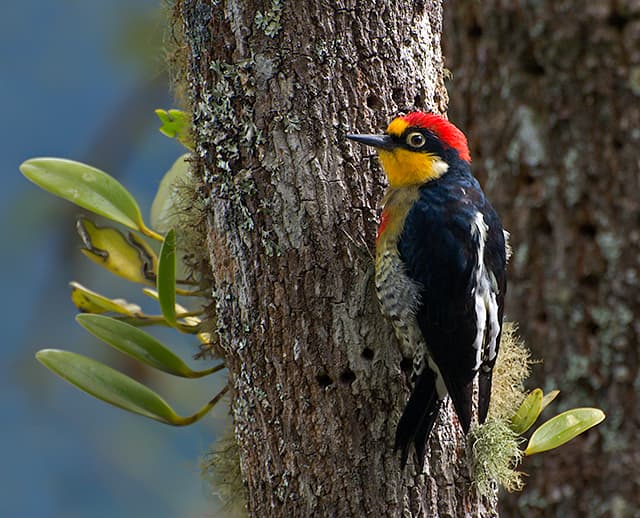
Yellow-fronted woodpecker
The yellow-fronted woodpecker is a colorful bird found in eastern South America, specifically in Brazil, Paraguay, and northeastern Argentina. It inhabits subtropical and tropical lowland forests, as well as degraded former forest areas. This species is characterized by its distinctive yellow fore-crown and throat, with males having a red crown and nape.

Eurasian wryneck
The Eurasian wryneck is a migratory woodpecker species found predominantly in temperate regions of Europe and Asia, wintering in tropical Africa and southern Asia. It is characterized by its thrush-like body shape, unique snake-like head-twisting ability used as a defense mechanism, and a diet primarily consisting of ants and other insects.
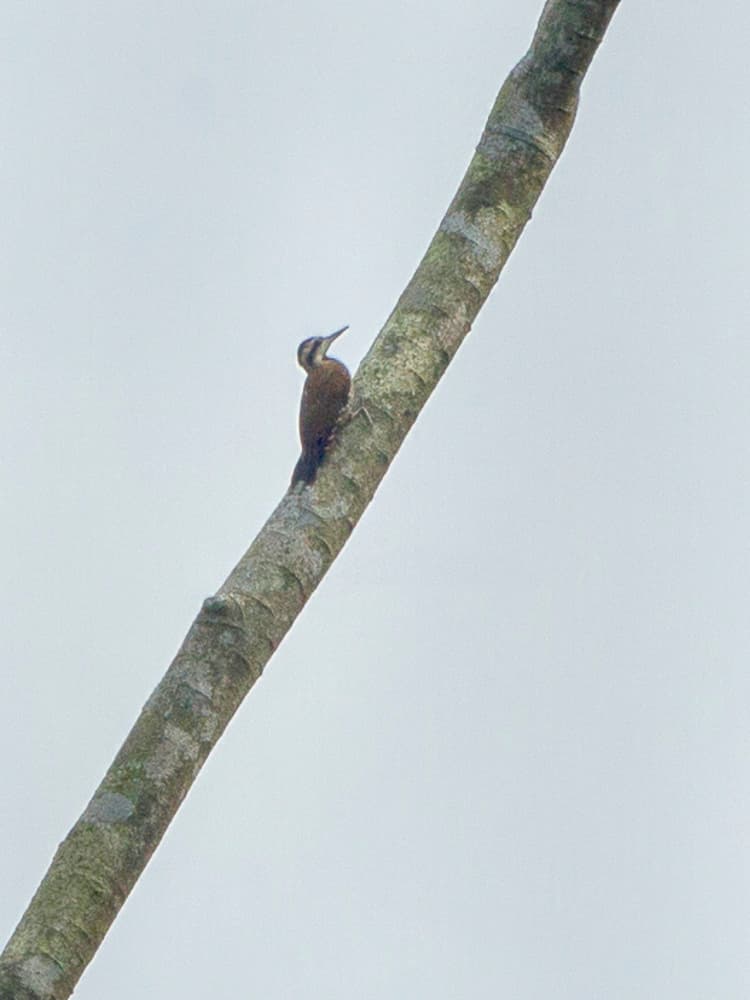
Fire-bellied woodpecker
The fire-bellied woodpecker is a bird species found across tropical West Africa, inhabiting various wooded environments from primary rainforest edges to savannahs. It is characterized by its olive-bronze upperparts, crimson rump, and a striking scarlet belly, with males displaying a red crown and females a black one. This species is common and its population is considered stable or increasing, leading to a 'least concern' conservation status.